

DoorDash Air Shows That the Future of Logistics Will Be Defined by Intelligent Orchestration
By Brian k. Neal
For more than a decade, DoorDash has built one of the largest local commerce networks in North America by connecting consumers, merchants, and independent Dashers through a single platform. To most people, it remains synonymous with food delivery. But the launch of DoorDash Air—and the FAA certification allowing the company to operate commercial drone deliveries—suggests the company is entering a different phase of its evolution. Rather than simply expanding how deliveries are made, DoorDash is expanding how its entire network thinks. The aircraft may be the newest piece of infrastructure, but the software coordinating it is becoming the company’s defining asset.
It would be easy to mistake this for another drone story. It is not.
Commercial drone delivery has been developing for years. Companies such as Wing, Zipline, and Amazon Prime Air have already demonstrated that autonomous aircraft can complete short-distance deliveries safely and efficiently. DoorDash is not attempting to prove that drones work. It is integrating aviation into an ecosystem that already includes millions of customers, millions of merchant relationships, digital payments, dispatch intelligence, mapping systems, demand forecasting, and one of the largest last-mile delivery networks in North America. The significance is not the aircraft itself. It is the system the aircraft joins.
Every successful technology platform eventually reaches the same strategic crossroads. After building a network, the next challenge is increasing the intelligence of that network. DoorDash has already solved the difficult problems of acquiring demand, attracting merchants, processing payments, and coordinating deliveries at scale. Introducing drones does not require building another marketplace because the marketplace already exists. It simply gives the platform another capability.
That changes the economics.
Every additional transportation method added to DoorDash’s network increases the value of the infrastructure already in place. The company does not need another customer acquisition strategy, another merchant ecosystem, another payment network, or another dispatch platform for drones. Those foundations have already been built. Every new mobility option simply gives the decision engine another way to solve the same problem. Over time, the competitive advantage shifts away from the vehicle performing the delivery and toward the intelligence determining which vehicle should perform it.
This is why the image of a drone flying across a suburban neighborhood tells only part of the story.
The more important image is the one that happens before takeoff.
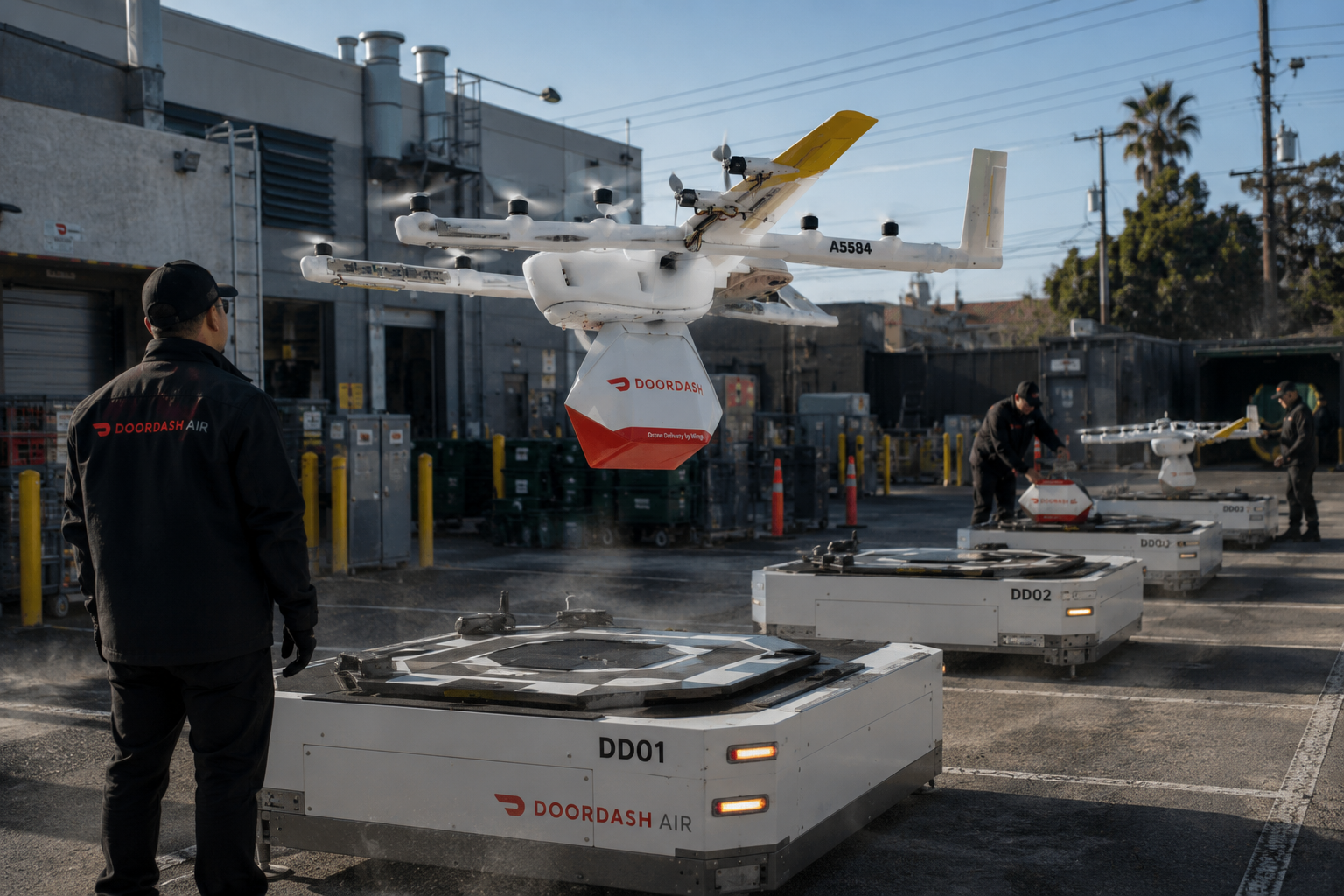
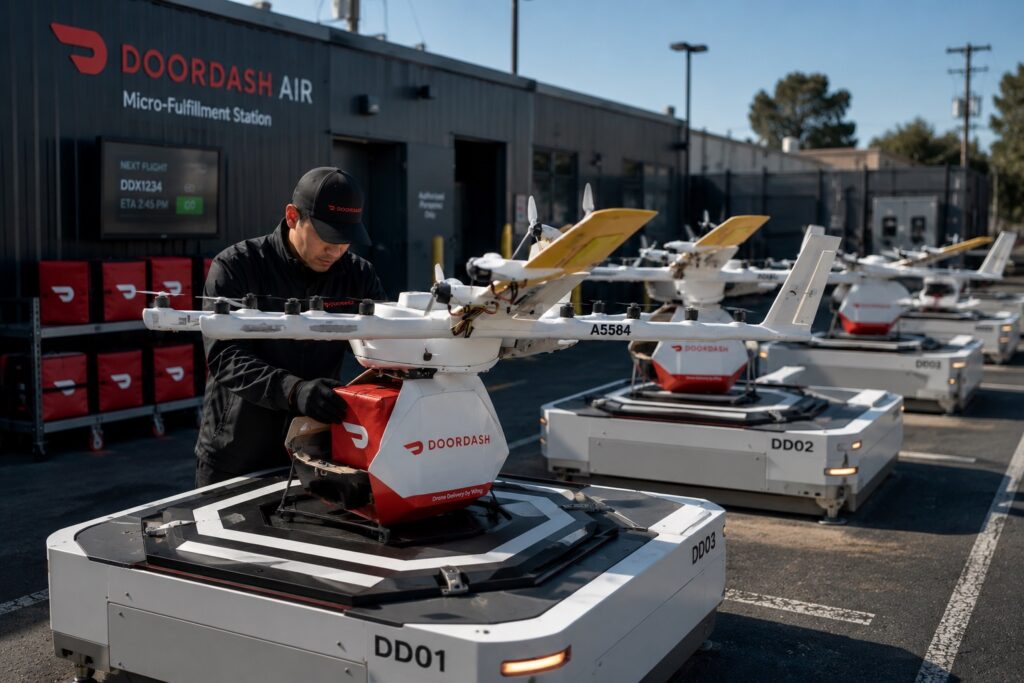
A completed order arrives at a launch station. An operations associate secures a standardized payload beneath the aircraft. Software confirms the route, weather conditions, airspace, and delivery parameters. The drone lifts from its pad while another is being loaded nearby. Behind the scenes, restaurants continue preparing meals exactly as they always have. The transformation is not happening in the kitchen. It is happening in the infrastructure connecting the kitchen to the customer.
That distinction reflects a broader shift taking place across the modern economy.
Historically, logistics companies competed by owning more physical assets. Larger fleets, additional warehouses, and broader geographic coverage created competitive advantages that were difficult to replicate. Those assets remain essential, but artificial intelligence is beginning to change where value is created. Increasingly, competitive advantage comes not from owning more infrastructure, but from orchestrating existing infrastructure more intelligently.
DoorDash appears to be building around that principle.
Every order flowing through the platform generates information about geography, traffic, merchant preparation times, customer behavior, weather conditions, and delivery performance. Each completed delivery improves the system’s understanding of when a human courier is the best option, when a robot is more efficient, and when a drone can reduce delivery time. As additional transportation technologies mature, they do not replace the network—they expand it. The platform simply gains another decision to make.
That evolution places DoorDash alongside a broader movement occurring across technology. Amazon expanded from online retail into an interconnected fulfillment ecosystem spanning robotics, aviation, warehouses, and cloud computing. Uber evolved from ride-sharing into a platform managing transportation, food delivery, freight, and autonomous mobility partnerships. Across industries, the pattern is remarkably consistent. Once companies establish dense networks of customers and suppliers, their next competitive frontier becomes orchestrating increasingly complex physical systems through software.
DoorDash Air fits squarely within that evolution.
What makes this moment particularly significant is the convergence of technologies that until recently matured independently. Artificial intelligence has become capable of making increasingly sophisticated real-time routing decisions. Autonomous delivery systems are transitioning from pilot programs into commercial deployment. Regulatory frameworks continue to expand. At the same time, DoorDash has achieved enough marketplace density that every new transportation option immediately creates value across an existing network. Together, those developments make autonomous logistics increasingly practical rather than merely experimental.
The drone may capture the headlines because it is visible.
The operating system beneath it is the lasting story.
Consumers will continue to judge DoorDash by whether their order arrives quickly and reliably. Merchants will continue to focus on efficiency and customer satisfaction. Beneath those familiar expectations, however, a quieter transformation is taking place. DoorDash is evolving from coordinating deliveries to orchestrating an increasingly autonomous network of people, robots, vehicles, and aircraft through a single intelligence layer.
Every era of infrastructure has been defined by the asset it depended upon. Railroads depended on tracks. Airlines depended on aircraft. Delivery companies depended on fleets of drivers. The next era may be defined less by the vehicles themselves than by the intelligence coordinating them. DoorDash Air suggests the future of logistics will not be won by the company with the most drones, but by the company whose software can orchestrate every available transportation method into a single, continuously optimizing network. In that future, the drone is not the competitive advantage. It is simply another endpoint connected to an increasingly intelligent operating system.
Related Posts

NFL and Sony Forge New Technology Partnership
NFL and Sony Team Up: A New Era of Football Technology.

Gulfstream Achieves Historic Trans-Atlantic Flight Milestone Using Exclusively Sustainable Aviation Fuel
Gulfstream Aerospace Corp. has proudly announced the successful comple

Tech Meets Culture: LG Partners with will.i.am to Redefine Audio with Xboom
LG ELECTRONICS AND WILL.I.AM TRANSFORMS LG XBOOM'S SOUND.

Ergatta Launches Instructor-Led Studio Classes in Partnership with CityRow
ERGATTA PARTNERS WITH CITYROW

Introducing the Happy Plugs Clip: Wireless Innovation Meets Scandinavian Design
TURA SCANDINAVIA presentsHappy Plugs Clip.

Ricoh Imaging Unveils the PENTAX 17: A Modern Take on Classic Film Photography
Ricoh Imaging Americas Corporation has announced the launch of the PEN