

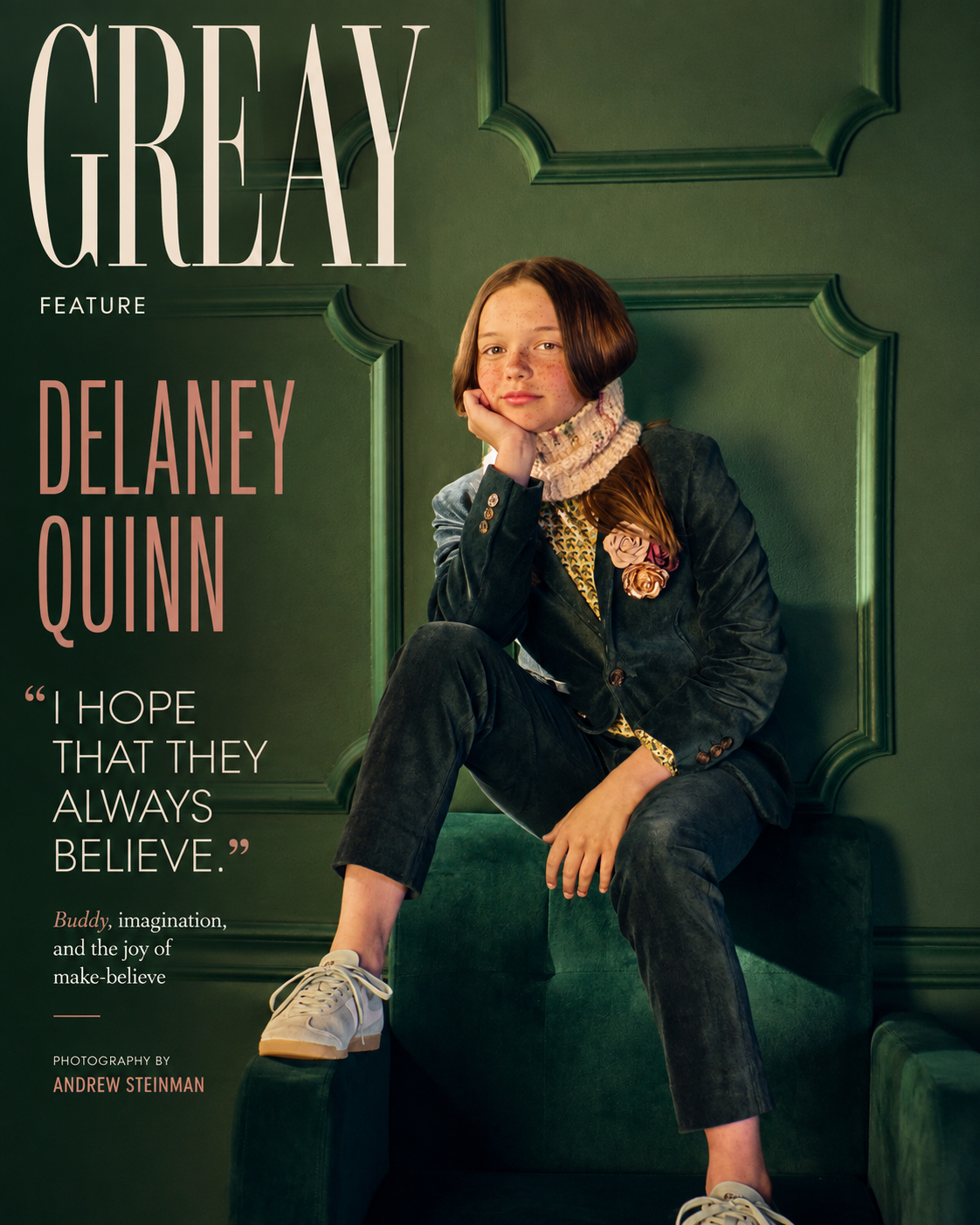
Delaney Quinn Is Growing Through the World of Buddy
Delaney Quinn knows exactly where Freddy is in the story. She knows what Freddy has discovered, what she still believes, how frightened she is allowed to be and how much further that fear has to travel. Because Buddy was filmed out of sequence, Delaney had to carry that emotional map with her from scene to scene, revealing only the part of it the audience was supposed to see.
It is a remarkably disciplined way for an eleven-year-old to describe the work. And then, almost as quickly, Delaney reminds you that she is eleven.
She talks about dance parties after difficult scenes, getting treats at crafty, making puzzles with the other kids on set and remembering how completely you once believed in whatever role your friends gave you while playing make-believe. That combination may be the most interesting thing about her. Delaney can take acting seriously without making herself serious in order to do it.
In an industry that can be unusually eager to turn talented children into miniature adults, she seems to understand something worth protecting: growing as an actor and growing up do not have to happen at the same speed.
GREAY: Freddy experiences the world of Buddy with complete trust before she begins to question everything around her. How did you approach portraying that gradual emotional shift without losing the honesty that defines her?
DELANEY: Actually that part was kind of challenging because, like with almost any movie, we didn’t film in the order of the scenes. I had to really think about where she was in her journey each day of filming. Like, oh wait, she doesn’t know that yet or this can’t be the most scared Freddy is because we have to have somewhere to go with it later. I just had to keep reminding myself of the whole story and to tell just a tiny part of it each day.
GREAY: At its core, Buddy explores much more than fear—it examines belief, trust, and the moment innocence gives way to awareness. What part of that journey resonated with you most as an actor?
DELANEY: I think every kid has a point where they realize that the grownups around them aren’t perfect. And that sometimes they lie or act mean or just have a bad day. I think the part that resonated with me most was that moment when Freddy first started to see cracks in her world. As I get older, I am starting to see that our world can be pretty messed up sometimes, so that moment really resonated with me.
GREAY: The emotional connection between the young cast is essential to the film. What did you and your castmates do to build that trust before the cameras started rolling?
DELANEY: Oh my gosh this was my favorite part of filming this movie. I’ve been in a lot of projects where I’m the only kid on set. This time it was just so much fun to be around other kids. We all became friends almost right away. During the long days on set, we danced, did puzzles and crafts, and just had the best time. At the end of the day I was genuinely sad that filming was done because I liked hanging out with all of them so much.
GREAY: The world of Buddy constantly balances comfort with uncertainty. How did you stay emotionally grounded while moving through those changing realities as Freddy?
DELANEY: I think I’m generally pretty good at getting into the emotions and feelings that a character is having in a given moment and then putting that away after it’s over. If you have to cry in a scene, which can last for a while, hours even, it’s important to do something fun afterwards like go get treats at crafty or have a dance party. I don’t believe in like accessing trauma or whatever in order to play a role. I think that’s a terrible way to do it and it could be really damaging and harmful for kids, and even to adults honestly. You have to find a healthy way to be able to go through emotions as your character without putting yourself in a dangerous place emotionally. You might think that this would make acting easier, but it makes it harder in the long run. You can only do that so many times before you start to actually feel bad or sad and who wants to experience that for real? Not me!
GREAY: When audiences leave Buddy, what do you hope stays with them about Freddy long after the final scene?
DELANEY: Of course I want them to think that she’s strong and brave and determined. But also that you can make mistakes or mess things up and that doesn’t have to define you. Tomorrow is another day and, like Freddy, you can do the next right thing.
GREAY: As your career continues to grow, what qualities have become non-negotiable when you’re deciding whether to say yes to a role?
DELANEY: My mom looks at everything first. She says she is not going to explain something to me that I’m not ready to learn about just for an acting role. So she doesn’t even show me some of them, and she just lets me know that we’re going to respectfully decline. We also kind of have a rule that if I wouldn’t be comfortable saying or doing something in real life I won’t do it for a role either. I love really scary movies and I have 4 older siblings, so I’m pretty chill about a lot of things. But if any of us aren’t comfortable with the content of a project, we pass. There will always be something else that’s a better fit.
GREAY: What’s the most important lesson you’ve learned about storytelling from being on set that no acting class could have taught you?
DELANEY: Well, I’ve never really taken an acting class, so I’m not sure what they talk about. But I can think of one time I had to play the role of a little girl that was mute. So I had to do all my acting without any words. I was playing opposite Mary Beth Peil in a lot of the scenes. She is an amazing actress. She told me that you have to have real thoughts in your head not just try to look or act like you feel something. And if you do, the camera (and everyone watching) will be able to see those thoughts in your face and they will believe it.
GREAY: Looking back, was there a defining moment when acting stopped feeling like something you loved and became the career you knew you wanted to build?
DELANEY: I’m only 11 so I don’t know much about building a career. So I wouldn’t say I’ve had a defining moment or anything. I love acting a lot but I love doing a lot of other things too. Maybe I will be an actor when I grow up or maybe I will be something totally random. I used to want to be a dentist or a nail tech. I’ll figure it out later, but in the meantime I love acting and will keep doing it as long as it’s fun.
GREAY: Every actor develops a unique creative process over time. What have you discovered about yourself that consistently helps you unlock a character?
DELANEY: I’m not really sure I have a technique or process. Honestly I think it’s mostly about having a good imagination and keeping that alive. I just always try to remember what it was like to play make believe games when I was a much younger kid. Like when you played house with your friends you really commit to being the mommy or the baby or the dog or whatever role the group decided you were going to be. There was no question that was who you were in that moment. So that’s kind of how I approach acting roles. I just play and let my imagination take me into the character’s mind.
GREAY: If audiences were to look back on your work a decade from now, what do you hope they’ll recognize as the defining thread that connects every performance you’ve given?
DELANEY: I hope that they always believe. My favorite performances to watch are the ones that make me forget I’m watching a movie or TV show and I think it’s real. So if I can make people believe in my character, even for just a few minutes, even when the story is unbelievable, then I will have done my job as a storyteller.
There is a quiet boundary running through nearly everything Delaney says. The emotions can belong to the character without becoming hers. A role can matter without requiring her to do something she would not be comfortable doing in her own life. Acting can be something she loves without becoming an answer to the question of who she has to be. Even the future is allowed to remain undecided.
Maybe she will grow up and continue acting. Maybe she will do something completely different. For now, she still approaches a character the way she once approached make-believe: decide that this person is real, enter their world completely, and trust that someone watching will enter it with you.
There will be plenty of time for Delaney Quinn to decide what she wants to become. At eleven, she is interested in something happening right now: that small distance between pretending and making someone forget that you are pretending at all.
“I hope that they always believe.”
Photographer Andrew Steinman @andrew_steinman
Words Kyra Greene @noteasybeingreen
Fashion Styling Barbara Eisen @stylegalbee
Hair & Make Up Norah Salazar @norahlovesmakeup_mua
Related Posts

Lewis Hamilton Shifts Gears from F1 to Fashion: Unveiled as Dior’s Latest Menswear Ambassador and Guest Designer
Dior Announces Lewis Hamilton as Brand Ambassador and Guest Designer
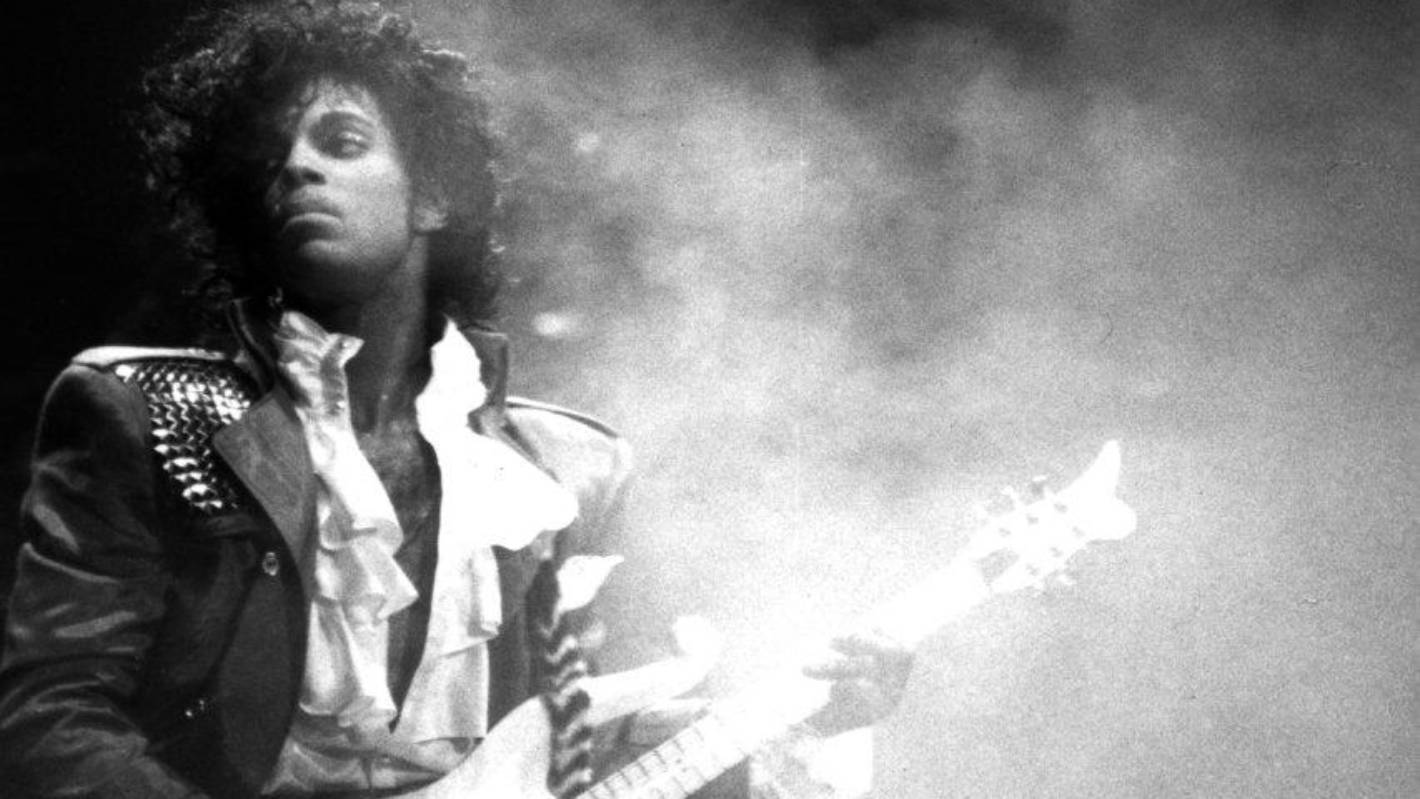
Stage Adaptation of Prince’s ‘Purple Rain’ in the Works
A stage adaptation of Prince's film Purple Rain, is currently in the w

MTN DEW Launches Limited-Time RED, WHITE & BLUE Flavors to Celebrate Summer Outdoors
MTN DEW ® CELEBRATES SUMMER WITH THREE NEW MTN DEW

Branding vs. Logo: The Battle of Identity in Business
By Jason Locke In the dynamic world of business, a company’s ide
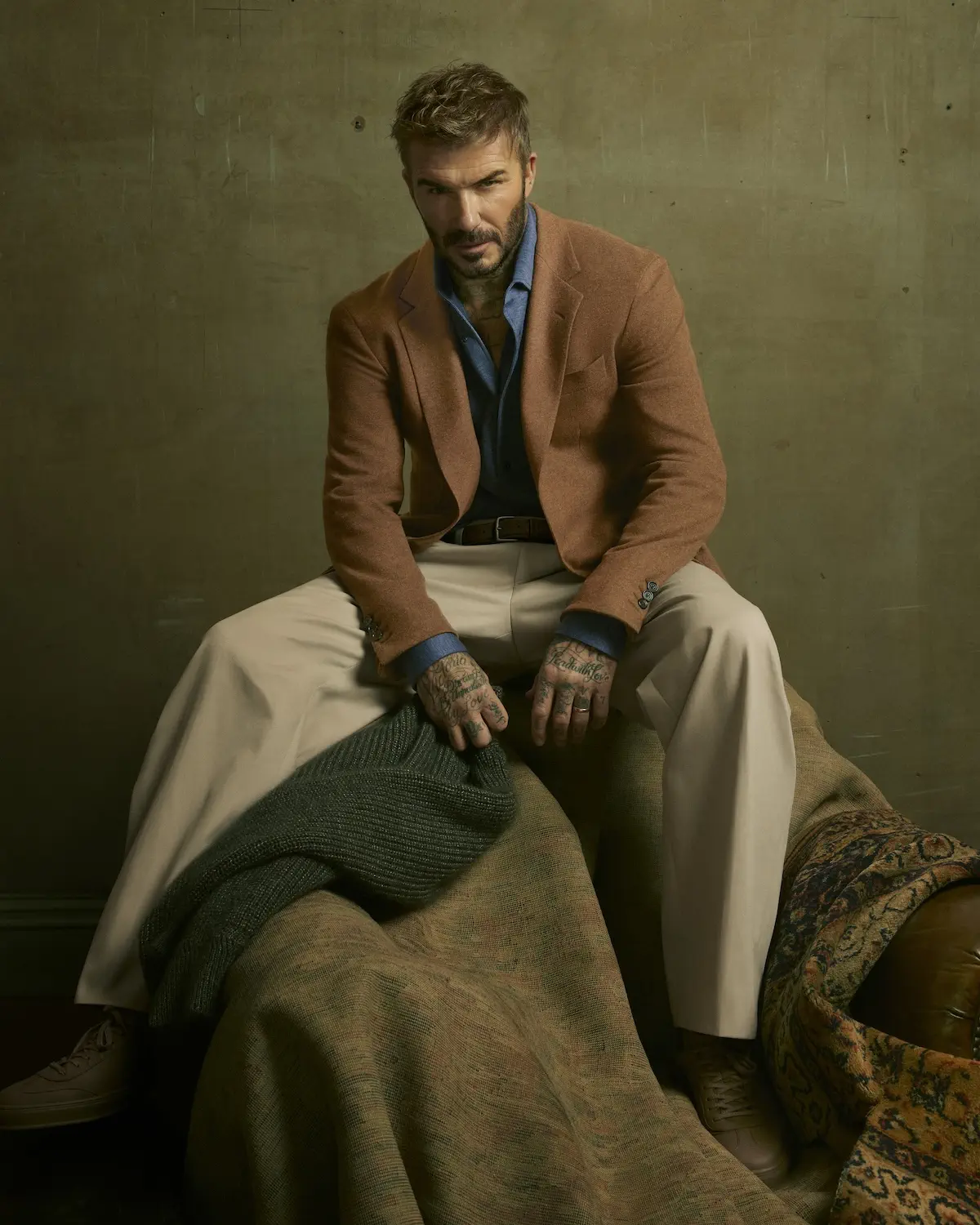
The Beckham x BOSS Fall/Winter 2025 Collection: Quiet Confidence, Defined
Quiet Power, Sharp Lines
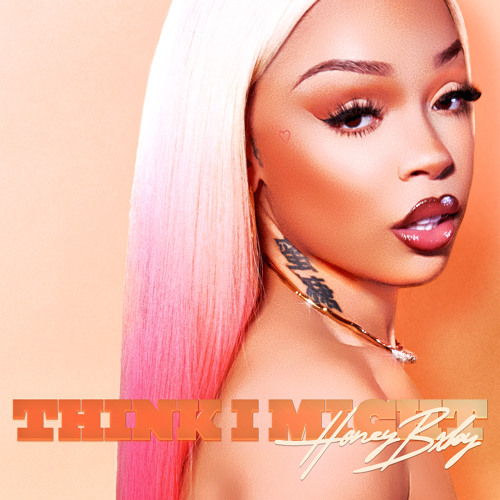
“Think I Might” — Honey Bxby’s Bold New Anthem for the Soft-Hearted Savage
Honey Bxby: The R&B Newcomer Who Might Just Steal Your Heart.