

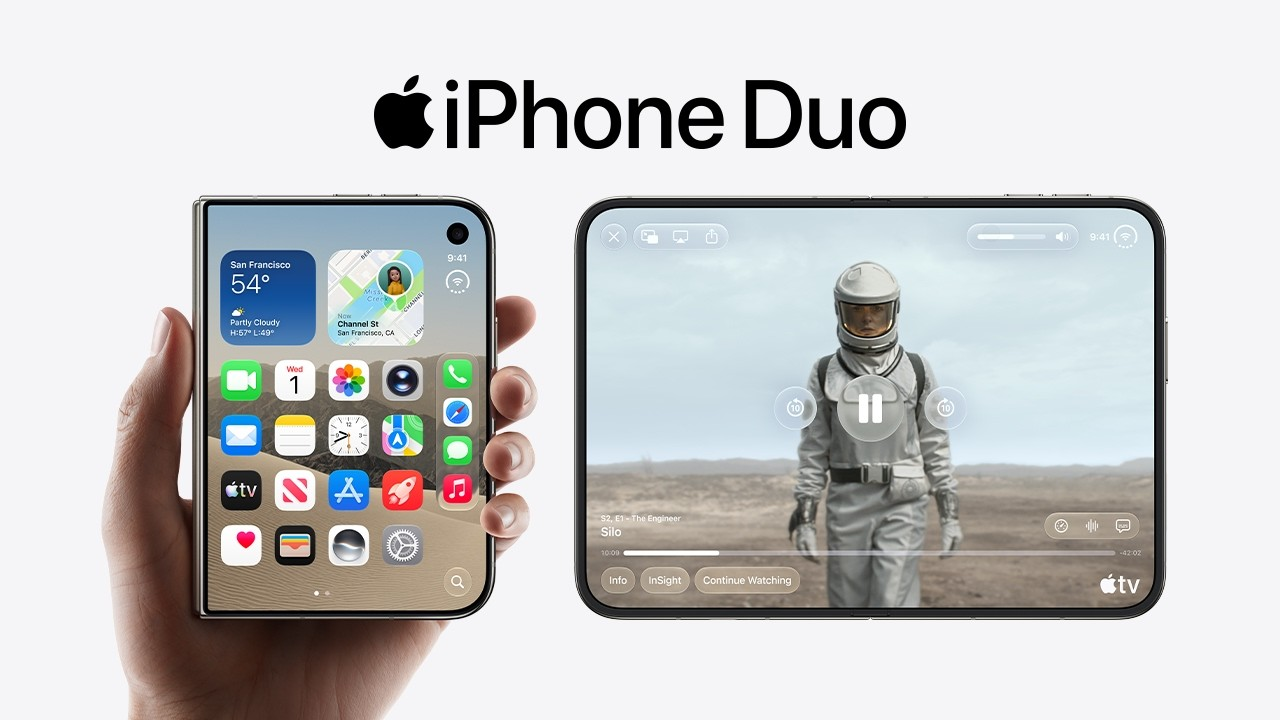
Apple Didn’t Fold the iPhone — It Expanded What an iPhone Can Be
By Brian K. Neal
For nearly twenty years, Apple has been remarkably disciplined about what an iPhone is.
The screen became larger. The cameras became more capable. Buttons disappeared and occasionally returned in different forms. The processor became powerful enough to perform work once reserved for computers. But through all of that change, the basic relationship remained intact: an iPhone was a single screen designed primarily to be held in one hand and carried everywhere.
The iPhone Duo breaks that agreement.
It does not, however, introduce the foldable phone.
Samsung began selling the Galaxy Fold in 2019. Motorola revived the Razr around a folding display that same year. Huawei, Google, Honor, Oppo and others followed with their own interpretations. By the time Apple arrived, consumers had already spent years opening phones into tablets and folding full-size smartphones into smaller objects.
Apple is late.
That matters because it changes the question surrounding iPhone Duo. The story is not whether Apple can invent the foldable phone. That work has already been done by an industry that spent years developing the displays, hinges, software and consumer expectations that made this category possible.
The more interesting question is what Apple believes an iPhone should become once it is allowed to fold.
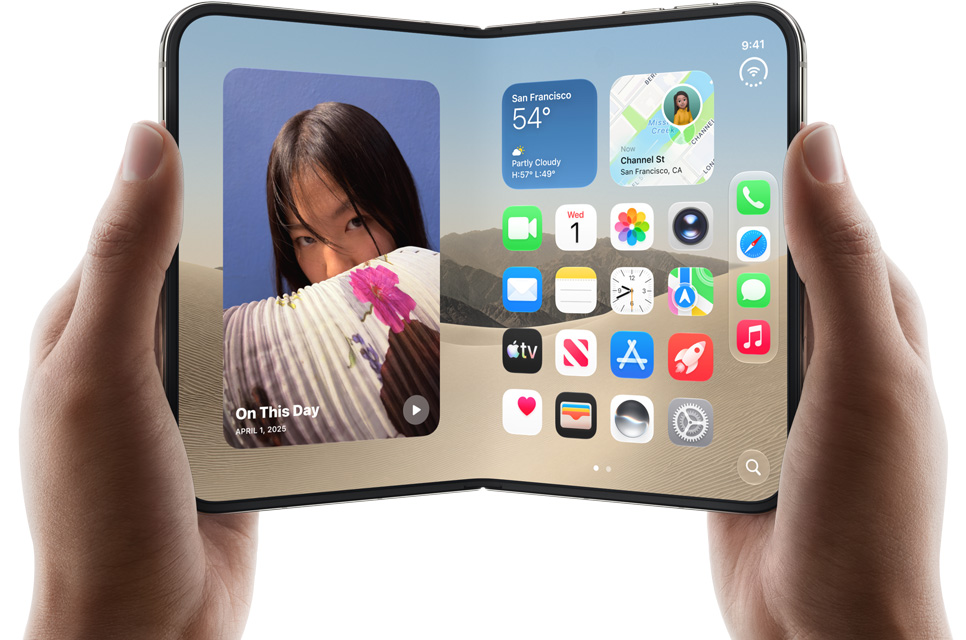
Closed, iPhone Duo remains recognizable as the object Apple has spent two decades refining. Its 5.4-inch exterior display provides 90 percent of the screen area of the iPhone 18 Pro. Open it, however, and the device becomes a 7.6-inch canvas that Apple says is 50 percent larger than the display on the iPhone 18 Pro Max. It is the largest display Apple has ever put on an iPhone.
The size alone is not the important part.
Apple could have treated the additional screen as more room for the same iPhone experience. Instead, it is beginning to change how applications behave inside that space.
With iOS 27, Split View comes to the iPhone for the first time. Two applications can operate beside each other. Users can open two windows from the same app, create combinations of applications and return to those pairings later. Zoom can place a presentation beside meeting participants. Slack can expose more of a workspace. Siri AI can occupy one side of Duo while the information a user is discussing remains visible on the other.
Those are not simply features designed to demonstrate a hinge.
They begin moving the iPhone into behaviors Apple has historically associated with larger computing surfaces.
That distinction matters because Apple has spent years maintaining an unusually clear architecture across its devices. The iPhone was the computer that went everywhere. The iPad offered a larger touch canvas and increasingly sophisticated multitasking. The Mac remained the company’s broadest productivity environment.
The borders were never absolute, but Apple protected them.
That was particularly visible as conventional iPhones became larger. Apple could make an iPhone enormous without turning it into an iPad. Screen size increased, processing power increased and professional applications became more capable, but certain interactions remained elsewhere in the product family.
Duo begins crossing that behavioral line.
Later this year, Apple says Apple Pencil with USB-C will work on either Duo display, allowing users to write, sketch and annotate directly on an iPhone. That is notable precisely because Apple had years of increasingly large iPhones in which it could have made the same decision and chose not to.
The fold appears to have changed the calculation.
Once an iPhone can physically transform from a conventional phone into a 7.6-inch workspace, some of the old distinctions become harder to maintain. The device is still an iPhone when closed. But when opened, Apple is increasingly allowing it to behave like something that previously lived somewhere between an iPhone and an iPad.
Siri AI makes that transition even more consequential.
Apple’s new Siri can work with personal context across messages, email and photos, understand information visible onscreen and take actions connected to what the user is doing. On Duo’s larger display, that intelligence can exist beside another application rather than replacing it.
That sounds like a small interface decision. It points toward a much larger one.
The smartphone industry is currently trying to solve two transitions at the same time. Foldables are changing the physical surface of mobile computing. Artificial intelligence is changing how people interact with the information inside that surface.
Duo puts those transitions together.
A larger display gives an AI assistant more room to become part of the workspace instead of remaining a voice or interface summoned temporarily over it. A user can look at something while discussing it with Siri. The assistant can occupy space alongside the task rather than interrupting the task.
The fold therefore becomes useful not because the phone bends, but because opening it creates another kind of computing environment.
Apple is applying the same thinking elsewhere.
The exterior display can become a preview screen for someone being photographed. The rear cameras can effectively become selfie cameras because a subject can see themselves from the opposite side of the device. FaceTime can use both sides of the hardware. Partially folding Duo allows the phone to support itself for photography, video calls and other experiences without requiring a separate stand.
None of these ideas independently reinvent the smartphone. Some have precedents elsewhere in the foldable market.
That distinction is important.
Apple’s contribution does not need to be invention for the strategy to matter. Its late arrival brings the foldable form into an ecosystem with billions of active devices, established developer relationships and clearly defined roles for the iPhone, iPad and Mac. The significance will depend on what happens when a folding device enters that architecture and begins borrowing behaviors from the products around it.
And entering late creates its own burden.
Foldable phones have spent years exposing the compromises created by moving parts: thickness, weight, battery distribution, display creases, hinge durability and the long-term reliability of flexible screens. Apple can describe the engineering it has developed to address those problems. Duo uses the A20 Pro, a custom vapor chamber, a battery divided between both sides of the device and a hinge containing more than 100 components.
But durability cannot be proven during a product announcement.
That test begins when these devices are repeatedly opened, closed, dropped, carried and used outside Apple’s controlled demonstrations.
Price creates another test.
At $1,999 in the United States, Duo is not positioned as an immediate replacement for every conventional iPhone. It is an expensive proposition about what Apple’s most important personal computer might eventually become.
That distinction keeps the significance of Duo in perspective.
Apple executive John Ternus calls it the “most transformational change to iPhone since the original.”
That is an enormous standard.
The original iPhone did not matter because it introduced the first mobile phone, the first touchscreen or the first device capable of accessing the internet. It mattered because Apple reorganized several existing technologies and behaviors around an interface that ultimately changed what people expected a phone to do.
Duo has not earned a similar position because it folds.
Samsung and the companies that followed it deserve the historical credit for building the foldable smartphone category before Apple entered it. The market will determine whether Apple’s interpretation becomes transformative, merely successful or something consumers ultimately decide they do not need.
But Apple’s decision still tells us something important about where the iPhone is going.
For years, Apple kept expanding what could fit inside the familiar rectangle without fundamentally changing the rectangle itself.
Duo changes the equation.
The hinge is the easiest part of the device to see, but it may be the least interesting part of the strategy. What matters is what Apple is allowing to cross the hinge with it: multitasking behaviors, Pencil input, AI working beside applications, dual-display camera experiences and an increasingly blurred boundary between the phone in your pocket and the larger computers around it.
Apple did not invent the foldable phone.
It finally decided the iPhone no longer has to remain one shape to remain an iPhone.
Related Posts

Microsoft Appoints Sarah Bond as President of Xbox, Marking a Historic Moment for Diversity in Gaming Leadership
By DaMarko Webster In a groundbreaking move, Microsoft has taken a sig

Razer Removes the Desktop’s Advantage
Quiet Hardware, Loud Capability

Google Unveils Gemini, Its Most Powerful and Extensive AI Model Yet
Google has introduced its latest and most advanced AI model named "Gem

Muah AI: Transformative Multi-Modal AI Platform, Revolutionizing Human-AI Interaction as an Authentic Character AI Alternative
groundbreaking stride forward in artificial intelligence technology

Google’s A24 Deal Is Less About a Film Library Than the Production Pipeline
The Invisible Engine of Hollywood

Conversation Is the Mask, The Algorithm Is the Decision
The Death of the Menu Layer