

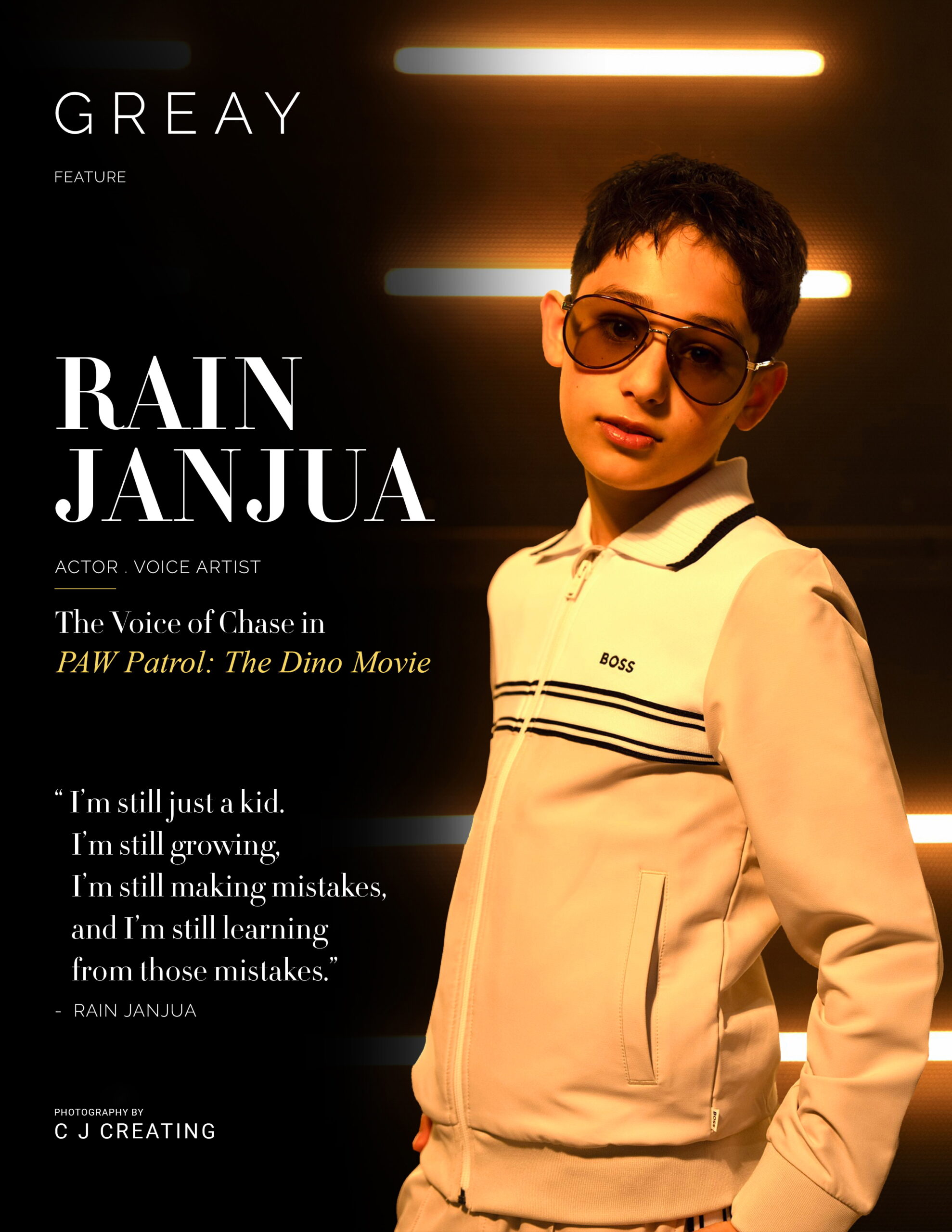
Rain Janjua Is Learning to Own the Work Without Rushing the Future
By Kyra Greene
There is something revealing about hearing Rain Janjua describe one of the biggest opportunities of his young career as “just another day at work.” It isn’t indifference. It is the language of someone who learned unusually early that excitement and responsibility can occupy the same room. Rain grew up watching PAW Patrol. Now, as the voice of Chase in PAW Patrol: The Dino Movie, he finds himself inside a world that once existed for him on the other side of a television screen. The significance isn’t lost on him; he celebrated when he got the role. But once the microphone turns on, something changes. He goes to work. “I just go into professional mode and I’m locked in,” he says.
GREAY: You grew up watching PAW Patrol, and now you’re the voice of Chase in PAW Patrol: The Dino Movie. When you walked into the recording booth for the first time, did it still feel like work, or was there a part of you that felt like the kid who used to watch the show was somehow living inside that moment?
Rain Janjua: The first big role I ever booked was as Gekko on PJ Masks: Power Heroes. I watched PJ Masks when I was younger—probably even up to a year before I booked that part—so when I first walked in for that, I definitely thought, “Wow, this is like a dream!”
Since then, I’ve done multiple shows where I have been a character that I watched growing up, so over time it’s become less of, like, a dream and more sort of the norm because I’ve done it a lot. And by the time I booked the role of Chase and started recording for the PAW Patrol movie, I was at a point in my career where it was just another day at work.
I mean, don’t get me wrong—I still think then and now that it is really cool to be voicing a character that I used to watch all the time on TV, and especially for PAW Patrol! And I celebrated and had that “wow” moment when I first found out that I booked the role. But I have a very good work ethic, and as exciting as it is, when I step into the recording booth, my focus is to work and do the best job I can do. I just go into professional mode and I’m locked in.
GREAY: Chase has always been the pup who runs toward responsibility instead of away from it. As you spent time bringing him to life, did you find yourself understanding courage differently than before you accepted the role?
Rain Janjua: Because I used to watch PAW Patrol a lot when I was younger, I think I learned what courage is probably through Chase—through watching the show—so I don’t think my definition of how I understand courage has changed from the time when I was watching the show to actually becoming Chase. I think it’s pretty much stayed the same.
Like Chase, I’m generally pretty responsible. For example, a couple of years ago, there was a babysitting course being offered in my school and I decided to take it. I told my parents that when I’m a little bit older, I wanted to be ready to babysit my brother, so they let me sign up for it. And now that I’m a teenager, I started babysitting him recently. I also started to teach him beatboxing because he really wanted to learn.
I think that to be a child actor you generally have to be responsible, because even though I miss a lot of school, I have to make sure I get caught up on all my schoolwork and stuff, and I make sure that I have good grades. So even though I skipped a grade, I work hard to be on my school’s Honour Roll every year.
That was the main thing my parents talked to me about when I first started acting, and they made sure I understood this kind of extra responsibility that I would have. The deal was that as long as I keep my grades up and do well in school, I can continue with my acting career. And I was about six or seven years old when I got into acting, so I kind of learned about responsibility and courage at a young age already.
GREAY: One of the unique aspects of voice acting is that you’re often asked to trust a story before you’ve seen the finished film. Did that experience teach you anything about trusting the creative process—and about trusting yourself when you don’t yet know how everything will come together?
Rain Janjua: I think that having to trust a story and the creative process before seeing the finished film is just part of being an actor no matter what project you’re working on. So I don’t think this particular experience was any different in that way because with all of my other shows for voice-over, even though I have the whole script, I never know how it will turn out visually because we always record the script first, and then the team works on the animation after.
And even with PAW Patrol, even though I didn’t get the full script, I think I’ve just learned how to trust the process already—it’s just second nature at this point. I have trust in all the different teams that work together toward making these movies and shows and making them come to life.
The PAW Patrol movie is a great production with lots of great people working on it, and it’s world-class, so I trust everyone that’s part of it—from writing all the way to producing, animation—every aspect of it. Everyone is an expert at what they do, so I have full faith in them making this movie as great as it can be.
And working with Cal Brunker, the voice director, was great and helped with that, too. His work ethic and his style are really outstanding. Cal’s job was to make sure that I brought his and the team’s vision of Chase to life, and that I brought the best version of myself to the role, so I have no doubt that he was able to do the same with all the other actors. So, because of all these things, I’m 100% sure everything will come together in the best possible way.
GREAY: Children may not remember every line Chase says, but they’ll remember how he made them feel. When a family leaves the theatre, what do you hope children carry home with them after spending time with your version of Chase?
Rain Janjua: I can’t really say I have any specific hopes for how kids and families would feel after seeing my particular version of Chase. You know, I wasn’t trying to bring anything new or different to my version of the character. If anything, I was trying to make sure that my version of Chase was true to the Chase that already exists—that kids and families already know and love. So I hope that my version of Chase is just as likeable and lovable as any other version.
But my part playing Chase is one part of a whole movie, you know? Chase is one character out of many, and PAW Patrol is about the whole group—the whole team. PAW Patrol wouldn’t be PAW Patrol without all of the pups together—and Ryder, of course.
So for my role, for sure, I hope that everybody watching walks away feeling like it’s the same reliable, dependable, heroic Chase as always, but most importantly, I just want them to like the movie.
GREAY: PAW Patrol has become part of so many childhoods around the world. What did joining a story with that kind of legacy mean to you, and how did you hope to honor a character that already means so much to so many families?
Rain Janjua: Joining PAW Patrol has meant so much to me, and it’s an honor to be chosen as part of this team—this legacy. It’s hard to explain. PAW Patrol is really big. As I said, I watched it a lot when I was younger and I always enjoyed watching it, and so it feels really exciting and honestly it’s pretty crazy to be part of something this big and something that was a big part of my childhood. It really means a lot to me.
For voicing Chase, I tried to sound as similar to the original voice of Chase as possible, but not just the voice—I also wanted to bring the same energy so that audiences could connect to the character they know. But at the same time I wanted to make sure I stay true to myself, so I put my own little twist on Chase by letting little bits of my own personality shine through here and there.
So in some lines and the ways that I would deliver them, there are times when my personality would come out a little now and then.
GREAY: You’ve balanced school with a professional acting career from a young age. Has living in both worlds helped you see growing up differently than most people your age?
Rain Janjua: Yeah, definitely. I mean, the biggest difference I see is that I don’t—and can’t—have, like, a “normal childhood” like a lot of other kids because my job is a bit unpredictable, so my life is different from most kids who typically have more structured schedules.
There are some things that I can’t really do because of acting—like, I’ve never been able to join a sports team or anything like that because I can’t always make practices. You know, I could get auditions at any time, so there are definitely some parts of childhood that I’ve missed out on.
But like my dad says, everything is a trade-off, and so is acting; it’s taught me a lot of things about the world and about how to have a good work ethic. Basically, I’ve had to work with adults from a very young age, so I guess I have actual real-world work experience that the majority of kids my age won’t have for another bunch of years. And that’s taught me how to stay disciplined and keep persevering when I get really tired or when things get a little tough.
Having a full-time job while doing full-time school has taught me that to be successful, you can’t just take a day off if you don’t feel like working; you have to work really hard consistently to do well in both worlds. And I think because of that, I enjoy my time off and the time I spend with my family and friends a lot more than most people my age. I value it a lot more.
GREAY: Your mom has shared that making funny voices together at home became one of the first sparks that led you toward voice acting. This shows that the smallest interactions with family and friends can have a big influence on shaping someone’s future. Can you share some of your thoughts about that?
Rain Janjua: Yeah, I definitely agree that they do. I feel like little interactions and moments can definitely change the course of the future. Like, it can spark a whole new trajectory in someone’s life.
So I feel like it’s important to be present with your family, not just because it’s good to connect, but also because you never know how these small everyday moments can grow. I hang out with my family a lot and we try to have a lot of good quality time together, and we also reflect a lot on our favourite parts of the day or an experience. I feel like it’s important to have those moments and to create connections with the people that we’re closest to, because you never know how something can inspire you.
Also, I’ve heard that you are the product of the five people that you spend most of your time with. I think that means that the people that you surround yourself with—which for me is mostly my family and now my friends, too—you start influencing each other, and those people can change the way you think and the way you want to live your life.
So something as small and silly as my mom and I doing funny voices at the kitchen table—you know, it was something that we did regularly and something that just made us laugh—but even something so small can have such a big impact, and I think that’s pretty cool.
GREAY: Beyond acting, you’ve explored music, beatboxing, martial arts, and other creative interests. What have those different passions taught you about discipline, creativity, and the kind of person you want to become?
Rain Janjua: Well, the biggest lesson I’ve learned is that you have to put your reps in to get better at anything. You have to practice over and over again—that will help you get better at all those things—acting included.
I don’t really know what kind of person I want to be just yet—you know, I’m still trying to figure that out—but I think these things have definitely taught me that I have a few different talents, that I’m a creative person, and that I am pretty hard on myself because I want to be the best possible version of me.
It’s also taught me that I have so many different parts of myself that I want to explore, but I think that maybe I need to choose just one or two of these things and probably settle more into them.
But you know, trying all these things in such a short time, I learned that you have to have structure and discipline to make sure everything gets scheduled, because it’s a lot and it can get overwhelming sometimes. But with art, too much structure can kind of hold you back and not allow for your full creativity to come out.
So I think maybe you need both at times: you need to kind of work under a schedule with, like, a specific result in mind, but you need to be free, too, to let your ideas flow.
So I’d say in creativity it’s good to have goals to work towards, but then it’s also nice to do things kind of carelessly sometimes because that can kind of help you to explore yourself. And to do that, I learned that you need to, like, schedule unstructured time to let your creativity just come out.
But no matter what I end up doing later in my life, overall, I definitely know that I’m the kind of person who will always continue to learn and explore new things in a creative way. That’s just the way I am.
GREAY: Your family reflects both Punjabi and Polish heritage. As you’ve grown older, are there traditions, values, or conversations from home that have quietly shaped the way you see yourself and the world around you?
Rain Janjua: On a regular day-to-day, our family doesn’t exactly follow either culture. If anything, you know, the different cultures influence how we spend time for different holidays.
Because my mom is Polish and comes from a Catholic background, we spend Christmas Eve and Easter with my grandparents and celebrate those holidays in a very traditional way; and because my dad is Punjabi, when I spend time with that side of my family, then I’m exposed to the Indian culture and heritage—so things like going to the Gurdwara, the Sikh temple, listening to bhangra music and dancing bhangra at weddings, eating the food.
But because we’re a culturally diverse family, you know, I don’t feel that I’m really shaped by those cultures as much.
Instead, our family has come up with our own traditions that have a much bigger influence on me, like our annual Cousin Jam, for example. Every year, I hang out with all of my cousins, who happen to be on my dad’s side of the family. The eight of us in total live in different provinces across Canada, so once a year, we all get together and hang out for about a week or so.
This is just a family tradition that we came up with and it’s strengthened our connections with each other. This really makes me value my family and my relationships with my cousins because now, as we grow up, we know we can support each other and be there for each other.
Also, at the end of the year when we get our report cards, my dad hosts a competition for all eight of us kids—whoever gets the highest grades, the highest overall average for the year, wins a grand prize, which is a lot of money. We all get competitive with each other, but it’s made us all work even harder to get good grades.
Other than that, the conversations that I have with my parents about values have a much bigger impact on me than either cultural background. My parents have taught me that honesty, balance, and putting family first are the most important things in life. So that’s what’s really shaped the way I move through life and how I see the world when my family is not around.
GREAY: Friendships become especially meaningful during the teenage years. When you meet someone new, what qualities make you feel you’ve found someone you can genuinely trust?
Rain Janjua: Generally, as a teenager, I think the thing I look for most when I meet new people is I just try to find people with similar interests and see if our personalities click, and if we, like, vibe well together. But that’s just the surface-level stuff.
The qualities that I look for in people who I want to keep around in my life as close friends, and people who I can trust, are people that are kind, respectful, funny, have a good sense of humour, and who enjoy quality time together.
And the thing that makes me trust someone is if they’re honest with me—like, if they tell me something that may be difficult to say but that is true—if they keep their word, and also people who are loyal. Like, those who are protective of others and stand up for others, especially if they have my back around other people.
GREAY: Voice acting asks audiences to connect with emotion without ever seeing the actor’s face. Has that experience changed the way you think about human connection and the idea that people often remember how you made them feel more than what you said?
Rain Janjua: I definitely think that the way you say something can affect the way people feel. That’s why I don’t really like talking to people over text; I’m not good at texting because I find it’s a lot easier to convey emotion and what you’re really trying to say in person or, like, actually hearing someone’s voice rather than just reading texts.
Having a conversation by text, especially an important one, can cause a lot of trouble and miscommunication. I think human connection is both based on what you say and how you say it—and then I also think that seeing how people feel definitely plays a factor, too. I don’t think one is necessarily more important than the others. I think they all have an equal share in how people will remember you and how you make other people feel.
Because sometimes things can sound one way but have a completely different meaning. I recognize from doing voice acting that even saying a line without a smile on my face can really change how it comes across. It’s as simple as that.
So I think communication is best when you can use your voice—that always helps to communicate and convey a message more clearly. But I think you still need to be aware of how what you say comes across to someone else. And I’m not an expert on that. I mean, I’m only a teenager, so I’m still learning, but it’s definitely something I will continue working on.
GREAY: Success often brings new opportunities, but it can also bring new expectations. As your career continues to grow, what do you hope never changes about who you are away from the microphone?
Rain Janjua: Well, I hope I’m still the same lovable, talkative self that I am. I hope my personality doesn’t change too much and I stay close with the people I care about and that I’m friends with.
But I hope I’m not too pressured with any huge expectations or standards just yet—I’m still just a kid! I know that as my career continues to grow, yes, there definitely will be bigger expectations. But I’m not too worried, because my family is always in my corner and they are always there to make sure that I don’t do anything that can negatively affect me, or make me look bad, or goes against my values and who I am.
So I hope that my bond and connection with my family stays the same, and that I remember who I am and where I came from.
GREAY: If someone were to read this interview ten years from now, what do you hope they would understand about the person Rain Janjua was becoming during this chapter of your life—not just as an actor, but as a son, a friend, and a young man?
Rain Janjua: I don’t know what I’m becoming yet. I feel like it would be cocky to say that I’m becoming something big—I mean, I hope I am, but I don’t want to assume. You never know what the future has in store for you, so it’s difficult to answer this question.
But I hope that people understand a little bit about who I am right now, and right now that’s a decently rising actor—a young rising star. And that’s the key thing: I’m still just a kid. I’m still growing, I’m still making mistakes, I’m still learning from those mistakes, and even when I grow up I will continue to make mistakes and learn from them.
I don’t know what I want to do yet with the rest of my life because I’m still figuring myself out. I’m definitely at an exciting point in my career and I’m really looking forward to where it’s going to go.
You know, I’m starting to really take ownership of my work. It’s not like it was before when I was little and my mom was a lot more hands-on with my auditions and preparing me for my auditions and for roles and my recordings. Now I have enough experience and confidence that I’m starting to make a lot more of those decisions by myself, and I really like having a lot more say in that now.
As far as who I’m becoming as a son, a friend, and a young man in general? I think that’s only something somebody can answer when they’re a lot older and when they can look back at their life and where they’ve come from.
So I guess I hope that the person reading this 10 years from now can see that my life as all those things is just at the very beginning, and I guess where I go from here all depends on the choices I make, the opportunities that I get, and maybe even the little interactions that I have between the people who are in—and who will enter—my life.
Because who knows how those little interactions will shape my trajectory at some point? Anything can be the next “silly voices in the kitchen with my mom” moment.
And that can change everything.
For someone whose career increasingly asks him to think about what comes next, Rain is remarkably comfortable admitting that he doesn’t know. Asked what someone reading this interview ten years from now should understand about the person he was becoming, he doesn’t manufacture an answer worthy of a headline. “I don’t know what I’m becoming yet,” he says. Later, he makes the point even simpler: “I’m still just a kid.”
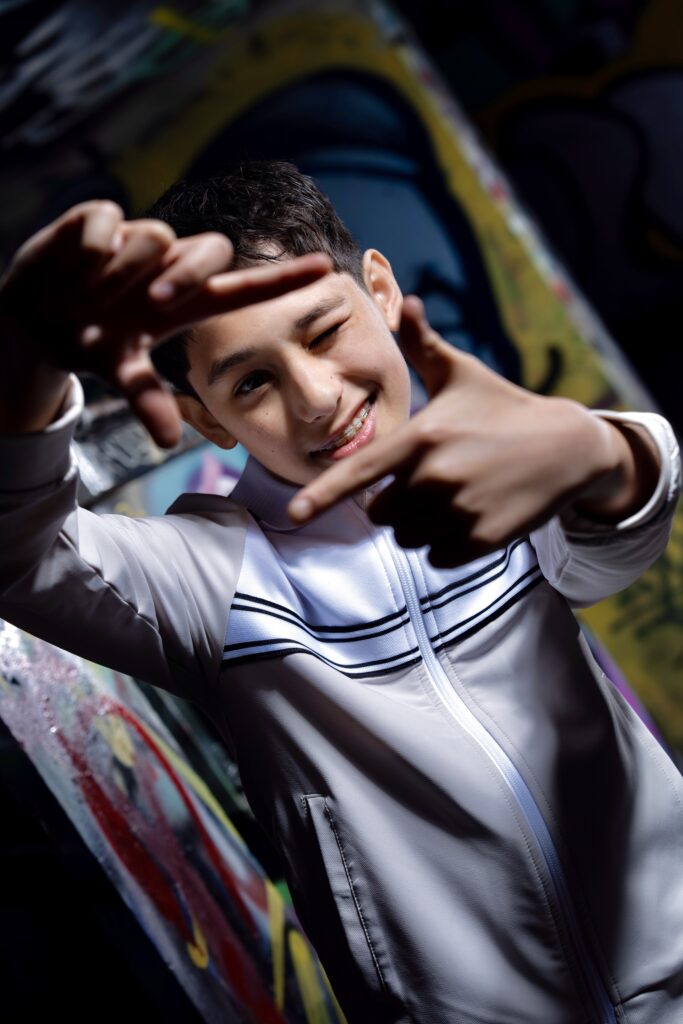
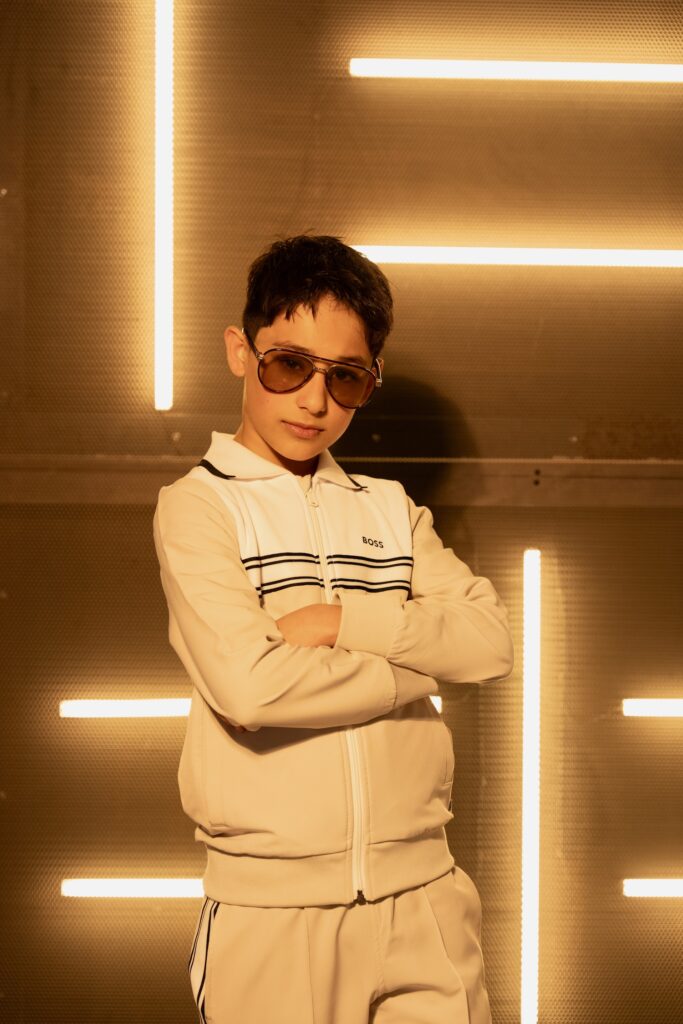
Photography CJ Creating
Related Posts

Fresh, Bold, and For Everyone: AMP Launches TONE at Target
Any Means Personal
Ray-Ban Is Building Atmosphere
The Best Brands No Longer Feel Like Stores
Pacsun Launches ‘A.R.C.’: The Ultimate Men’s Activewear Line for Gen Z
Pacsun unveils first dedicated men’s activewear line.
A$AP Nast Stars in adidas Originals’ Tribute to the Iconic SL 72
adidas Originals celebrates iconic SL 72.
The Bonds That Outlast the Credits: Malcolm D. Lee Pens the Next Chapter of The Best Man
Love, Legacy, and the Literary Turn of The Best Man.