

Adapt or Fossilize
By Kyra Greene
When a franchise survives for nearly six decades, nothing inside it is accidental. Adjustments are signals. Revisions are strategy.
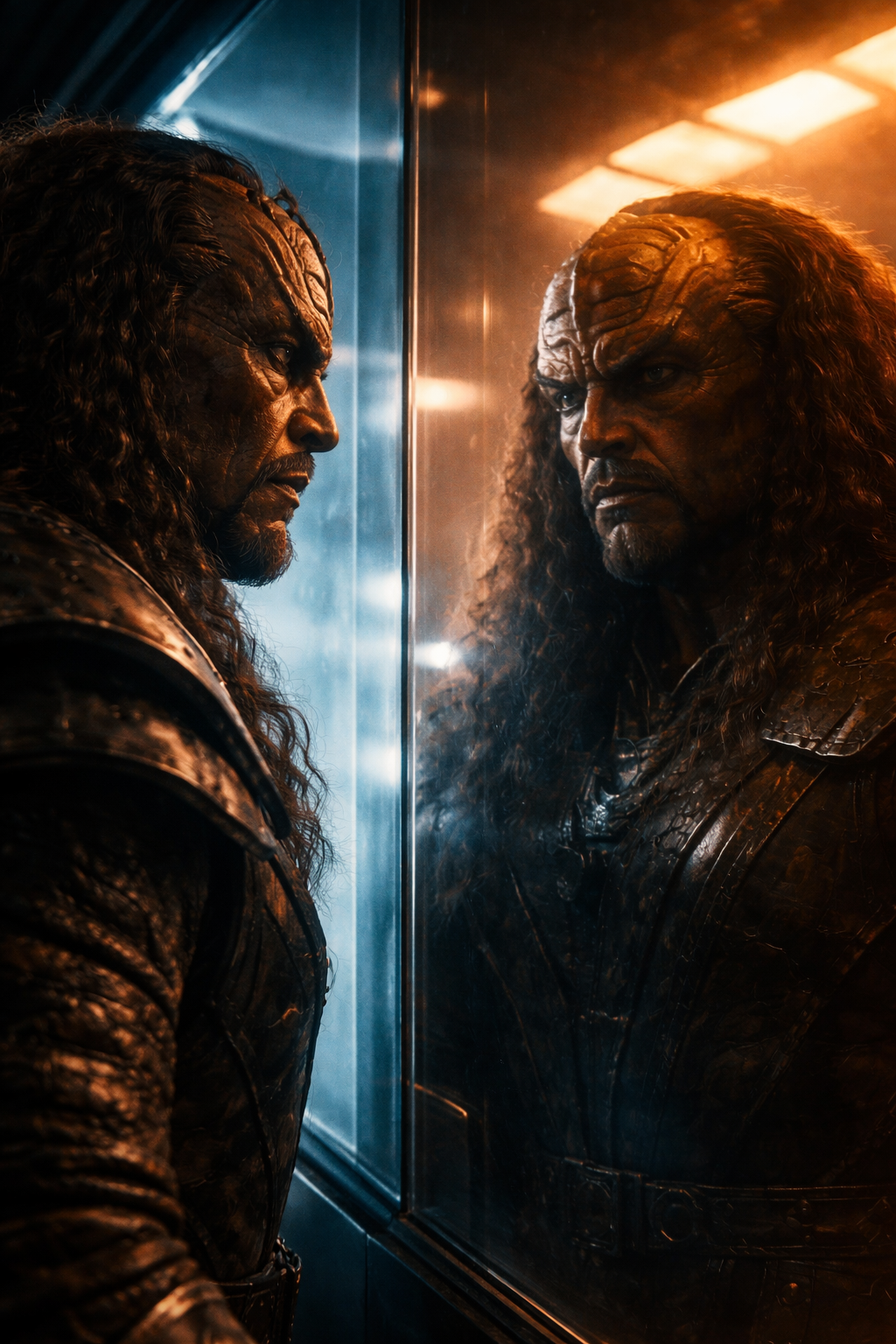
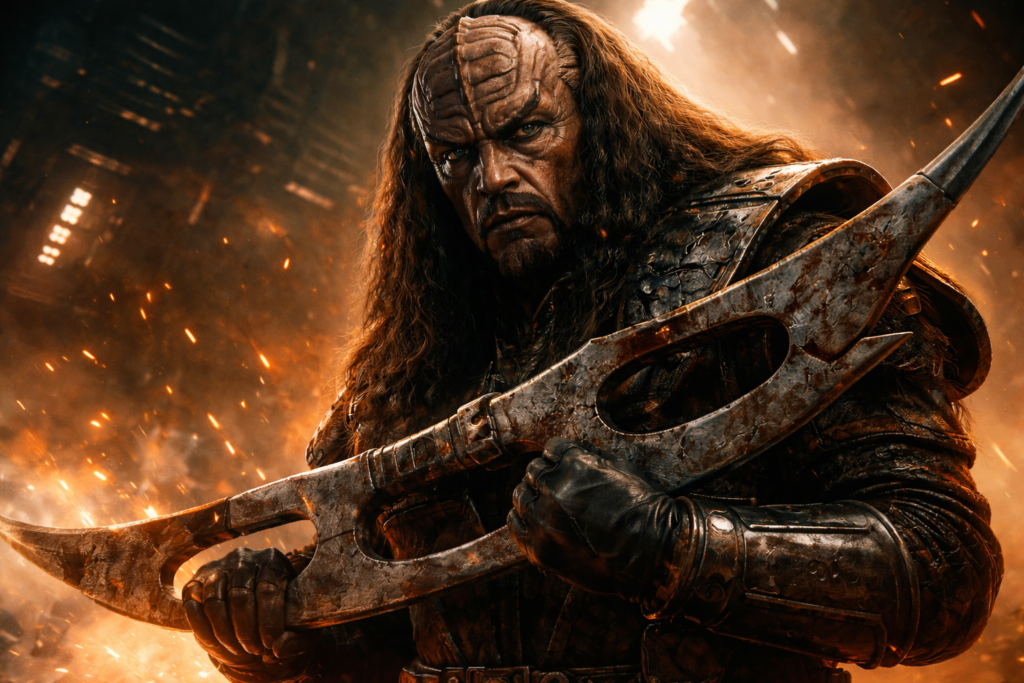
The introduction of a gay Klingon inside the world of Star Trek is not a culture-war headline. It is a longevity maneuver.
Legacy intellectual property does not die from controversy. It dies from irrelevance.
For generations, Klingons have represented one of science fiction’s most durable masculine archetypes — ritual honor, militaristic hierarchy, combat-first identity, emotional severity encoded as strength. They are not side characters. They are structural pillars of the franchise’s myth engine. Since Star Trek: The Next Generation elevated Worf into a bridge between Federation diplomacy and Klingon orthodoxy, the species has functioned as a calibrated contrast: tradition against progress, ritual against reform, rigidity against elasticity.
Klingon culture, as written on screen, is ceremonial and guarded. Honor is policed. Status is inherited and defended. Masculinity is theatrical and unwavering. The warrior code is not decorative; it is foundational. In a myth system like this, archetypes stabilize the world. They give the audience psychological anchors.
You do not revise anchors casually.
When a franchise adjusts one of its most rigid archetypes, it is testing whether the architecture can bend without breaking. Elasticity is not cosmetic. It is infrastructural.
In earlier cycles, representation expanded primarily within Starfleet. The Federation could plausibly absorb evolution; it is designed as a progressive institution. Series such as Star Trek: Discovery normalized queer leadership within the flagship structures of the universe. That was an ideological extension of the Federation’s core premise.
Embedding queerness within Klingon culture operates differently. Klingons are coded as heritage. They embody ritual continuity and inherited codes of strength. Expanding that space modifies a hardened symbol. It does not dismantle the warrior archetype — ritual remains, hierarchy remains, ceremony remains — but it redraws the boundary of who qualifies to inhabit it.
That distinction matters.
An archetype that collapses under inclusion was never durable. An archetype that expands without dissolving proves internal strength. By allowing elasticity within its most rigid species, the franchise is not weakening the warrior. It is reinforcing the myth’s adaptability.
And adaptability is the currency of survival.
The entertainment economy that sustains legacy franchises today does not resemble the broadcast era that birthed them. Streaming platforms monetize depth of library. Global audiences consume canon across generations simultaneously. Younger demographics interpret masculinity, identity, and power through lenses that did not exist in 1966. A myth world that refuses internal recalibration risks becoming archival — admired, but no longer urgent.
Expansion inside canon is not a press cycle decision. It is structural maintenance.
In a marketplace where libraries are leveraged as long-tail assets, myth stability without elasticity becomes depreciation.
That is the economic undercurrent beneath the discourse.
Backlash is cyclical. Online outrage spikes and dissipates. Irrelevance, by contrast, erodes quietly. It reduces entry points. It narrows demographic reach. It converts living franchises into museum pieces. Stagnation feels safe in the short term and fatal in the long term.
The strongest intellectual property does not refresh aesthetics alone. It revises archetypes. Cosmetic updates buy headlines. Structural elasticity buys decades.
By expanding the parameters of a Klingon identity, the franchise signals confidence in its myth architecture. Only stable worlds can afford evolution at the pillar level. Worlds that fear revision betray fragility. Worlds that adapt demonstrate durability.
This moment is not about identity politics. It is about infrastructural intelligence within narrative systems. Science fiction has always functioned as rehearsal space for future social logic. Star Trek has historically positioned itself slightly ahead of its audience, reflecting tensions through alien civilizations long before cultural consensus formed. What appears controversial in one decade often registers as inevitable in the next.
The critical variable is not whether every viewer approves. It is whether the world remains expandable.
A rigid myth preserves purity. It cannot preserve growth.
The expansion of a Klingon archetype does not guarantee ratings spikes or instant subscriber gains. No single character can. But canon-level elasticity compounds. Each adaptive decision widens interpretive access incrementally. Over time, those increments separate franchises that sustain cultural relevance from those that retreat into nostalgia.
Durable intellectual property evolves internally. It stress-tests its strongest symbols. It refines its most stable identities. It absorbs cultural shifts without surrendering narrative cohesion.
Myths that refuse to expand do not defend tradition.
They preserve extinction.
Adapt — or fossilize.
Related Posts

Troye Sivan Named Rabanne’s Global Makeup Brand Ambassador
TROYE SIVAN New RABANNE GLOBAL AMBASSADOR.

Jeffrey Wright will officially reprise his role as Isaac for The Last of Us season 2
Jeffrey Wright will play Isaac Dixon in The Last of US 2
Walmart Goes Street Luxe With Exclusive Stadium Goods Collection
Sneakers Go Superstore
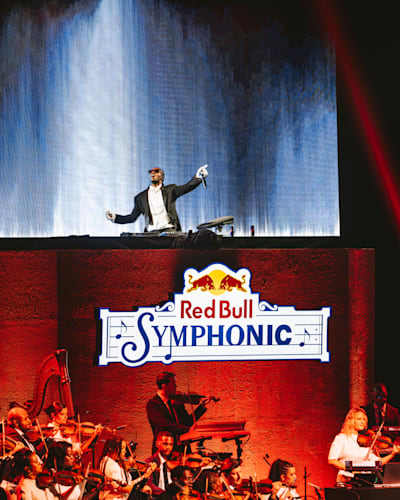
Metro Boomin – Red Bull Symphonic dolby Theatre
For one night only, world famous producer Metro Boomin teamed up with
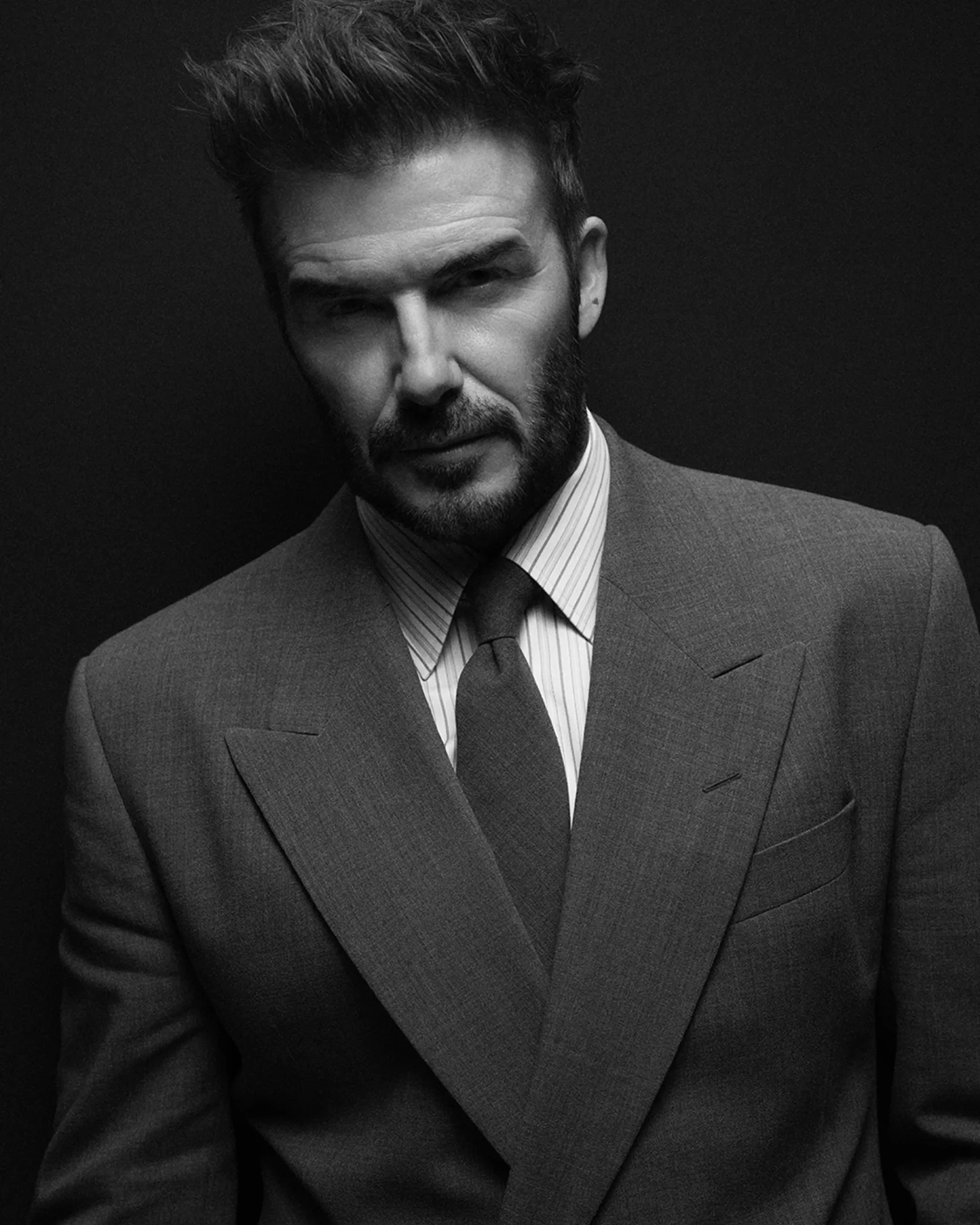
David Beckham to Design Boss Men’s Collections for Spring/Summer 2025 Season
David Beckham to design for Boss
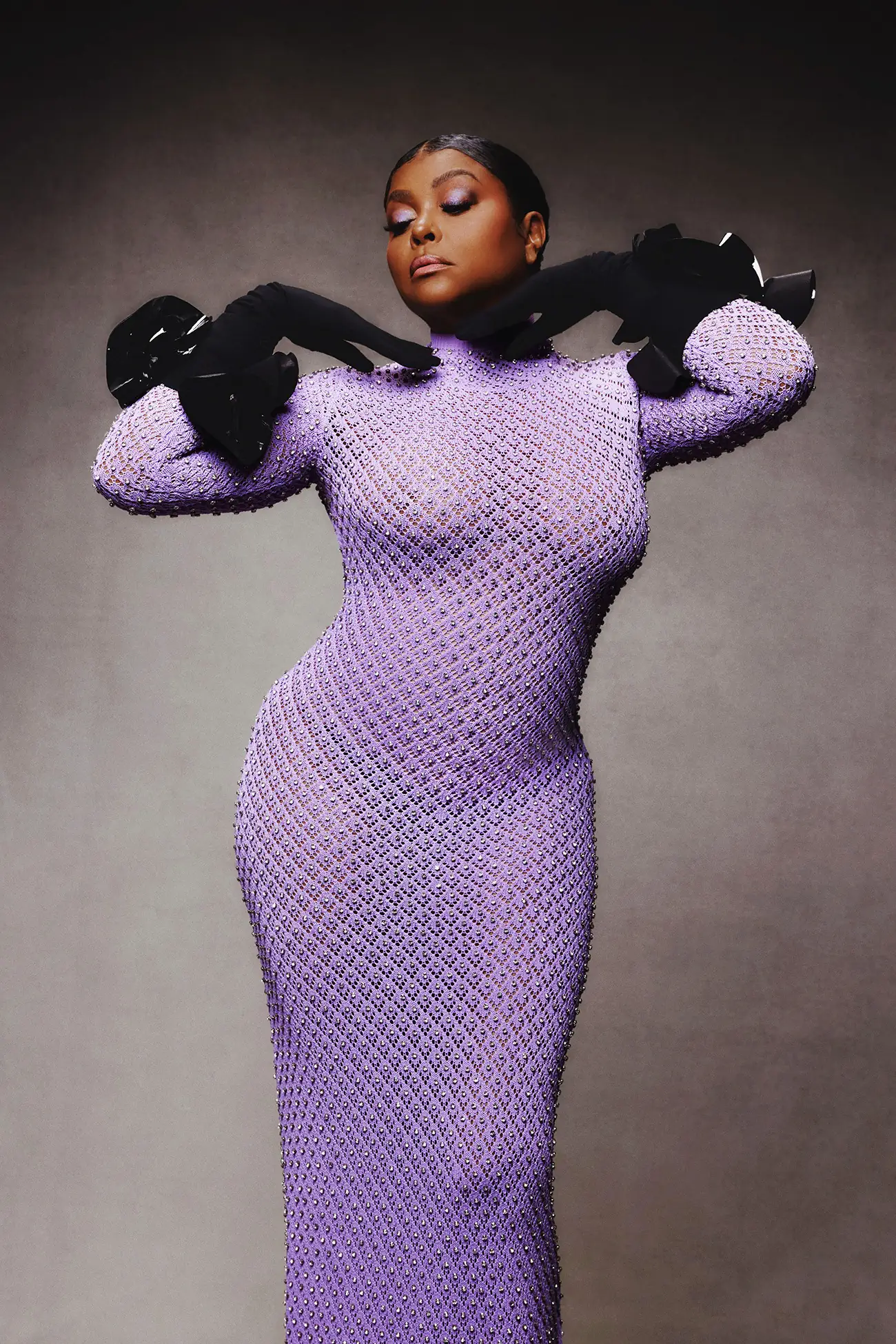
Taraji P. Henson Radiates Elegance and Power on the Cover of Elle Magazine’s January 2024 Issue
Taraji P. Henson takes center stage on the cover of Elle Magazine.
POST COMMENT