

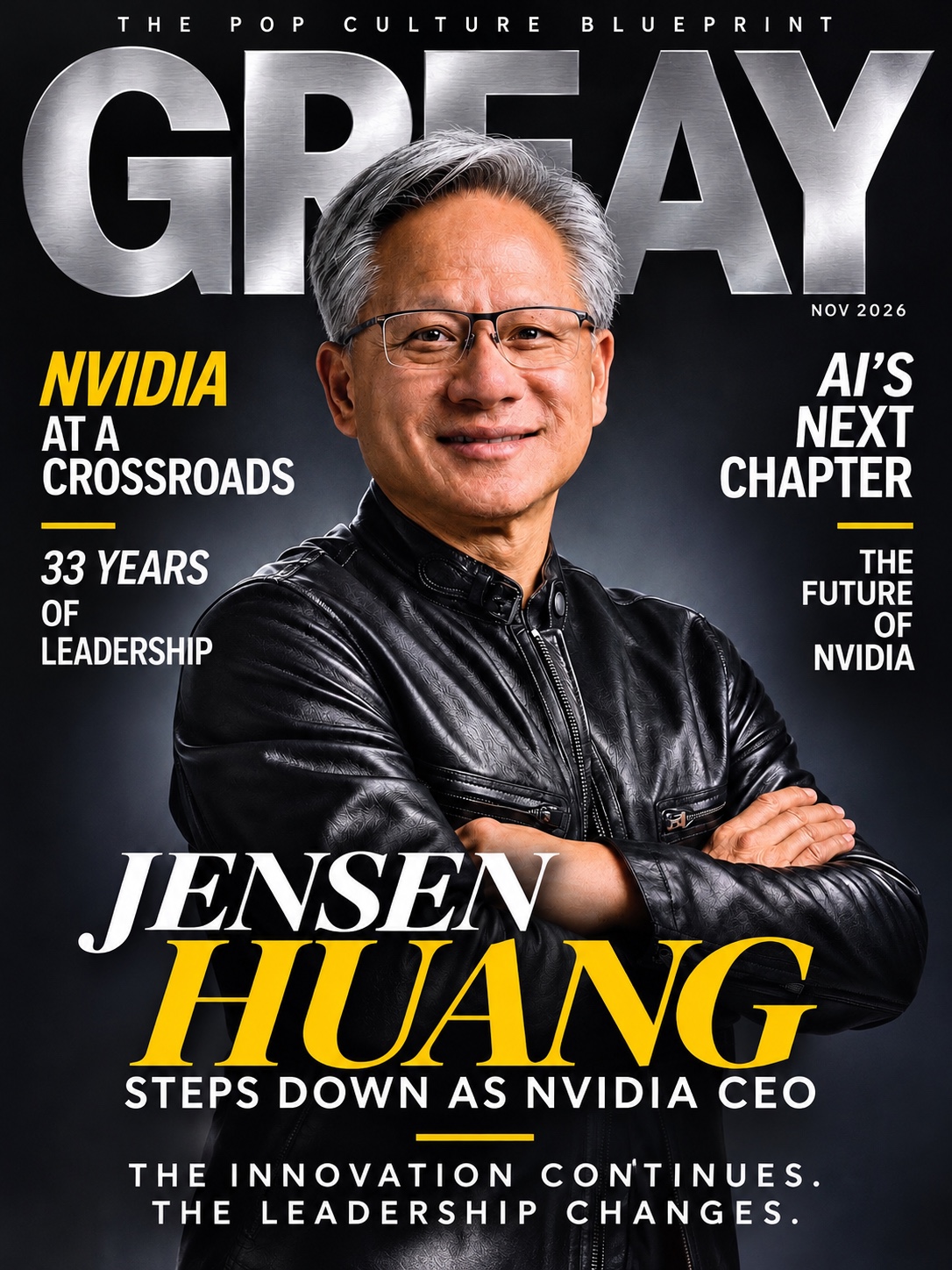
Jensen Huang’s Departure From Nvidia Raises a Defining Question About the Future of AI
By Brian K. Neal
For 33 years, Jensen Huang was more than the chief executive of Nvidia. He was the architect of a company that helped transform how the world computes, moving from the graphics technology that powered video games to the advanced systems now driving artificial intelligence. On November 12, 2026, that chapter came to an abrupt end. Huang resigned as Nvidia’s president and chief executive officer and stepped down from its board of directors, leaving one of the world’s most influential technology companies to confront a future without the person who had led it since its founding.
Nvidia appointed longtime chief financial officer Colette Kress as interim CEO, while its board began searching for a permanent successor. Harvey Jones, a veteran technology executive and longtime board member, assumed the newly established position of board chair. The transition followed days of intense scrutiny surrounding Huang’s personal conduct and concerns about potential national-security exposure. But beyond the circumstances of his departure lies a question with implications far beyond Silicon Valley: can a company so closely identified with one individual preserve its technological leadership, strategic direction, and influence over an industry that has become central to the global economy?
Nvidia’s position in the artificial intelligence industry did not emerge overnight. Founded in 1993, the company initially focused on graphics processing, developing technology that allowed computers to render increasingly complex visual environments. Its graphics processing units became essential to gaming, but their ability to perform large numbers of calculations simultaneously eventually opened opportunities in scientific computing, machine learning, and artificial intelligence. The development of Nvidia’s CUDA software platform further expanded those possibilities, giving researchers and developers tools to use graphics processors for computational tasks far removed from their original purpose.
Huang recognized that accelerated computing could become a foundation for the next generation of technology. As artificial intelligence research advanced, Nvidia’s processors became increasingly important to the training and operation of sophisticated models. The emergence of generative AI accelerated that demand, placing the company at the center of an extraordinary expansion in data centers, cloud infrastructure, and computing investment.
The transformation was not simply about producing faster chips. Nvidia developed an interconnected ecosystem of hardware, software, networking technology, manufacturing partnerships, and relationships with some of the world’s largest technology companies. Its influence expanded into the decisions of cloud providers, AI developers, semiconductor manufacturers, and governments seeking to strengthen their technological capabilities. Huang became the public face of that expansion, known for his product presentations, aggressive investment strategy, and willingness to make long-term commitments before the commercial value of emerging technologies was fully understood.
That history makes the circumstances of his resignation particularly consequential.
The leadership crisis followed reports of two extramarital relationships, including one involving a businesswoman whom U.S. authorities reportedly suspected of connections to Chinese intelligence. A separate report concerned a relationship with an Nvidia executive. Huang publicly acknowledged marital infidelity and apologized to his family and employees, while Nvidia’s board initiated an independent investigation into potential security concerns.
The allegations introduced questions that extended beyond personal conduct. Nvidia operates in an industry where advanced technology, commercial relationships, and national-security interests increasingly overlap. The possibility that a prominent executive could have been targeted by foreign intelligence was therefore a matter of legitimate concern for the company and U.S. authorities. Yet the distinction between suspicion and established wrongdoing remains essential. Public reporting has not established that Huang knowingly participated in espionage, disclosed Nvidia trade secrets, or compromised national security.
The company’s board initially expressed confidence in Huang and his leadership team while the investigation proceeded. Within days, however, the situation had escalated into a leadership crisis. Reuters reported that directors met to consider his future before Nvidia announced his resignation on November 12. The company’s announcement did not provide a specific reason for his departure.
The market reaction demonstrated how closely Nvidia’s financial identity had become associated with its founder. Shares fell sharply as investors considered the implications of a sudden leadership change at a company central to the AI investment cycle. Reuters reported that the stock declined by more than 14 percent at one point during trading, although intraday movements should not be confused with a final closing loss. Competing semiconductor companies, including AMD and Broadcom, attracted attention as investors evaluated whether uncertainty at Nvidia could create new competitive opportunities.
The immediate concern was not that Nvidia’s technology would suddenly lose its value. Its processors, software platforms, engineering teams, customer contracts, and manufacturing relationships remain intact. The deeper concern involved the coordination of those assets and the strategic judgment required to sustain the company’s position as artificial intelligence continues evolving.
Shay Boloor, chief market strategist at Futurum Equities, captured that distinction in comments to Reuters. “I don’t see the next 12 to 18 months of revenue suddenly disappearing if Jensen were to leave,” he said, explaining that the greater concern was the company’s longer-term direction. Huang, Boloor argued, had repeatedly recognized where computing was headed before customers fully understood the opportunities themselves. Replacing that kind of foresight would be an enormous challenge.
That assessment reaches the heart of Nvidia’s succession problem. The company is not simply searching for an executive capable of managing an established semiconductor business. It needs leadership capable of anticipating technological shifts, maintaining complex international partnerships, and deciding where to commit capital in an industry whose future remains both promising and uncertain.
Nvidia’s influence also extends beyond the sale of processors. Under Huang, the company became an active participant in the development of the broader AI economy, supporting infrastructure providers, cultivating strategic partnerships, and helping create commercial conditions in which customers could expand their computing capacity. Those relationships have contributed to the rapid construction of AI infrastructure, but they also require careful financial management and a willingness to accept substantial long-term exposure.
The question facing investors is whether Nvidia’s next leadership team will maintain the same appetite for expansion. A more cautious approach could alter the pace of investment across parts of the AI ecosystem. Continued aggressive investment could preserve momentum but would require confidence in future demand and the financial sustainability of increasingly expensive computing projects. Neither outcome is inevitable, and Nvidia has not announced a fundamental change in its strategy.
The company’s extensive relationships with Asian semiconductor manufacturers introduce another dimension to the transition. Taiwan plays a central role in advanced chip production, while South Korea and other regional suppliers provide critical components used in AI computing systems. Huang cultivated relationships throughout that manufacturing network, frequently visiting partners and emphasizing the importance of expanding capacity to meet demand.
One executive at a Taiwanese supplier told Reuters that the company would continue supporting Nvidia’s manufacturing needs but questioned whether a successor would pursue expansion as aggressively as Huang. The concern reflected the long planning cycles involved in semiconductor production, where decisions about manufacturing capacity, equipment, and supply commitments often precede commercial demand by years.
Neil Shah, vice president of research at Counterpoint Research, similarly warned that Nvidia could become less aggressive in its ecosystem investments and large AI infrastructure agreements without Huang directing those decisions. His assessment was not a prediction that Nvidia would abandon its partners, but a recognition that leadership style can influence the speed and scale of corporate investment.
These relationships also exist within a complicated geopolitical environment. The United States has restricted exports of certain advanced semiconductor technologies to China, while American technology companies continue navigating the commercial importance of international markets. Huang had advocated maintaining access to Chinese customers where permitted, arguing through his business strategy that participation in global markets could help sustain American technological competitiveness.
His departure arrives as policymakers continue debating how to balance commercial interests against national-security concerns. Nvidia’s next CEO will inherit those tensions regardless of the outcome of the investigation surrounding Huang. The company must continue complying with export restrictions while managing relationships with customers, suppliers, and governments whose priorities do not always align.
For Colette Kress, the immediate responsibility is to establish continuity.
Kress joined Nvidia in 2013 after nearly 25 years in financial positions at technology companies including Microsoft and Cisco. During her tenure, she helped oversee the company’s financial transformation as demand for AI computing expanded. Her familiarity with Nvidia’s operations, financial structure, and investor relationships provides an important measure of stability during the transition.
In announcing her appointment, board chair Harvey Jones emphasized that Kress had helped guide Nvidia through extraordinary growth and possessed a deep understanding of its business, customers, and operations. The board also expressed confidence that Nvidia’s experienced leadership team could maintain its customer commitments and technology roadmap without interruption.
Kress’s appointment, however, is explicitly temporary. Nvidia has begun evaluating internal and external candidates for the permanent position, a process that will force the board to consider what kind of leadership the company requires for its next chapter.
An executive drawn from Nvidia’s engineering organization could offer continuity in technical development and product strategy. A candidate with broader operational experience might emphasize governance, international relationships, and the management of a business whose influence now extends far beyond semiconductor design. The company could also seek a leader capable of combining those responsibilities, although finding someone with Huang’s particular combination of technical understanding, commercial instincts, and industry relationships will be difficult.
The succession challenge is intensified by the structure Huang established. His leadership was highly centralized, with an unusually large number of executives reporting directly to him. That arrangement allowed him to remain closely involved in decisions across the organization, but it also raises questions about how responsibilities will be distributed under a different leader.
A company can preserve its technological expertise while changing how decisions are made. Whether Nvidia can accomplish that transition without disrupting its pace of innovation will be one of the most important measures of its next leadership team.
The broader artificial intelligence industry is watching because Nvidia’s influence extends into the economics of nearly every major AI infrastructure investment. Technology companies are committing enormous resources to data centers, specialized computing systems, networking equipment, and energy infrastructure. Those investments depend on expectations that artificial intelligence will become deeply integrated into commercial services, scientific research, manufacturing, and everyday digital life.
Nvidia supplies much of the computing technology supporting those ambitions. Its position gives it substantial influence over product development cycles, infrastructure costs, and the availability of advanced processing capacity. A change in its leadership therefore matters not only to shareholders but also to businesses whose own expansion plans depend on Nvidia’s technology and strategic commitments.
Competitors may see an opportunity in the uncertainty, but Nvidia’s established advantages remain substantial. Its software ecosystem, engineering expertise, manufacturing partnerships, and relationships with major customers cannot be replicated simply because its founder has departed. Companies such as AMD and Broadcom continue competing for a larger role in AI computing, while major cloud providers are developing specialized processors of their own. Those competitive pressures existed before Huang’s resignation and will continue regardless of who becomes Nvidia’s next CEO.
The company’s financial results, scheduled for November 17, will provide an early opportunity to evaluate its operating performance under the new leadership arrangement. Investors will be looking for evidence that customer demand, product development, and commercial commitments remain on course. They will also be listening for indications of how the board intends to manage succession and whether the company’s investment strategy will change.
The results cannot answer every question. The independent investigation remains unresolved, and the permanent leadership structure has yet to be determined. But they will help establish whether Nvidia can maintain confidence during a period of extraordinary corporate uncertainty.
Huang’s legacy presents a complicated distinction between achievement and accountability. His role in transforming Nvidia from a graphics technology company into a central institution of the AI economy is historically significant. The allegations surrounding his personal conduct and the circumstances of his departure are also legitimate matters of public scrutiny, particularly given the responsibilities attached to leading a company whose technology has national-security implications.
Neither dimension erases the other. His contributions to computing remain part of the industry’s history, while the investigation and corporate response must be evaluated according to the evidence that emerges.
For Nvidia, the immediate task is not to reproduce Jensen Huang. It is to demonstrate that the company he built possesses the institutional strength to continue without him. That means maintaining the trust of employees, customers, investors, manufacturing partners, and governments while preserving the technological ambition that helped establish its position.
Artificial intelligence will continue advancing. Data centers will continue operating, researchers will continue developing new models, and companies will continue investing in the computing systems required to support them. Nvidia remains deeply embedded in that infrastructure.
What has changed is the leadership of the company that helped make much of it possible.
For more than three decades, Jensen Huang guided Nvidia through successive transformations in computing, ultimately positioning it at the center of the artificial intelligence era. His departure does not end that era, nor does it determine Nvidia’s future. It introduces a different test of the company’s strength.
Huang built Nvidia into an institution capable of helping shape the future of computing. Its next chapter will reveal whether that institution can sustain his vision without depending on his presence.
Related Posts

diVine Intervention: Jack Dorsey Brings Vine Back to Life—Minus the AI
By Kyra Greene In a move that’s sparking a wave of nostalgia and fut
Balenciaga Races into Need for Speed Mobile with Stylish New Collaboration
Balenciaga has teamed up with Need for Speed Mobile.

Dyson Unveils OnTrac: Its First-Ever Audio-Only Headphones
Dyson Announces OnTrac, Its Debut Audio-Only Headphones.

Sora 2 Launches: How OpenAI Is Reinventing AI-Driven Short Video
When AI Meets Social

Roku Debuts NBA FAST Channel and NBA Zone
Roku is poised to enhance its TV home screens

JBL Unveils Tour PRO 3: The Most Advanced True Wireless Earbuds Yet
JBL Tour PRO 3: leading the next generation of TWS earbuds.
POST COMMENT