

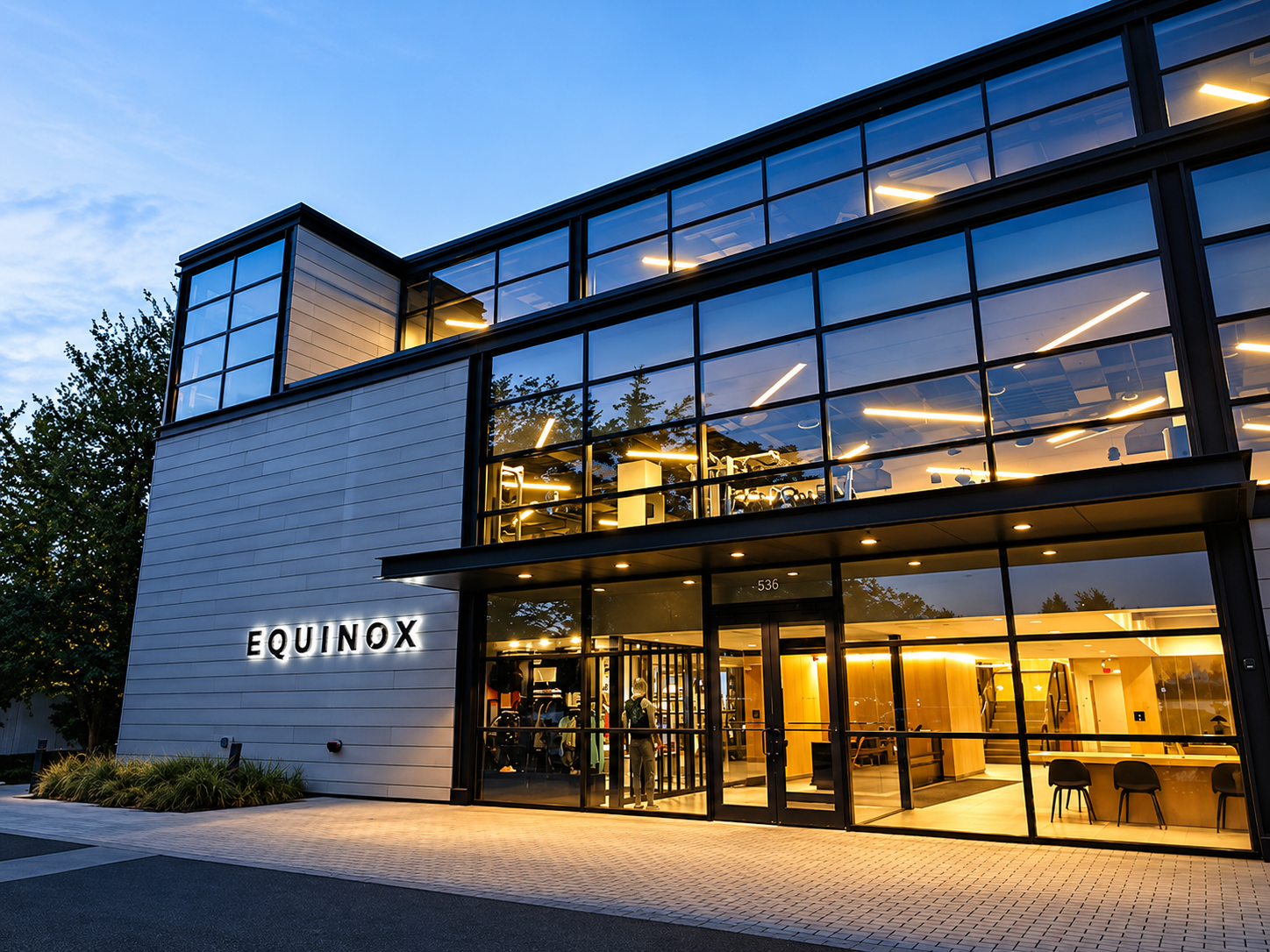
Equinox Is Betting More Than $1 Billion on the Future of Luxury Fitness

By DaMarko GianCarlo
There was a time when the value of a gym membership was measured largely by access. A place to exercise, equipment to use, classes to attend, and perhaps a personal trainer to help establish a routine. Equinox helped change that relationship by building a business around the idea that fitness could be more than a service. It could be an expression of lifestyle, personal ambition, and the experience of belonging to something distinctive.
Now, the company is preparing to test how far that proposition can grow.
Equinox has announced a refinancing and recapitalization intended to support more than $1 billion in planned investments, alongside a leadership transition that places former Anheuser-Busch chief executive Brendan Whitworth at the center of its next phase. Harvey Spevak, who has led the company for more than 25 years, is transitioning to chairman.
The announcement brings together three consequential developments: a new financial structure, a substantial development pipeline, and a leadership change at one of the most recognizable names in premium fitness. Taken together, they suggest a company preparing not simply to open more locations, but to expand the reach of a brand built on exclusivity.
The ambition is significant. So is the challenge.
Equinox reports operating 118 clubs across 18 major markets, with approximately 50 additional clubs in its development pipeline. That pipeline represents a substantial potential expansion of its physical footprint, although planned locations should not be confused with completed openings.
For a company whose identity depends heavily on the experience inside its clubs, expansion introduces a question that cannot be answered by the number of locations alone: Can a luxury business become substantially larger without compromising the qualities that made it desirable in the first place?
The answer will depend on more than demand for fitness.
Equinox’s November announcement describes a financing arrangement involving additional equity from existing investors and the refinancing of debt. The distinction matters. The company is not simply announcing that a new investor has handed it $1 billion to spend. It is reorganizing its capital structure to support a planned investment program.
That financial context is particularly important because this is not Equinox’s first major financing transaction in recent years. In March 2024, the company announced approximately $1.8 billion in financing to refinance existing loans and support its operations and expansion. At that time, Equinox reported 107 operating clubs and a development pipeline exceeding 25 locations.
The comparison illustrates both progress and ambition. Its reported operating footprint has increased to 118 clubs, while the announced pipeline has grown to approximately 50.
Those figures demonstrate a larger development strategy, but they do not establish how quickly every planned location will open or what financial returns the expansion will produce.
The company’s new leadership will be responsible for turning those plans into an operating business.
Whitworth arrives with experience leading large consumer organizations, including Anheuser-Busch, and a background that includes commercial leadership at PepsiCo. His appointment brings an executive whose career has been shaped by brand management, organizational scale, and consumer relationships into a company operating at the premium end of the fitness industry.
In Equinox’s announcement, Whitworth acknowledged the responsibility attached to that positioning.
“I take seriously the responsibility of upholding that standard of excellence and earning our members’ loyalty day in and day out,” he said.
The emphasis on loyalty is particularly relevant.
Unlike a product purchased once and replaced months or years later, a fitness membership depends on a continuing relationship. Customers make recurring decisions about whether the experience justifies the expense, whether the facilities meet expectations, and whether the brand continues to deliver something they consider valuable.
For Equinox, that relationship has historically extended beyond access to exercise equipment. Its clubs combine training, group fitness, design, and hospitality-oriented amenities in an environment intended to feel different from conventional gyms.
The company’s broader wellness offerings have also moved into areas such as personalized health assessments, nutrition, recovery, and longevity-focused services.
Through EQX Optimize, developed with Function Health, Equinox introduced a program combining extensive biomarker testing with personalized training and health-related guidance. The offering reflects a broader strategic direction in which fitness is increasingly presented as one component of a more comprehensive wellness experience.
That evolution carries commercial significance.
A company that provides access to exercise facilities competes primarily on location, equipment, convenience, and price. A company that builds an ecosystem around training, recovery, personal services, and lifestyle can develop a more extensive relationship with its customers.
It also assumes a greater responsibility to deliver consistent value across those experiences.
Equinox is making this investment against a backdrop of substantial participation in the American fitness industry. The Health & Fitness Association reported that 81 million Americans held fitness-facility memberships in 2025, representing 26.1 percent of the population aged six and older.
The figure demonstrates the scale of the market, but it does not mean that every segment of the industry is growing at the same rate.
The association’s fitness traffic research found differences among high-volume, low-price, mid-priced, boutique, and luxury facilities. Luxury locations did not experience the same average visitation growth as some lower-priced segments.
That distinction is essential to understanding Equinox’s strategy.
The company is not necessarily pursuing the largest possible number of members. Its business is built around attracting customers willing to pay for a particular standard of experience. Growth therefore depends not only on the number of people participating in fitness, but also on the number who see sufficient value in premium services to sustain that commitment.
Equinox has reported double-digit revenue growth and record membership activity. Those are company-reported performance indicators, rather than independently disclosed audited financial results, and they provide context for management’s decision to pursue expansion.
The financing also reflects continued interest from institutional investors in the business. Ares Management confirmed its participation in the transaction, including an additional equity investment and the appointment of Jim Miller to Equinox’s board.
The involvement of established financial institutions gives the expansion access to capital, but the presence of investors should not be mistaken for a guarantee of commercial success.
Opening and operating premium fitness clubs requires substantial resources. Locations must be developed, equipped, staffed, and maintained. The experience customers associate with the brand must remain recognizable even as the company enters new markets and expands within existing ones.
That is where the transition from Spevak to Whitworth becomes particularly consequential.
Spevak’s tenure helped establish Equinox as a brand associated with luxury fitness rather than simply another participant in the gym industry. His move to chairman creates a leadership structure in which the company’s existing identity remains represented while operational responsibility shifts to a new chief executive.
In announcing the appointment, Spevak described Whitworth’s understanding of the business.
“Brendan has a deep appreciation for what Equinox represents and a deep understanding of what makes exceptional brands resonate with consumers,” he said.
The statement captures the central tension of the company’s next chapter.
Equinox is seeking to increase its presence while preserving a brand identity that depends on differentiation. Its customers are not simply purchasing access to physical spaces. They are purchasing an experience shaped by service, environment, convenience, and the expectations associated with the Equinox name.
The company must now translate those expectations across a potentially much larger network.
That challenge extends beyond the fitness industry. Luxury hospitality, fashion, and other premium consumer businesses regularly confront the question of how to grow without making their products or experiences feel less distinctive. Expansion can increase reach and revenue opportunities, but scale also creates operational complexity.
For Equinox, the consequences will be visible in everyday details: the quality of instruction, the condition of facilities, the consistency of service, and whether members continue to believe the experience warrants its premium positioning.
The company’s investment also speaks to a broader change in how wellness is being commercialized.
Fitness has increasingly become connected to conversations about longevity, recovery, performance, and the management of personal health. Equinox’s investment in more comprehensive services places the brand within that developing marketplace, where physical exercise intersects with hospitality, technology, and personalized wellness.
Yet there is an important difference between offering more services and demonstrating that those services produce superior outcomes. Equinox’s expansion strategy establishes its commercial ambitions; it does not, by itself, prove that a premium membership delivers better health results than less expensive alternatives.
That distinction does not weaken the business story. It clarifies it.
Equinox is competing to provide a particular experience to consumers who value the combination of fitness, service, and lifestyle. The company’s next phase will test how effectively that experience can be reproduced, how strongly customers respond, and whether the financial structure supporting expansion proves sustainable.
The appointment of Whitworth, the transition of Spevak, and the planned investment program mark a consequential moment in that process.
There is no guarantee that every club in the pipeline will open as envisioned, that every market will respond equally, or that the broader premium wellness industry will continue developing in the same direction.
What is clear is that Equinox has committed to pursuing a substantially larger role within it.
The company helped establish the idea that a gym could represent something beyond exercise. Its next challenge is to determine whether that identity can support a larger business without losing the sense of distinction on which it was built.
More than $1 billion in planned investments gives Equinox the means to pursue that ambition. The next chapter will be measured by what the company builds, how its members respond, and whether its vision of luxury fitness remains compelling at scale.
Related Posts

The Moment Before — Hannah Cheramy: Control, Stillness, and What Registers
Emotion, Delayed

The Cul-de-Sac Grows: Four Join Keke Palmer in Peacock’s The ‘Burbs
New Neighbors Alert

Tyler The Creator Presents LACOSTE X le FLEUR
By Fall Lewis Tyler the Creator’s le FLEUR* and Lacoste have joi

Lin-Manuel Miranda and Eisa Davis to Drop Star-Studded Concept Album Inspired by ‘The Warriors’
Lin-Manuel Miranda and Eisa Davis Collaborate With Nas.

A Spirited Kick-Off: Chivas Regal and Arsenal Unite in a Multi-Year Partnership
CHIVAS REGAL SCORES BIG WITH GLOBAL ARSENAL PARTNERSHIP

Victor Belmondo Named Berluti’s Brand Ambassador for 2025
Victor Belmondo joins Berluti
POST COMMENT