
Instagram Is Making Room for Longer Stories
By Brian K. Neal
For years, Instagram has been a place where audiences discover entertainment in fragments. A revealing exchange from an interview, a comedian’s punchline, a moment from a podcast, or a scene from a documentary can travel through Reels, reaching people who may never have encountered the original production. Watching the rest has often meant leaving Instagram for another platform. Now, the company is testing a way to keep more of that experience in one place.
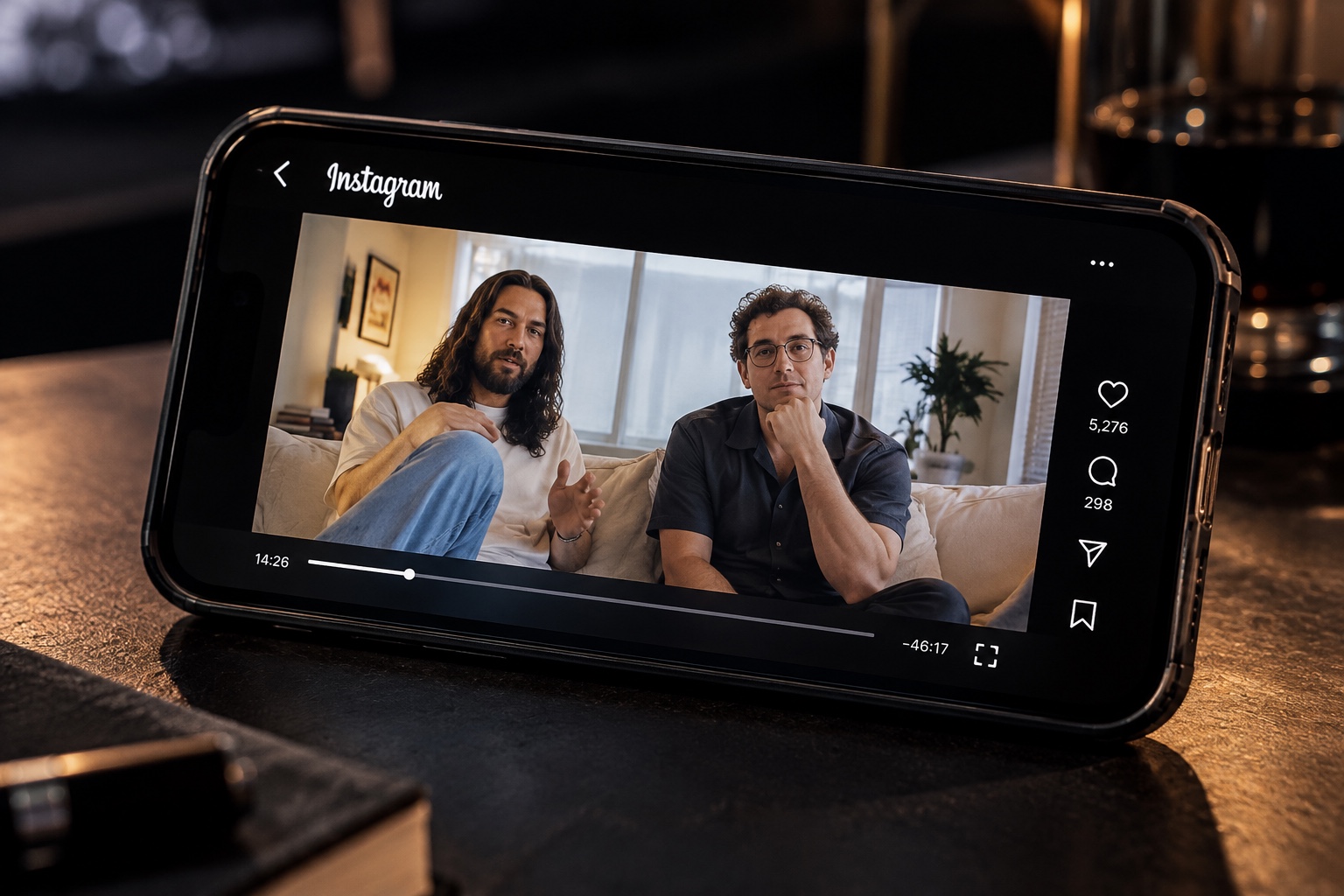
On October 26, Instagram announced Features, a new long-form video format allowing participating creators to publish horizontal videos lasting up to 90 minutes. The initiative, previously tested with creators in Brazil, is expanding to a limited group in the United States. It is part of a broader set of video developments that includes connecting short clips to longer productions, organizing episodic storytelling, improving livestream discovery, and extending Instagram’s presence on television.
The announcement marks a notable adjustment for a platform whose video experience has become closely associated with short, vertically presented content. Instagram is now making room for the kinds of programming audiences commonly encounter on YouTube and other video services: extended interviews, podcasts, comedy specials, documentaries, and creator-produced shows.
Instagram Vice President of Product Tessa Lyons explained the relationship between the company’s existing video experience and its new direction. “Reels is still going to be a core part of Instagram,” she said during an announcement conversation with Instagram head Adam Mosseri. Her explanation positioned longer programming as an extension of the entertainment audiences already discover through the platform, rather than a replacement for its established short-form format.
That distinction is important because the new system is designed to connect two viewing experiences that have often existed separately. A creator might publish a brief excerpt from an hour-long podcast to introduce the conversation to a wider audience. Previously, someone interested in watching the complete episode might have needed to move to YouTube or another destination. With Features, Instagram is testing the ability to host the full production alongside the short clips that introduce it.
One accompanying tool, Clips as Reels, allows creators to connect up to eight short videos to a longer program. The clips serve as entry points to the complete production, giving audiences a direct path from discovering a moment to watching the larger conversation or performance. For creators who already produce long-form programming, this introduces another way to distribute finished work without relying exclusively on external links or separate platforms.
The addition of horizontal viewing is equally significant. Instagram’s Reels experience has largely been shaped by vertical video, a format designed for phones held upright and audiences moving between posts. Features accommodates widescreen programming, making it possible to present productions in the horizontal format commonly used for interviews, documentaries, video podcasts, and television.
A professionally produced podcast lasting 60 minutes, for example, could be presented as a complete horizontal production rather than being limited to short promotional excerpts. Viewers could encounter a moment through Reels and continue into the full program within Instagram. The new format expands the kinds of material the platform can accommodate, although access remains restricted to participating creators during testing.
For Mosseri, the decision represents a reconsideration of an approach he had defended for years.
“For a long time, I have been against doing long-form video on Instagram,” he acknowledged while discussing the announcement.
His previous resistance was rooted in a concern about the relationship between entertainment and social interaction. Instagram’s identity has historically depended not only on people consuming content but also on sharing it, communicating with friends, and participating in the activity surrounding what they watch. Longer viewing sessions could potentially reduce some of those interactions by keeping audiences focused on a single production for an extended period.
The company is now testing whether shorter and longer formats can reinforce one another. Reels can introduce a creator or production, while Features provides room for the complete experience. Rather than requiring audiences to choose between the two formats, Instagram is developing ways for them to operate together.
There is history behind that decision.
In 2018, Instagram introduced IGTV, an initiative intended to establish a destination for longer videos. The product emphasized vertical viewing and included a standalone application, reflecting the company’s mobile-first approach at the time. Instagram eventually discontinued the separate IGTV application in 2022 as it consolidated its video offerings.
Features arrives in a different environment. Reels is now an established part of Instagram’s entertainment experience, and short clips routinely circulate as introductions to longer programs distributed elsewhere. Instagram is building on that existing behavior rather than asking audiences to adopt an entirely separate destination for extended viewing.
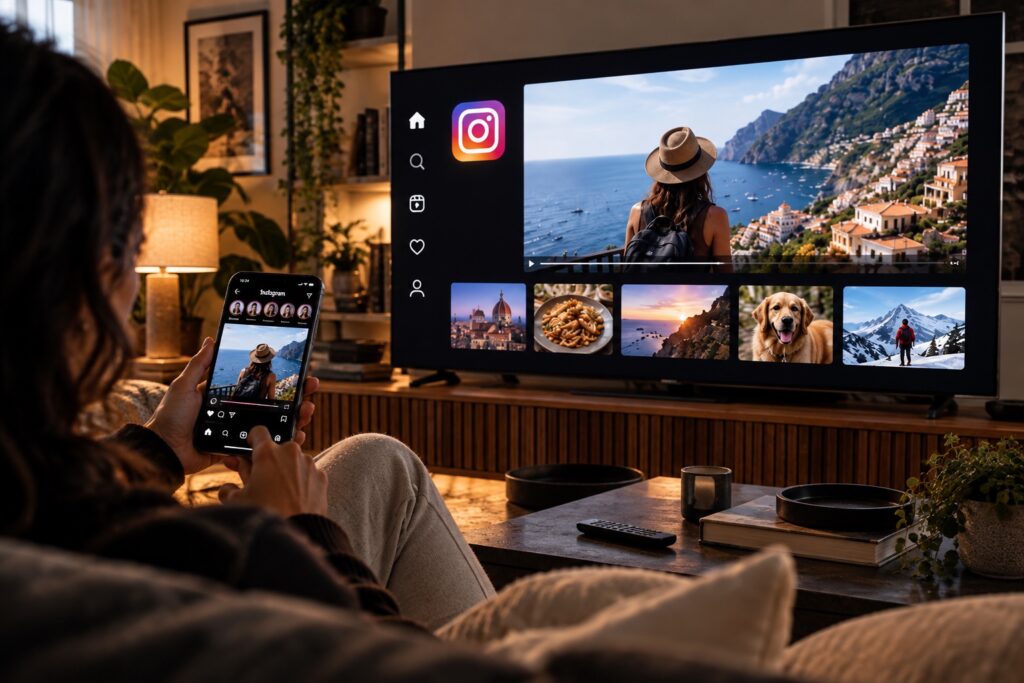
The company is also pursuing a larger television presence. Instagram for TV, initially introduced through Amazon Fire TV, has expanded to additional television platforms, including Samsung televisions, Google TV, and Apple TV in the United States. The experience began with an emphasis on Reels, while Instagram is developing support for a broader range of video formats.
Television introduces another viewing environment for a service traditionally associated with mobile interaction. A short clip encountered on a phone may introduce a production that someone would prefer to watch on a larger screen. Instagram’s television initiative is intended to accommodate more of those experiences, although the company has described its work in that area as early and still developing.
The expansion is occurring alongside changes in how entertainment is produced and distributed. Independent creators, established production companies, podcasters, performers, and media publishers increasingly use the same digital platforms to reach audiences. A professionally produced interview can circulate through short excerpts, full-length video, audio distribution, and social promotion, with each format serving a different purpose.
Instagram’s announcement adds another potential destination for that complete production. It does not require creators to abandon existing distribution channels, nor does it establish that audiences will prefer watching longer programs on Instagram. Instead, the company is testing whether the audience relationships already developed through its platform can support more substantial viewing experiences.
The business model remains an important unresolved part of that effort.
YouTube has an established advertising revenue-sharing system for eligible creators, allowing long-form programming to generate income through advertising alongside memberships, sponsorships, and other arrangements. Instagram offers monetization opportunities of its own, but it has not announced a comparable, broadly available advertising revenue-sharing program specifically for Features.
Instagram has provided direct support to some creators participating in its initial long-form efforts. The company is also exploring how longer programming might generate income through brand relationships, audiences, and platform-supported incentives. Those possibilities have not yet become a permanent financial structure available to all creators.
The distinction matters for productions that require significant resources. A documentary, interview series, or video podcast may involve producers, editors, camera operators, sound technicians, and other professionals whose work extends well beyond the finished recording. Giving those productions another distribution destination is one development. Establishing a sustainable financial model for the people producing them is another.
Mosseri has discussed that challenge in the context of Instagram’s broader creator economy. Speaking on the Colin and Samir Show, he described three principal sources of creator income: “You can get paid by the platform directly, you can get paid by a fan, and you can get paid by a brand.”
His explanation reflects the financial environment into which Features is arriving. Instagram has long been a place where creators develop audiences and commercial relationships, particularly through sponsorships and brand partnerships. Long-form programming may create additional opportunities within that system, but the company has not established how those opportunities will translate into consistent earnings from extended viewing.
The competitive context is difficult to separate from the announcement. YouTube has spent years developing a platform that accommodates everything from short videos to full-length programs, supported by established discovery tools, television applications, and creator monetization. Instagram’s new products introduce some overlapping capabilities, particularly the relationship between short clips and longer videos.
That overlap does not mean the platforms have become interchangeable. Their audience behaviors, recommendation systems, creator economics, and viewing environments remain different. Features gives Instagram a new way to accommodate programming that might otherwise be watched elsewhere, but the company has not demonstrated that the introduction will meaningfully change where audiences choose to spend their time.
Instagram is also testing Series, a feature intended to organize related Reels into episodic collections. The initiative supports serialized short-form storytelling, including recurring narratives and microdramas. Separately, the company is developing improvements intended to make livestreams easier to discover beyond a creator’s existing followers.
These products are at different stages of testing and availability. Together, they illustrate the range of entertainment experiences Instagram is beginning to accommodate, from brief moments and recurring episodes to live broadcasts and extended productions.
For viewers, the most immediate significance of Features is straightforward. A short clip that introduces an interesting conversation may no longer have to function only as a preview for something hosted elsewhere. The complete conversation could be available within the same application, presented in a format more closely aligned with the original production.
For creators, the announcement offers another potential way to reach audiences who already follow their work. Whether that opportunity becomes commercially valuable will depend on factors Instagram has not yet resolved, including broader availability, audience discovery, viewing behavior, and monetization.
The company has announced new capabilities, not the results of their adoption. There is no established evidence yet that Instagram users will routinely watch 90-minute programs, that creators will shift significant portions of their long-form businesses onto the platform, or that the new format will alter YouTube’s position in the entertainment market.
What has changed is the range of experiences Instagram is preparing to support. The platform that helped make short-form discovery a central part of contemporary entertainment is now testing a more direct connection between discovering a story and spending time with the complete production.
For years, Instagram has introduced audiences to conversations, performances, and programs whose full versions often existed somewhere else. With Features, the company is testing whether those experiences can begin and continue in the same place.
The announcement does not establish where audiences will ultimately choose to watch. It establishes that Instagram wants to give them another option.
Editorial verification: This pass incorporates three verbatim leadership quotations, attributed to Tessa Lyons and Adam Mosseri, and preserves the distinction between announced capabilities and unproven outcomes. The quotations and key product details were checked against October 26 reporting from TechCrunch, the Los Angeles Times, and The Verge. TechCrunch+2
Canon assessment: Strong editorial draft, with a clear citizen walk-away and no predictions presented as fact. I would make one final line-editing pass to remove some repeated explanations of short-to-long discovery before publication.
Related Posts

Toshiba’s AX-RP10 Turntable Marries Retro Portability with Modern Wireless Flair
Spin Anywhere: Toshiba’s AX-RP10 is a Vibe on the Go
Lucid Air Goes Full Android: Wireless Auto Integration Arrives
Connected in Style

GIGABYTE Unveils Latest AORUS 17 and AORUS 15 Gaming Laptops Featuring Intel® Core™ Ultra 7 Processors
GIGABYTE introduces the AORUS 17 and AORUS 15 models

Apple and MLB Bring Back ‘Friday Night Baseball’ for 2025 SeasonFans Can Enjoy Weekly Doubleheaders with No Blackouts and Enhanced Coverage
Friday Night Baseball returns to Apple TV+ March 28th

Razer Removes the Desktop’s Advantage
Quiet Hardware, Loud Capability

Fear Refined: Inside Resident Evil Requiem’s Dual-Hero Nightmare
Survival, Style, and Speed
POST COMMENT