

Shakira Built a Pop-Up City in Madrid — And It May Change What a Residency Can Be
By DaMarko GianCarlo
Shakira could have returned to Spain, booked a stadium, performed for tens of thousands of people and left. At her level, that alone would have been an event. Instead, for her Madrid residency, she and Live Nation built somewhere for the audience to go before Shakira ever walks onto the stage.
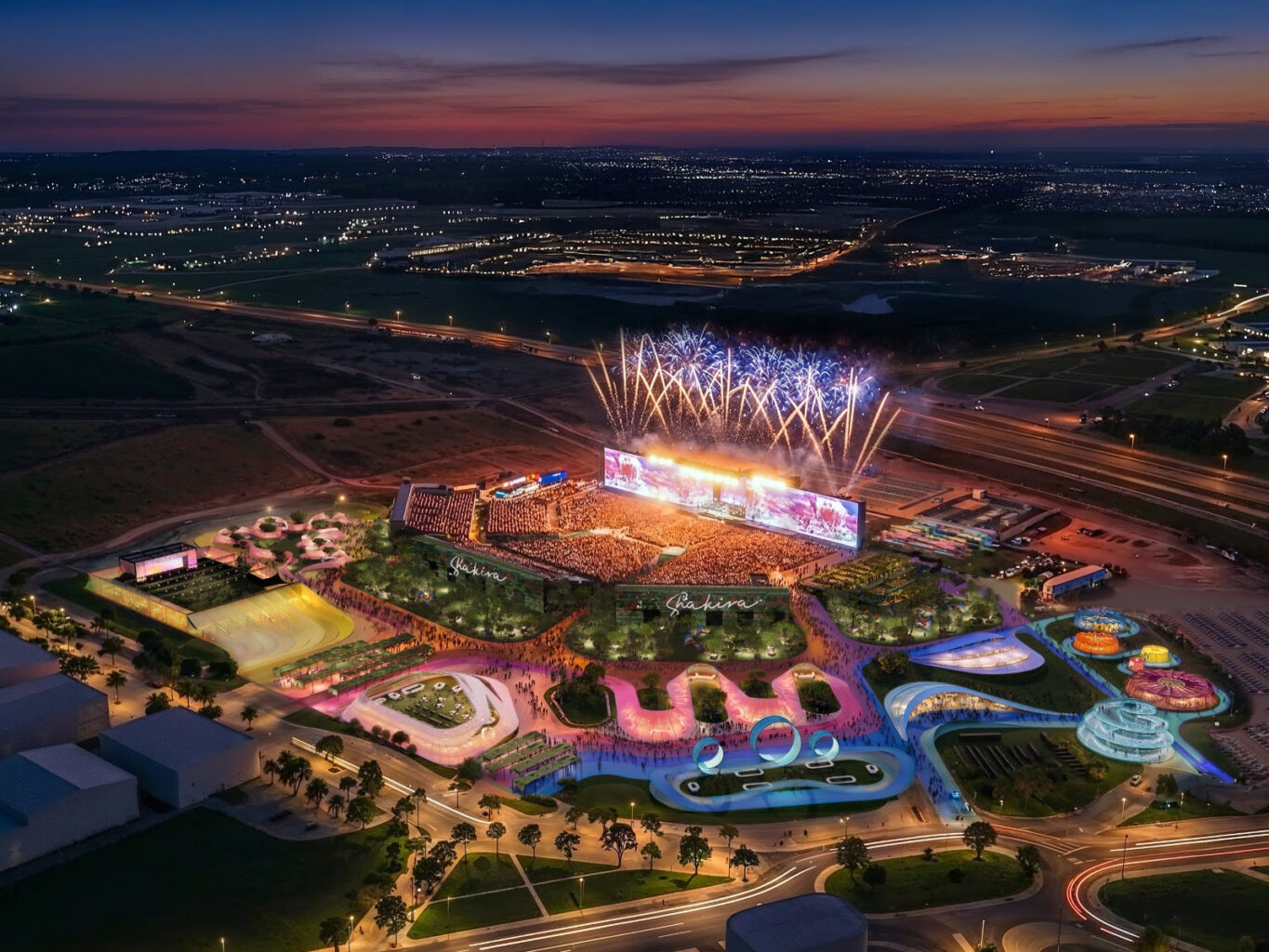
Macondo Park surrounds a temporary stadium created specifically for Shakira’s 12-show Madrid residency, running from September 18 through October 11. Designed by Bjarke Ingels Group with collaborators including Komodo and Vampire, the temporary destination covers roughly 185,000 square meters at Iberdrola Music in Villaverde. The stadium can hold more than 50,000 people a night, while the larger environment extends into spaces devoted to music, fashion, literature, food, art, dance and family programming. Across the residency, roughly 600,000 people are expected to enter a place that did not exist in this form before Shakira arrived.
That makes Macondo Park more interesting than an unusually elaborate concert venue. It represents what can happen when an artist becomes large enough that the world surrounding the performance can become part of the performance itself.
Artists have been moving in this direction for some time. Las Vegas residencies have allowed performers to temporarily reshape existing venues around themselves. ABBA built a dedicated home in London for Voyage. Adele’s Munich residency demonstrated how a purpose-built temporary stadium could turn a limited run of concerts into a destination. More recently, Bad Bunny’s Puerto Rico residency demonstrated the cultural power of creating an immersive world within an existing arena. Shakira takes that idea outside the walls of the building. In Madrid, the destination itself had to be constructed.
The stadium is only the center of it.
Macondo Park takes its name from the fictional town in Gabriel García Márquez’s One Hundred Years of Solitude, but Shakira and her collaborators have translated the idea into a temporary physical environment shaped around her Colombian identity and a broader celebration of Latin culture. There is a library, a market, music spaces, a museum tracing Shakira’s career, a nightlife-inspired Club Loba and Macondito, an area created for children and families. BIG describes the project as an alternative to the traditional stadium model, with spaces intended to remain active before, during and after the concerts.
And then it disappears.
The physical build took shape at extraordinary speed after construction began in August, but Macondo Park was not conceived in a month. The larger project required approximately 16 months of planning and work and involved thousands of people. Once the final residency weekend ends, the temporary structures and landscape elements are scheduled to be dismantled.
That temporary nature may be one of the most consequential parts of what Shakira is testing. An artist does not necessarily need to own permanent real estate to create a destination around their work. For several weeks, existing land can become an artist-specific environment, bring hundreds of thousands of people through it and then return to something else.
But Macondo Park also demonstrates why this model cannot simply be copied by every successful musician.
You have to be big enough.
A project like this requires considerably more than fans willing to buy concert tickets. It requires enough concentrated demand to support 12 stadium-sized performances in one city. It requires a promoter willing to spend months planning an enormous temporary operation. It requires architects, production teams, construction crews, transportation, security, hospitality and cultural programming. And it requires an artist whose name carries enough commercial weight that other companies want to enter the world with them.
Those companies are already there.
Geely Auto became the official car sponsor of the Madrid residency and established a presence inside Macondo Park. Spanish insurer Occident sponsors the residency and lends its name to the music pavilion, where two stages host performances before Shakira’s concerts. Amazon Music is connected to the Shakira museum and is extending the Madrid moment beyond Spain through an October 3 concert livestream, merchandise, exclusive music and additional fan experiences.
Shakira’s own businesses can occupy that environment too. Her hair-care brand ÍSIMA is being introduced in Spain through the fashion pavilion alongside other beauty partners. What would normally exist as separate pieces of an artist’s commercial life — touring, sponsorship, merchandise, beauty, hospitality, content and brand partnerships — can now exist inside the same physical place.
That is where Macondo Park starts looking less like an oversized fan activation and more like an ecosystem.
The audience arrives because of Shakira, but its relationship with her does not have to begin when the lights go down or end when the final song finishes. Fans can eat there, shop there, discover other performers there, walk through Shakira’s history, encounter brands associated with the residency and spend hours inside an environment whose organizing idea is ultimately Shakira herself.
For sponsors, that creates something different as well. Instead of simply placing a logo around a concert, a company can occupy part of the experience surrounding it. The artist’s cultural world becomes commercial space without requiring the entire environment to feel like an advertisement.
There is an important distinction here. Shakira did not personally build a private city in Madrid. Live Nation Spain produces the residency. BIG and its collaborators designed the environment. Iberdrola Music provides the site. Sponsors and commercial partners participate throughout it. Thousands of people were required to turn the idea into a physical place.
But that may actually be the point.
The opportunity is not necessarily for the world’s biggest musicians to become property developers. It is for the live entertainment business to recognize that, for a very small class of artists, the audience surrounding them can become large enough to justify temporarily building something much bigger than a stage.
That is also where Shakira’s experiment separates itself from some of the immersive residencies that came before it.
Bad Bunny demonstrated how completely an artist can bring an audience into their culture by transforming the environment inside an existing arena. Shakira is asking a slightly different question: what happens when the artist’s world no longer has to stop at the walls of the venue?
The answer in Madrid is a temporary city.
Adele helped demonstrate that hundreds of thousands of people would travel to a purpose-built destination for a limited residency. Shakira is testing how much further that destination can expand when the artist’s culture, businesses, partnerships and community are allowed to occupy the space surrounding the concert itself.
There are limits to what Macondo Park proves. Twelve concerts in Madrid do not establish that temporary artist cities will become the next standard for touring. The economics have not been publicly disclosed in enough detail to know how easily the model could be reproduced elsewhere. And the enormous audience required immediately limits the number of artists for whom an undertaking like this would make sense.
But that limitation is part of the story.
Macondo Park is not evidence that every artist can build a city.
It is evidence of what becomes possible when an artist’s audience is large enough to function like one.
For decades, touring has largely been built around artists entering spaces that already existed. Stadiums. Arenas. Theaters. Festivals. The artist temporarily transformed the room, and when the night ended, the building returned to whatever it had been before.
In Madrid, Shakira has reversed that relationship.
For four weekends, the venue is entering her world.
Related Posts

Chameleon Unveils Upcoming Cold-Brew Coffee Varieties Inspired by Girl Scout Cookie™ Flavors
Chameleon Organic Coffee®, renowned for its consciously crafted bottl

Netflix Is Expanding Its Kids’ Worlds Beyond the Shows
Where Kids’ Stories Keep Growing

Dressing the Algorithm: How Wisdom Kaye Rewired Fashion Authority
Influence Scales. Authority Stabilizes
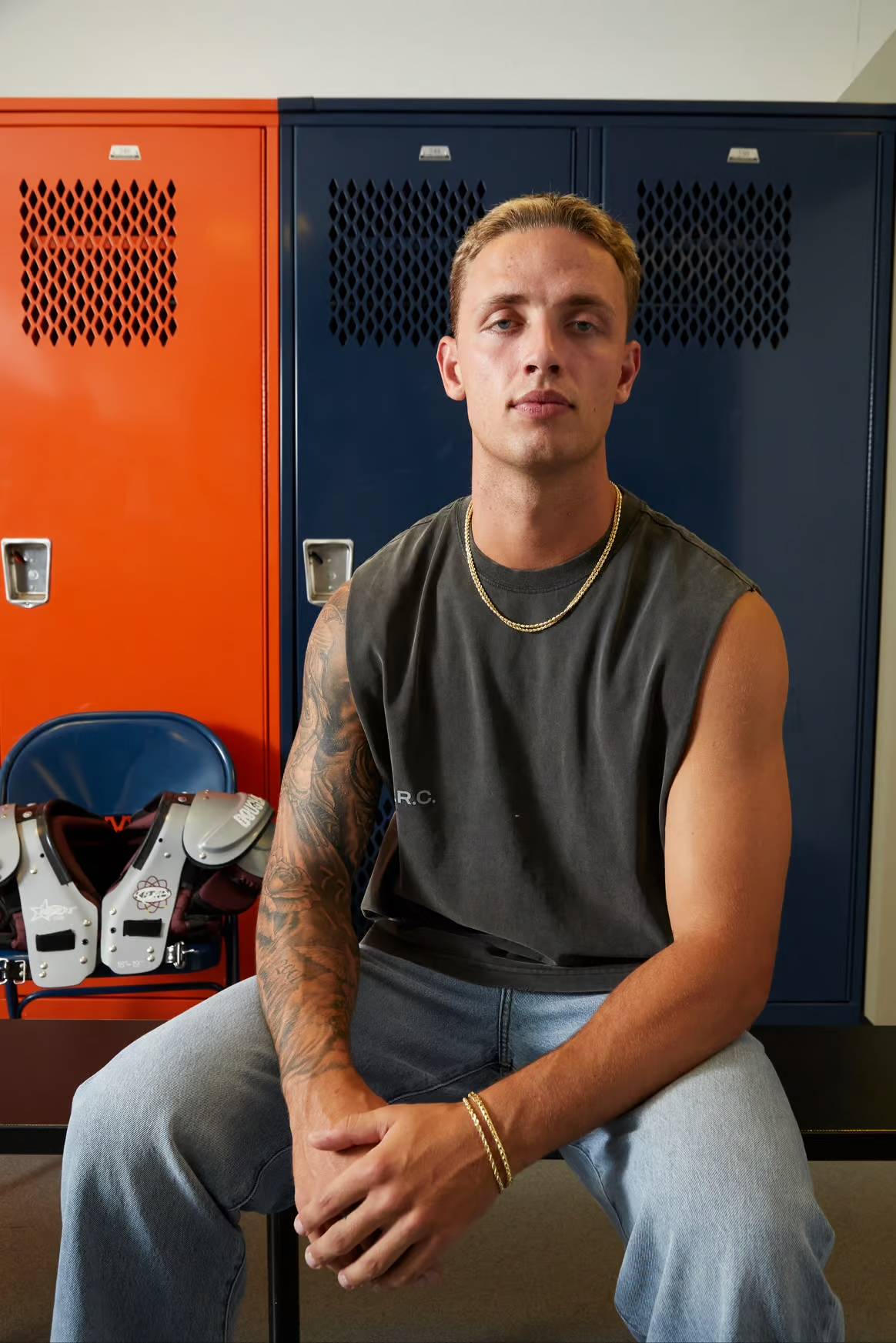
Pacsun Launches ‘A.R.C.’: The Ultimate Men’s Activewear Line for Gen Z
Pacsun unveils first dedicated men’s activewear line.
Messi Forever: Inter Miami’s Crown Jewel Extends Through 2028
The Miami Era Continues
POST COMMENT