

Sony Is Leaving CES as Entertainment Moves to the Center
By Brian K. Neal
For nearly sixty years, Sony and CES belonged to the same story. Sony’s products appeared at the inaugural Consumer Electronics Show in 1967, beginning a relationship that followed the company through generations of televisions, cameras, audio equipment, gaming hardware and technologies that helped define what consumer electronics could become. When CES returns to Las Vegas in January 2027, that relationship will change. Neither Sony nor its affiliates plans to exhibit, ending a presence stretching back to the beginning of the show. Sony confirmed the decision after it was first reported by Nikkei.
The absence matters because Sony is not walking away from technology. What has changed is the position technology occupies inside the larger Sony story.
For much of its history, Sony could arrive at CES and allow its products to explain its ambitions. A new television could demonstrate where displays were going. A camera could reveal what was becoming possible with imaging. Audio products could change how people listened to music. Hardware was not simply part of Sony’s identity; for generations, hardware was one of the clearest ways the public understood Sony.
That Sony still exists. But it is no longer the entire picture.
Sony has spent years moving entertainment, intellectual property and creation technology closer to the center of its corporate strategy. President and CEO Hiroki Totoki described a series of strategic decisions as reflecting “the ongoing evolution of Sony Group’s business direction towards entertainment, IP and creation technology.” Sony’s Creative Entertainment Vision similarly positions technology as a way to empower creators, connect them with audiences and increase the value and reach of intellectual property.
The numbers make that evolution visible. Entertainment represented approximately 30 percent of Sony Group’s consolidated sales in fiscal 2012. By fiscal 2025, it represented approximately 67 percent. PlayStation connects Sony to more than 125 million monthly active users, while Crunchyroll surpassed 21 million paid subscribers by the end of March 2026. Sony has continued investing across games, music and anime while expanding its ownership of intellectual property, including increasing its stake in Peanuts Holdings.
That is why entertainment moving to the center is bigger than an explanation constructed around Sony leaving a trade show. The transformation was already happening.
And it has changed what Sony can be.
A game does not have to remain a game. A character can move into television or film. Anime can travel through streaming, theatrical distribution, games, merchandise and global fan communities. Music can function not only as a recording business but as a library of intellectual property capable of generating value across decades. Sony Pictures, Sony Music, PlayStation and Crunchyroll occupy different parts of culture, but increasingly they can operate within the same larger system.
Technology remains essential to that system.
Sony continues developing image sensors, artificial intelligence, production technology and tools for creators. That makes the company’s transformation more nuanced than Sony simply moving from technology into entertainment. Sony is increasingly positioning technology and entertainment to work together, with its engineering capabilities helping creators make things and its entertainment businesses giving those creations places to live, travel and grow.
That distinction may be the most important part of the shift.
For generations, entertainment helped Sony demonstrate what its technology could do. Increasingly, technology helps Sony create, distribute and expand its entertainment.
Seen through that architecture, leaving CES begins to mean something different.
Sony has not described its departure as a rejection of CES. Explaining the company’s approach to events, a Sony spokesperson told Bloomberg, “We continuously and strategically evaluate our approach to events and communications based on the needs and priorities of our diverse business.” Sony also pointed to its evolving focus on entertainment, intellectual property and technology geared toward supporting creators.
That distinction matters because there is an easy version of this story that the evidence does not support. Sony has not said CES is becoming irrelevant. It has not said consumer electronics no longer matter. And it has not said its entertainment strategy caused the company to leave CES.
The actual play is more precise.
Sony’s relationship with CES is changing at the same time Sony’s center of gravity is changing.
There were already signs of that separation. Sony did not operate its own booth at CES 2026, although Sony Honda Mobility maintained an AFEELA presence on the exhibition floor. CES 2027 takes that separation further: neither Sony nor its affiliates plans to exhibit.
And CES keeps going.
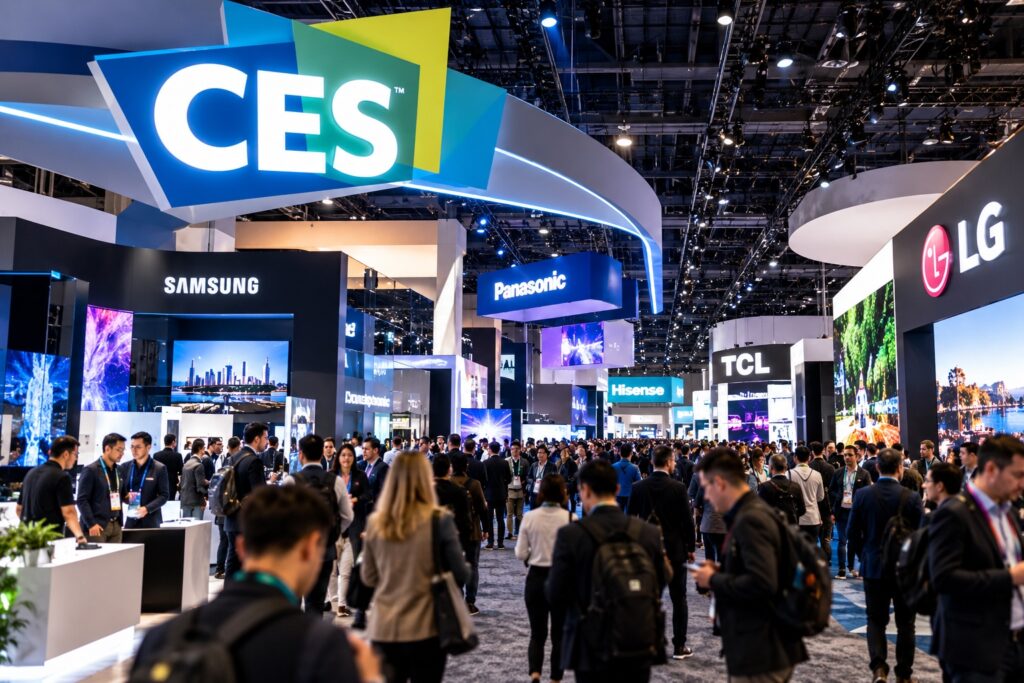
The aisles will fill. Companies will introduce products. Screens will illuminate booths. Executives, engineers, journalists and buyers will move through the convention floor. One of technology’s largest annual gatherings will continue doing what it was built to do.
Sony simply will not be part of that floor.
That is why Sony’s departure should not be understood as one institution winning and another losing. CES remains a major global stage for technology. Sony remains deeply invested in technology. What has changed is the architecture around that technology and the businesses Sony increasingly places beside it.
Companies rarely become something different through a single announcement. Their identities change gradually through acquisitions, investments, divestitures, reorganizations and decisions about where their attention belongs. Eventually, enough of those decisions accumulate that the new architecture becomes visible.
Sony has spent years assembling that picture: games, music, film, television, anime, intellectual property, creators and technology connecting all of them.
For nearly sixty years, CES provided one of the biggest stages in the world for Sony to show people what it was building.
For the first time, Sony’s decision not to be there makes it easier to see what Sony has been building instead.
Related Posts
LG gram at CES 2026: AI-Driven Mobility Without the Weight
Beyond Thin and Light

Step into the Future: Nike and EA SPORTS Join Forces in FC 25’s Futuristic Stadium Experience
Nike and EA SPORTS Team up to Create New Air Zoom Arena.

Saudi Arabia’s Ambitious Leap into the Gaming Industry: A Vision for Powerhouse Status
In recent years, Saudi Arabia has set its sights on becoming a formida
From Mars to Medieval: DOOM: The Dark Ages Reinvents the Slayer Saga
The Dark Ages of DOOM
The Phenomenal Success of Minecraft: Over 300 Million Copies Sold Worldwide
By DaMarko Webster Minecraft, the sandbox video game created by Markus

Unveiling the Galaxy Book4 Series: A New Standard of Intelligence and Power in the Galaxy Book Lineup
Samsung Electronics Co., Ltd. has unveiled its most advanced PC lineup
POST COMMENT