

Ford Is Betting the Fathom Can Make Electric Vehicles Mainstream

By DaMarko Webster
Ford has already proved it can build an electric vehicle people recognize. The Mustang Mach-E translated one of the company’s most familiar names into an electric crossover. The F-150 Lightning took America’s defining pickup and made it electric. The Fathom is attempting something harder: making the fact that a vehicle is electric matter less.
Ford’s new midsize electric pickup is expected to begin reaching customers in 2027, with a starting MSRP of $28,350 before destination and delivery. It will be the first vehicle built on Ford’s Universal EV Platform, a new architecture designed around smaller, more affordable electric vehicles. The Fathom will seat five and combine a traditional pickup bed with a front trunk, while offering features including bidirectional power, digital key, Apple CarPlay and Android Auto compatibility, and hardware supporting Ford’s next generation of BlueCruise.
Those specifications make the Fathom interesting. The number Ford reportedly wants to build makes it consequential.
The Wall Street Journal reports that Ford is targeting more than 100,000 Fathom sales during its first year of production. Ford has not publicly confirmed that volume forecast, so the distinction matters: 100,000 is a reported internal ambition rather than a promise from the company. But reaching it would put the Fathom in territory that no individual EV model outside Tesla has reached in the United States.
That ambition arrives after Ford learned an expensive lesson from the first phase of the EV transition. Building a compelling electric vehicle and building a profitable electric-vehicle business are not the same thing.
Ford changed significant parts of its EV strategy in late 2025, ending production of the current-generation F-150 Lightning and stepping away from some larger electric-vehicle programs as it confronted high costs and softer-than-anticipated demand. The company redirected its North American pure-EV strategy around the Universal EV Platform and says its Model e operation now has a path toward profitability in 2029.
The Fathom is the physical expression of that reset.
What makes it different is not simply that Ford intends to sell an electric pickup for around $30,000. Ford has redesigned the manufacturing system around the economics required to make that price possible.
Ford is spending roughly $2 billion transforming its Louisville Assembly Plant for Fathom production. The change is significant enough that Ford says the three-million-square-foot factory was effectively emptied as the old production system was removed and the new one installed. The plant that emerges will operate around what Ford calls its Universal EV Production System.
At its center is an idea Ford describes as an “assembly tree.”
Traditional automobile production largely follows a long sequential line. Ford’s new approach separates the Fathom into three major assemblies — the front, rear and structural battery — that can be worked on simultaneously before coming together. Large aluminum castings replace numerous smaller stamped and welded components, while the structural battery becomes part of the floor of the vehicle itself.
The changes can sound like manufacturing minutiae until they are translated into what Ford is actually trying to accomplish.
Ford says the Fathom’s wiring harness is more than 4,000 feet shorter and 22 pounds lighter than the harness in its first-generation electric SUV. The company says its new process reduces workers reaching over the fender by 84 percent. Fathom assembly can initially move 40 percent faster than Louisville’s previous production system; after Ford reinvests some of that advantage into additional automation and quality processes, it expects a net 15 percent improvement in assembly time.
Those are not merely factory statistics. They are part of the price printed on the window.
Every component Ford can eliminate is something it no longer has to source, transport, install and inspect. Every unnecessary production operation consumes time and money. Every simplification that occurs inside Louisville creates another opportunity to remove cost before the Fathom reaches a dealership.
Ford is not trying to discount its way into an affordable EV. It is trying to engineer affordability into the architecture of the vehicle.
That distinction may ultimately matter more than the Fathom itself.
The first era of modern electric vehicles was largely about proving what the technology could do. Range increased. Acceleration became extraordinary. Screens became larger. Software became more important. Electric vehicles increasingly demonstrated that abandoning an internal-combustion engine did not require accepting a lesser automobile.
But capability often came with price.
That created a strange point in the EV transition: manufacturers became increasingly good at building electric vehicles while millions of ordinary buyers still had perfectly rational reasons not to purchase one.
The Fathom approaches that problem from the opposite direction. Instead of asking consumers to stretch toward the technology, Ford is attempting to bring the economics of the technology closer to the consumer.
That is why its reported 100,000-unit target matters so much.
Ford does not appear to be designing the Fathom to occupy a protected corner of its lineup. One hundred thousand vehicles requires something broader. It requires people who may never have described themselves as EV buyers. It requires households comparing a Fathom with gasoline and hybrid vehicles based on price, usefulness and monthly payment rather than ideology about what powers the wheels.
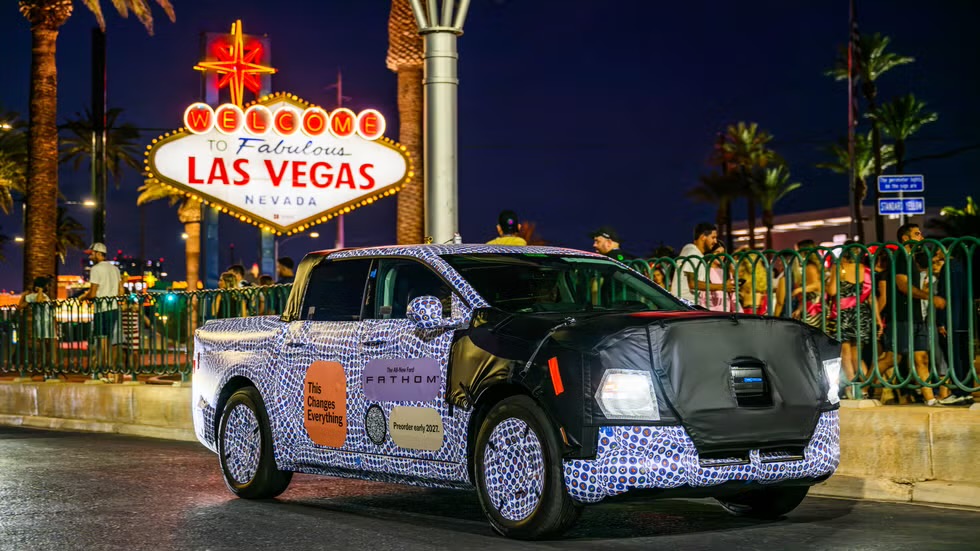
The photographs Ford has released capture that transition almost perfectly.
The Fathom is still covered in camouflage. Prototypes photographed during Nevada testing carry patterned wraps across their bodies and heavy coverings over their front ends. Ford has driven them through Las Vegas with the Fathom name plainly visible while deliberately keeping much of the finished vehicle hidden.
It is an unusual image for a vehicle carrying such an enormous expectation.
But perhaps it is the right one.
Because the most important parts of Ford’s Fathom strategy cannot be seen in a photograph anyway. They are inside the battery architecture, in the number of pieces Ford has eliminated, in the way three sections of a vehicle move through a factory and in a Louisville plant being rebuilt around an entirely different theory of automobile production.
And none of that guarantees success.
A factory can manufacture a vehicle more efficiently. It cannot manufacture demand. A $30,000 price can remove one of the largest barriers to EV ownership without eliminating concerns about charging, range, depreciation or whether someone simply prefers a gasoline or hybrid vehicle. And Ford wanting to sell 100,000 Fathoms is very different from 100,000 customers deciding to buy one.
That uncertainty is what makes the Fathom worth watching.
The F-150 Lightning asked whether Ford could turn its most important pickup into an electric vehicle. Ford answered that question.
The Fathom asks something much more consequential: Can Ford make an electric vehicle ordinary?
If Ford reaches its reported 100,000-unit ambition, the accomplishment will not simply be that the company built a successful electric pickup. It could demonstrate that the next stage of EV adoption does not require consumers to become more enthusiastic about electric vehicles at all.
Ford may simply have to make the decision easier.
Because the moment an electric vehicle can compete on price, usefulness and familiarity without requiring the customer to pay a premium for participating in the future, the technology begins to disappear into the product.
And that may be the point when an electric vehicle finally becomes just a vehicle.
Related Posts

ViewSonic Unveils High-Performance XG36 Series Monitors for Competitive Gamers
ViewSonic Launches the New XG36 Series Monitors.

Gen Z Icons TOMORROW X TOGETHER Announce First-Ever VR Concert ‘HYPERFOCUS’
TOMORROW X TOGETHER Embark On Groundbreaking K-Pop VR Concert

ASUS ROG Announces Global Launch Date for ROG Phone 9 Series
ASUS ROG Phone 9 Series AI On Game ON.

amazon unveils its latest breakthrough in artificial intelligence with the introduction of the advanced second-generation AI chip, Tranium2
Amazon unveils its latest breakthrough in artificial intelligence with

Game Mode: Activated — The REDMAGIC 10S Pro Is a Console in Your Pocket
The Future of Mobile Gaming Looks Like This

United Airlines Brings Apple TV+ Originals to the Skies with Largest Seatback Screens in the U.S.
Streaming in the Stratosphere
POST COMMENT