
YouTube Is Building the Prestige Layer of the Creator Economy
By Rick Olkin
For most of YouTube’s history, Hollywood understood the platform as the beginning of a career.
A filmmaker uploaded a short. A comedian built an audience. A personality accumulated millions of subscribers. And if that person became successful enough, traditional entertainment might eventually call.
The hierarchy was understood even when nobody said it aloud.
YouTube could make you famous. Hollywood could make you legitimate.
Twenty years after YouTube launched, that hierarchy is becoming considerably harder to defend.
On September 10, opening day of the Toronto International Film Festival, YouTube and Variety will launch the inaugural Variety x YouTube Creator Festival. The program will showcase creator-led work from Ziwe and wildlife filmmaker Mark Vins, including Vins’ feature-length Reef to Ridge and new episodes of Ziwe’s You’d Be an Iconic Guest. The projects will subsequently live as YouTube exclusives.
At first glance, this looks like another example of creator culture entering Hollywood.
The more consequential interpretation runs in the opposite direction.
YouTube is beginning to bring the institutions, rituals and language of traditional entertainment back toward an ecosystem that already possesses something Hollywood desperately needs: enormous, direct and habitual audience attention.
TIFF is not the beginning of that strategy. It is evidence of how far it has progressed.
YouTube no longer needs to prove that people will watch. According to CEO Neal Mohan, YouTube has ranked first in U.S. streaming watch time for nearly three years. Globally, viewers watch more than one billion hours of YouTube on television sets every day, and TV has surpassed mobile as the primary device for YouTube viewing in the United States by watch time.
That television screen changes the context around everything YouTube is doing.
For years, the physical differences between watching YouTube and watching television helped preserve the industry’s psychological distinction between the two. Television happened on the largest screen in the house. YouTube happened on a laptop or phone.
That distinction is disappearing.
When millions of people sit on their couches and watch YouTube on the same screen where they watch Netflix, HBO Max, Disney+ and broadcast television, the difference becomes less about how audiences experience the programming and increasingly about what the entertainment industry chooses to call it.
YouTube has recognized that shift and is designing around it.
Creators can increasingly organize episodic programming into seasons and shows. The company has emphasized television viewing as a major growth area. And the number of channels earning at least six figures annually from television screens increased more than 45 percent year over year through June 2025.
The platform is not simply putting internet videos onto televisions.
It is creating an environment in which creator programming can increasingly behave like television.
The creators are evolving alongside it.
The old image of a YouTuber working alone in a bedroom still exists, and that accessibility remains essential to what makes YouTube different. But it no longer adequately describes the upper end of the creator economy.
Some creators now operate production companies. They employ staffs, build studios, develop recurring formats, produce documentaries, talk shows and competition series, own intellectual property and reach audiences that would be extraordinary by conventional television standards.
Mohan has increasingly described creators not merely as personalities but as the new studios.
That language reveals something important about YouTube’s strategy because the company has already tried moving toward Hollywood another way.
YouTube Red and the later YouTube Originals strategy placed YouTube closer to the conventional streaming model. The company financed premium programming, worked with established talent and commissioned shows in an attempt to compete more directly within an entertainment system being reshaped by Netflix and other streaming services.
YouTube eventually moved away from most of that original-programming strategy.
What is emerging now is almost the inverse.
Instead of turning YouTube into another Hollywood studio, YouTube can allow its most sophisticated creators to become studios themselves.
That difference is fundamental.
Traditional television was built around scarcity. There were only so many broadcast hours, cable channels, movie screens and opportunities for mass distribution. The institutions controlling those channels accumulated extraordinary power because reaching a large audience required access to them.
YouTube was built around abundance.
Anyone could publish.
That democratized distribution on an extraordinary scale, but it did not democratize everything surrounding entertainment.
Because distribution and prestige are not the same thing.
Traditional film and television developed an enormous secondary architecture around their programming: film festivals, awards organizations, critics, guilds, premieres, trade publications, markets, red carpets and industry institutions.
Those systems do more than celebrate successful entertainment.
They tell the culture what deserves to be taken seriously.
A film premiering at TIFF arrives with a different cultural signal than a video appearing in an algorithmic feed. An Emmy nomination can reposition a television series inside the industry. A festival screening can place a filmmaker in front of financiers, distributors, journalists and programmers who can materially change the future of a project.
YouTube democratized the ability to reach an audience.
It did not inherit the institutions that historically transformed audience attention into cultural authority.
That is the missing layer.
And increasingly, YouTube appears to be building it.
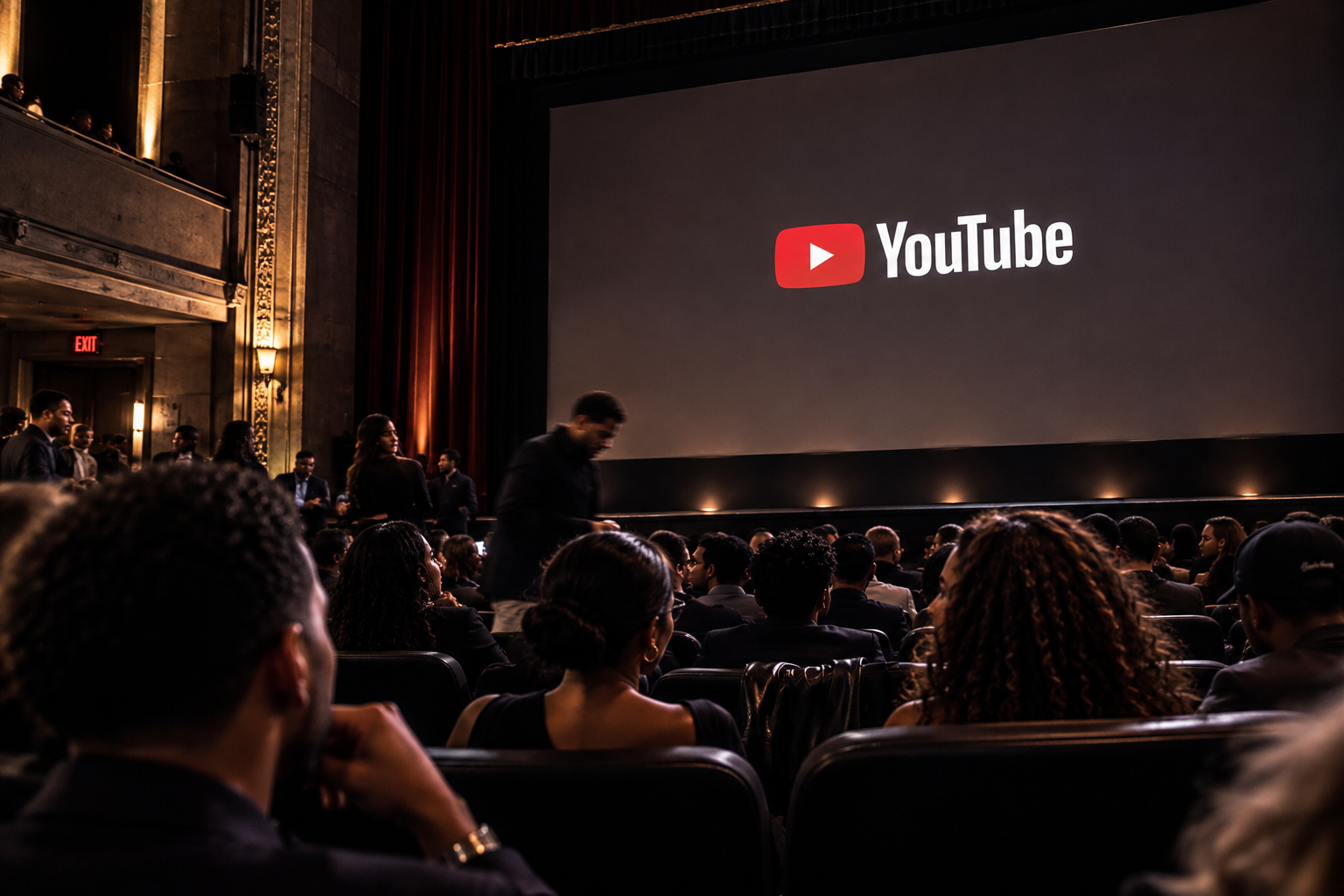
In November 2025, YouTube held its first Creator Premieres at Metrograph in New York, presenting creator programming inside a theatrical environment using many of the conventions historically associated with film and television premieres. The company explicitly framed the event around the changing definition of prestige entertainment.
Then came Brandcast.
YouTube used its 2026 presentation to advertisers to unveil an expanding slate of creator-led shows spanning competition formats, documentaries, talk programming and other categories that would be completely recognizable on a conventional television programming schedule. Projects connected to creators and personalities including Dude Perfect, Alex Cooper, Quen Blackwell, Kareem Rahma and Trevor Noah extend the strategy into 2027.
Even where YouTube presents that programming matters.
Brandcast operates during the television industry’s traditional upfront season, when networks have historically presented their programming to advertisers and competed for billions of dollars in marketing commitments.
YouTube is not standing outside television asking to be invited in.
It is increasingly operating inside television’s commercial calendar while arguing that creator programming belongs in the same conversation.
TIFF extends that argument from commercial legitimacy into cultural legitimacy.
And the timing is particularly revealing.
TIFF itself is expanding beyond the traditional conception of a film festival. Its new TIFF: The Market initiative creates a formal marketplace around screen projects, intellectual property and entertainment business activity across platforms.
YouTube is therefore entering TIFF at precisely the moment the festival is expanding the definition of the screen business surrounding it.
But the most important part of the YouTube Creator Festival may be what happens after the premiere.
The work goes back to YouTube.
That changes the historical progression.
For years, the creator economy operated partly as an enormous decentralized audition system for traditional entertainment.
Build enough subscribers and perhaps a network gives you a show.
Become culturally relevant enough and perhaps a studio casts you in a movie.
Create something viral enough and perhaps an agency, producer or distributor decides you are ready for the next level.
YouTube could generate extraordinary talent and extraordinary fame, but Hollywood often remained the place where that success received institutional validation.
In that system, YouTube was powerful.
But it was also an incubator.
The platform created talent whose graduation ceremony frequently happened somewhere else.
The emerging model gives YouTube a chance to eliminate the graduation ceremony entirely.
A creator can build an audience on YouTube.
Build a company around that audience.
Develop intellectual property.
Produce increasingly ambitious programming.
Sell advertising around it.
Premiere the work inside respected cultural institutions.
Receive critical and eventually awards recognition.
And still return to YouTube for distribution.
That is a very different entertainment system.
And it explains why prestige is not merely a vanity project for YouTube.
Prestige has economics attached to it.
The closer creator programming moves toward recognizable shows, franchises and professionally produced long-form entertainment, the easier it becomes for advertisers to evaluate it alongside the premium environments they historically purchased from television networks and streaming services.
A creator making a succession of viral videos represents one kind of advertising proposition.
A creator who owns a recognizable show, releases episodes consistently, attracts millions of viewers on television screens, owns intellectual property and operates a production company begins to look less like an influencer and more like a media company.
YouTube has already built an extraordinary financial engine underneath that transformation. In 2025, the company said it had paid more than $100 billion to creators, artists and media companies globally during the previous four years.
The next question is what kind of entertainment institutions can be constructed on top of that economy.
That is where awards become more important.
Creator programming still occupies a relatively small position inside many of the traditional institutions used to recognize premium television and film. Mohan has acknowledged that gap himself, pointing to recent creator Emmy nominations as progress while arguing that creator work deserves considerably more recognition.
It would be easy to interpret that as YouTube asking Hollywood for permission to belong.
But something more complicated is happening.
While YouTube moves toward Hollywood’s prestige institutions, some of Hollywood’s most powerful institutions are simultaneously moving toward YouTube.
The clearest example arrives in 2029.
Beginning with the 101st Academy Awards, YouTube will become the exclusive global home of the Oscars under an agreement extending through 2033. The partnership reaches beyond the ceremony itself to other Academy programming, including the Governors Awards, nominations announcement, nominees luncheon, filmmaker interviews and educational programming.
The historical reversal inside that deal is extraordinary.
YouTube launched in 2005 as a website where ordinary people could upload video.
Less than a quarter-century later, the institution most synonymous with Hollywood prestige will rely on YouTube for its global distribution.
At the same time, creators who built careers outside Hollywood are establishing production companies, acquiring studios, producing television-scale programming and entering cultural spaces historically reserved for traditional filmmakers and television producers.
The two entertainment systems are no longer simply competing.
They are becoming interdependent.
Hollywood possesses intellectual property, professional craft traditions, financing relationships and cultural institutions accumulated over generations.
YouTube possesses global distribution, enormous viewing time, creator-native talent, direct audience relationships and an economic system capable of supporting entertainment businesses without requiring many of the traditional gatekeepers.
Each increasingly possesses something the other needs.
That is why saying YouTube wants to become Hollywood misses the larger transformation.
YouTube does not need to become Hollywood.
Recreating the studio system would surrender much of what made YouTube disruptive in the first place.
The larger opportunity is to make the creator economy institutionally complete.
Distribution already exists.
The audience already exists.
Monetization already exists.
Production companies are emerging.
Franchises are emerging.
Television viewing is already happening.
What remains underdeveloped is the layer capable of telling the broader culture that work created inside this system does not need to leave it before being considered important.
That is the prestige layer.
TIFF alone cannot create it. Neither can Metrograph, Brandcast, an Emmy nomination or even the Oscars moving to YouTube.
But together, those developments reveal a direction.
For twenty years, the creator economy has been building upward toward Hollywood.
We may now be entering the period when Hollywood begins building outward toward the creator economy.
And if that continues, the most consequential outcome will not be that more YouTubers become movie stars or television producers.
It will be that the old idea of “crossing over” stops making sense.
Because there is no crossover when both sides have become part of the same entertainment business.
Related Posts

Urban Decay and Los Angeles Sparks Renew Sponsorship for 2024 WNBA Season
Urban Decay and Los Angeles Sparks Renew Sponsorship
Tre Horton and the Discipline Behind the Moment
Not the Spotlight—The Structure
From Dunder Mifflin to the Toledo Truth Teller: Peacock Drops Trailer for The Office Spinoff, The Paper
From Paper Company to Newspaper Company

Black Promoters Collective Reveals Thrilling Collaboration with Jazz In The Gardens Music Festival, Showcasing Headlining Performance by Maxwell
Black Promoters Collective (BPC) proudly unfurls the banner of a groun

The Air Jordan XI Retro “Gratitude” Enlists LA Bike Life Crew to hand out AJ XI pairs to the community
Jordan enlists LA Bike Crew
The Humanity of Performance: David Ajala on Storytelling as Survival
Stage, Screen, and Beyond