

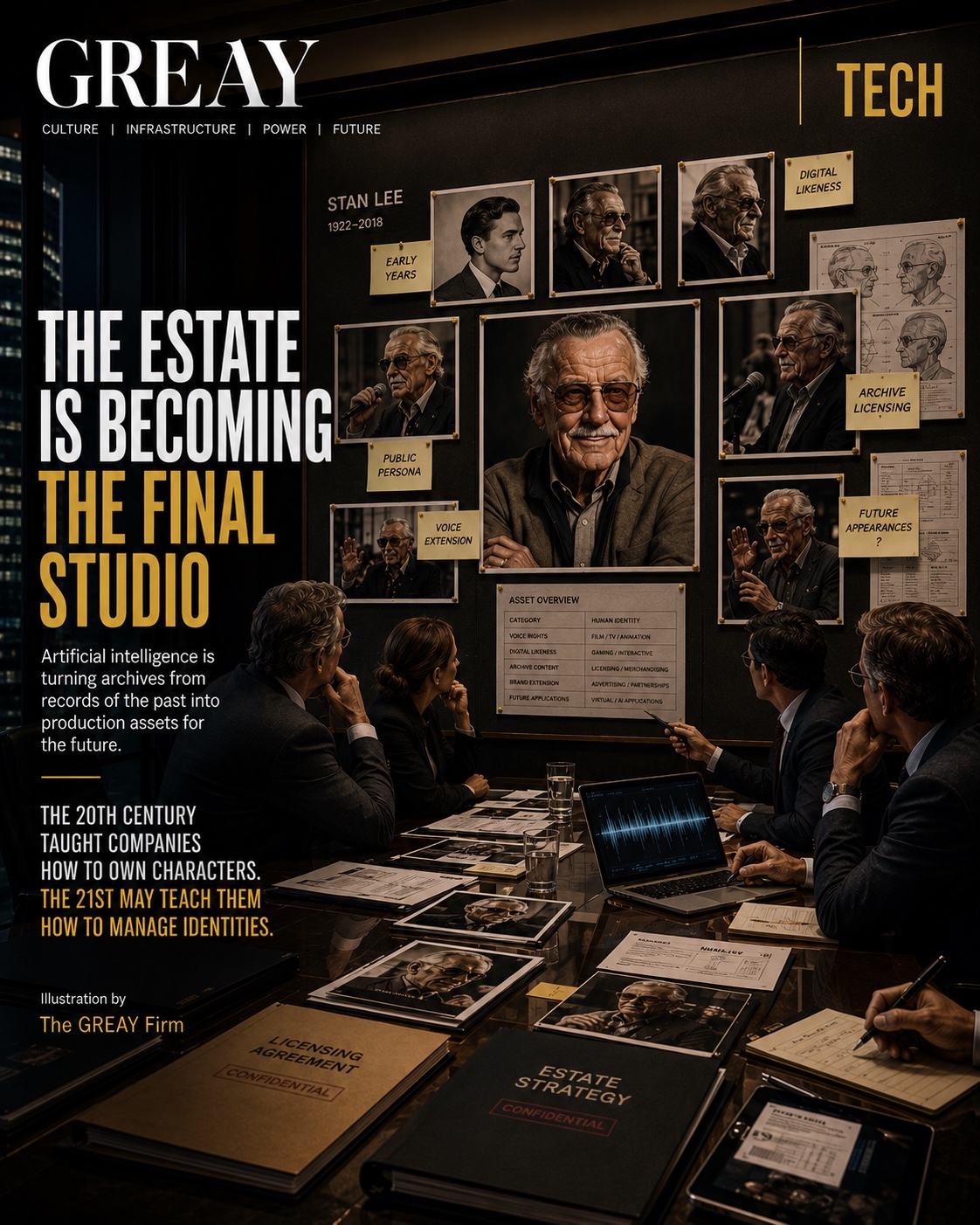
The Estate Is Becoming the Final Studio
By Brian k. Neal
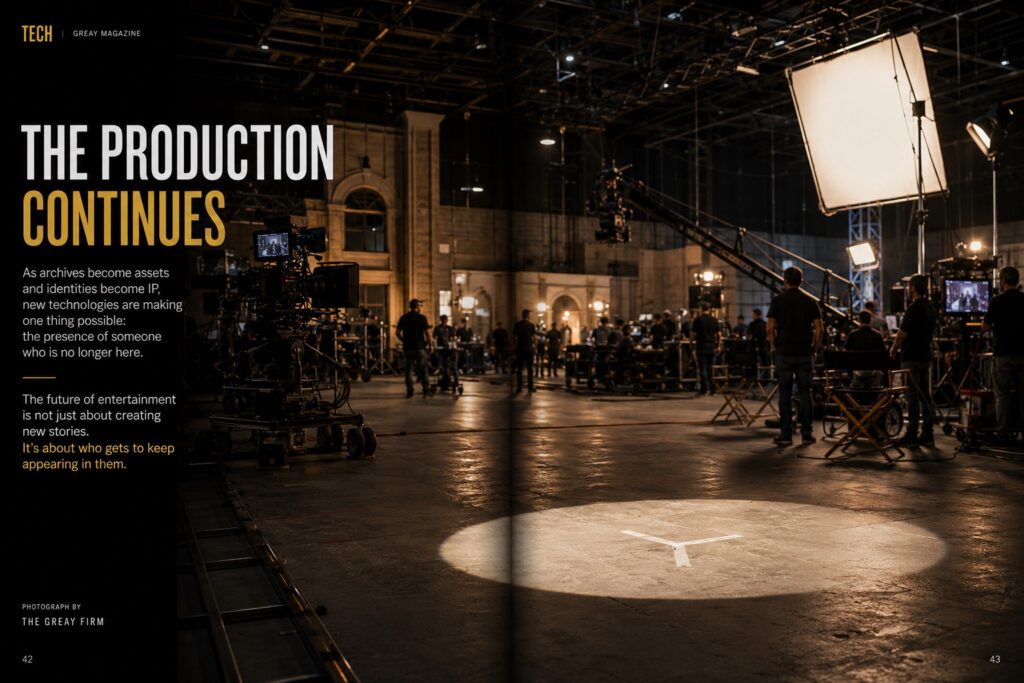
The soundstage is ready.
The lights are hung. The cameras are built. Crew members move through the frame with the quiet urgency that accompanies every production day. Monitors glow. Equipment rolls across the floor. Schedules are reviewed. The machine is operating exactly as intended.
Only one thing is missing.
The person.
For more than a century, entertainment functioned according to a simple rule. Production required presence. Someone had to walk onto the stage. Someone had to step in front of the camera. Someone had to speak the lines. Someone had to create the work.
The infrastructure could support creation, but it could not replace the creator.
That assumption is beginning to change.
The debate surrounding artificial intelligence often focuses on technology because technology is easy to see. We see voice models. We see digital likenesses. We see increasingly sophisticated recreations of people who are no longer alive. The conversation becomes trapped in questions of software and capability.
Yet capability is rarely the most important story.
Infrastructure is.
The twentieth century taught companies how to own characters.
The twenty-first century may teach them how to manage identities.
That distinction may define the next era of entertainment.
Characters were designed to survive their creators. Franchises were designed to survive generations. Intellectual property became valuable because it could continue producing value long after the people responsible for creating it had moved on.
Identity was different.
Identity belonged to the individual.
A voice belonged to the individual.
A likeness belonged to the individual.
A public presence belonged to the individual.
Artificial intelligence is blurring those boundaries.
Every interview. Every speech. Every appearance. Every photograph. Every recording. Every performance. What once existed as documentation increasingly functions as infrastructure. Archives are no longer simply preserving the past. They are becoming capable of participating in the future.
The archive is becoming productive.
That transformation changes the role of the estate.
Historically, estates existed to protect legacies. They approved licensing agreements, managed intellectual property, and preserved the integrity of a creator’s work. Their responsibility was stewardship.
Stewardship assumes the work is complete.
Artificial intelligence introduces a future where completion becomes less certain.
An estate can authorize a likeness. An estate can approve a voice model. An estate can participate in decisions that enable new appearances, new experiences, and new forms of commercial output.
The archive shifts from preservation to production.
The estate shifts with it.
The estate stops functioning like a museum.
The estate starts functioning like a studio.
That may ultimately become the defining business story of artificial intelligence.
Not because machines are replacing creators.
Because archives are becoming assets capable of generating new forms of production.
The implications extend far beyond entertainment.
Every athlete leaves an archive.
Every musician leaves an archive.
Every actor leaves an archive.
Every author leaves an archive.
Every public figure leaves an archive.
For generations we described these collections as legacies.
Increasingly, they look like inventories.
That realization sits at the center of the debate. Not whether technology can recreate a voice. Not whether software can generate an image. But whether identity itself is becoming a category of intellectual property capable of producing value long after the individual is gone.
The economics are obvious.
Recognition reduces risk.
Familiarity creates demand.
Audiences already return to familiar stories, familiar characters, and familiar worlds. The incentive to extend that logic toward familiar people will be enormous.
Yet economics and culture rarely ask the same questions.
Who decides what a person would have approved?
Who determines where preservation ends and invention begins?
Who controls the future of a public identity once the individual is no longer here to participate in it?
These questions are not technological.
They are questions of ownership.
They are questions of power.
And increasingly, they are questions of infrastructure.
For most of Hollywood history, death ended production.
The emerging era suggests something different.
The creator leaves.
The archive remains.
The rights remain.
The infrastructure remains.
And production continues.
The final studio may not be the one that discovered the talent.
It may be the one that inherited them.
Related Posts
Tiger Uppercut Reignited: Sagat Joins Street Fighter 6 Roster
Pride, Fireballs, and Fight Fashion

Graymatics Unveils Partnership Program for Smart Cities in Brazil
Graymatics, a globally recognized multimedia cognitive processing firm
Reebok Embarks on Metaverse Exploration with Futureverse in Groundbreaking Partnership
Reebok has unveiled a strategic partnership with Futureverse, a promin

Acer Unveils the Swift 14 AI Laptop: The First Copilot+ PC
Acer Announces Its First Copilot+ PC,

BodyPark’s ATOM Just Raised the Bar for AI in Fitness—And Everyone Else Is Playing Catch-Up
Forget Tracking Steps

Built for the Hustle: Endlss Copilot Lets Lean Teams Work Like Giants
Influence used to mean buzz. Now it means business