

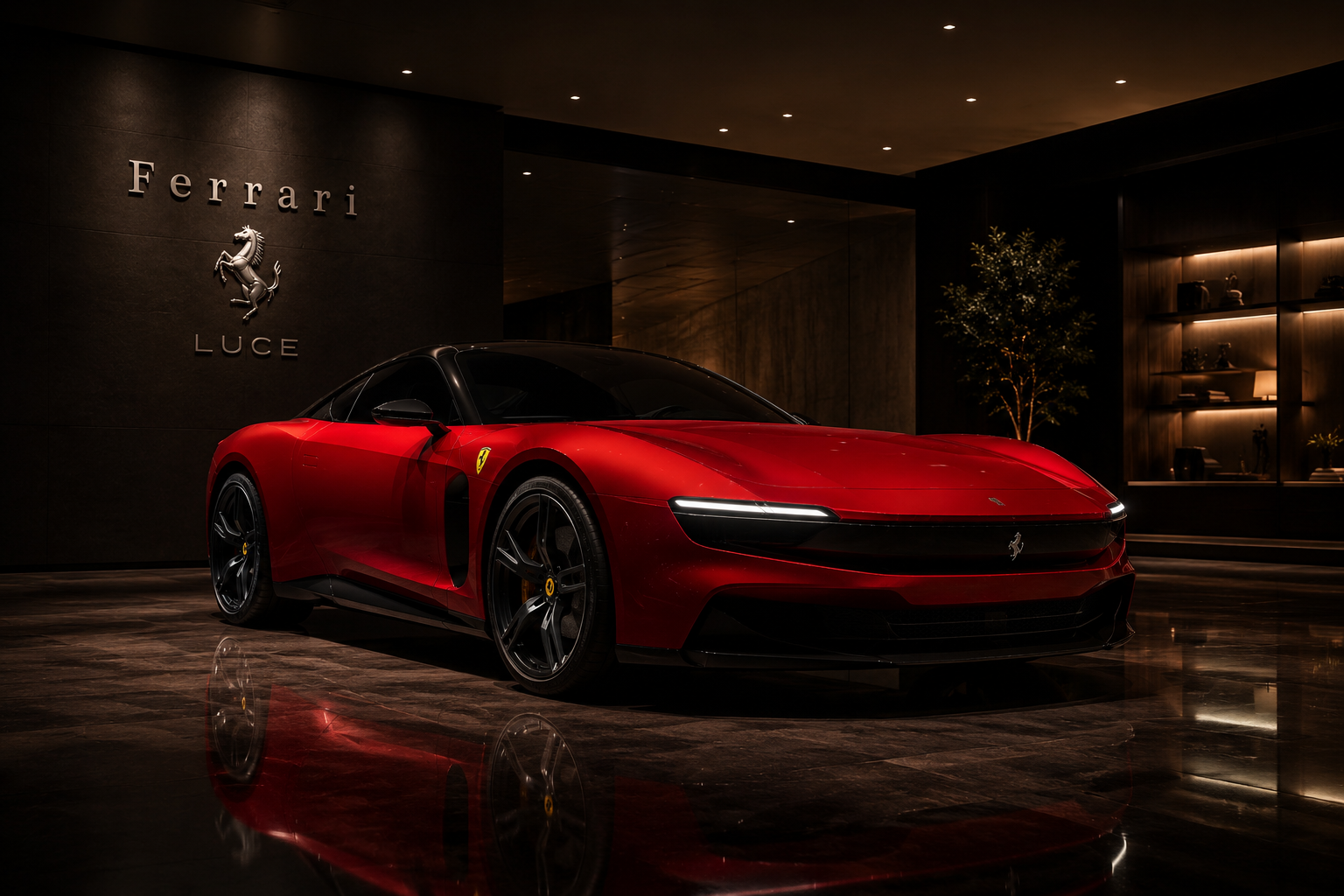
Ferrari Didn’t Just Build an Electric Car — It Reengineered What Ferrari Means
By Tory Sussex
For decades, Ferrari sold more than speed.
It sold combustion as emotion.
The sound of a Ferrari engine was not simply engineering. It was theater. Mechanical violence refined into luxury. You heard the car before you saw it. The vibration, the revs, the instability of raw horsepower — all of it created a relationship between human and machine that felt alive, imperfect, almost biological.
That mythology is why Ferrari mattered.
Not because it was transportation. Because it was ritual.
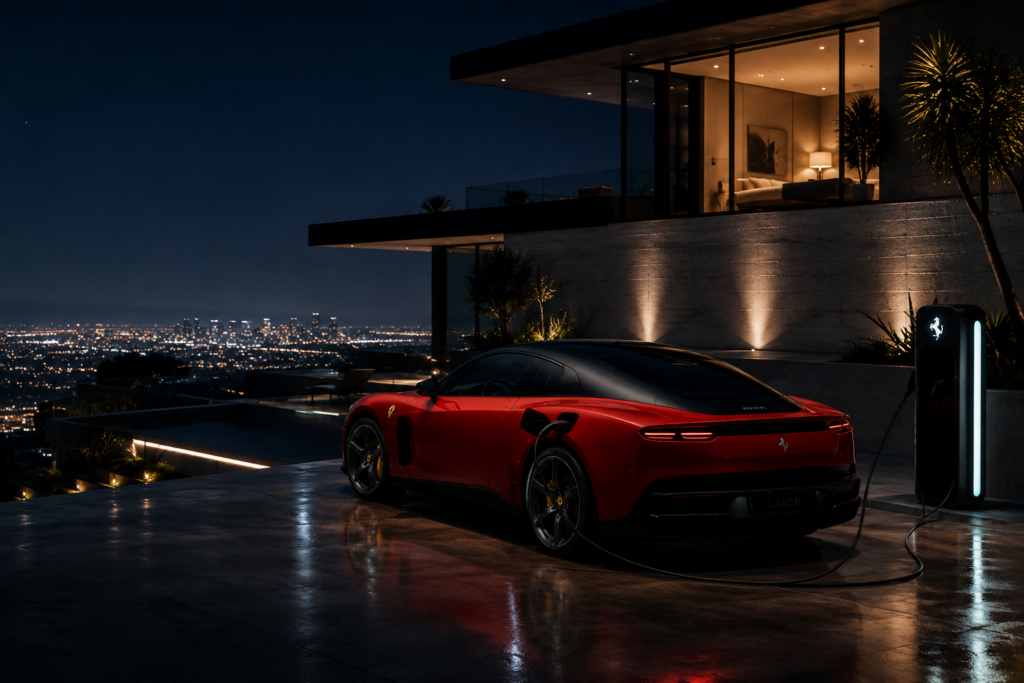
Which is why the unveiling of Ferrari’s first fully electric production car feels culturally larger than the launch of another EV. The Luce is not simply a new model entering the market. It represents one of the clearest signals yet that luxury itself is changing languages.
The engine used to be the identity.
Now the interface is.
That shift sounds technical until you realize how much modern luxury already operates this way. Apple transformed computing by turning hardware into experience design. Luxury hotels increasingly sell atmosphere over architecture. Fashion brands no longer just sell garments; they sell ecosystems of perception across social media, retail environments, and digital access.
Ferrari resisted that transition longer than most legacy brands because mechanical emotion was the product. The sound mattered. The heat mattered. The unpredictability mattered. Ferrari’s identity was inseparable from the violence happening beneath the hood.
Electric vehicles erase much of that theater.
Silence changes the psychology of performance. Torque becomes immediate and clean instead of dramatic. Software replaces portions of what mechanics used to communicate physically. Cabin interfaces begin carrying emotional weight that engines once handled naturally.
That is the real pressure facing Ferrari.
Not whether it can engineer an EV. Every major luxury manufacturer can do that now.
The question is whether Ferrari can preserve mythology after removing the very thing that created it.
Because once combustion disappears, Ferrari enters a competitive arena defined less by mechanical distinction and more by experience architecture. User interface. Material execution. Cabin philosophy. Artificial sound design. Responsiveness. Digital immersion. Software ecosystems. Emotional simulation.
The battlefield moves from the engine bay to the sensory environment.
And that changes what luxury performance even means.
For years, Silicon Valley trained consumers to associate seamlessness with sophistication. Smooth interfaces became status symbols. Frictionless design became premium. Minimalism replaced visible complexity. Tesla accelerated that shift by proving many consumers were willing to exchange heritage for technological identity.
Ferrari now finds itself entering a world it did not create but can no longer avoid.
What makes the Luce fascinating is that it does not fully resemble the emotional aggression traditionally associated with Ferrari. The design language feels calmer. Cleaner. More architectural. Almost post-mechanical. Less obsessed with announcing horsepower and more concerned with controlling atmosphere.
That matters.
Because luxury is slowly moving away from visible excess toward engineered experience. The richest environments increasingly feel quiet, controlled, and systemically intelligent rather than loud and performative. Wealth no longer always wants to scream. Sometimes it wants to disappear into precision.
The Luce feels designed for that future.
And the public reaction reveals how emotionally difficult this transition may become for legacy performance culture. Many enthusiasts are not mourning the loss of gasoline itself. They are mourning the loss of mechanical identity. The fear underneath the criticism is that Ferrari could become another premium technology object instead of an irrational emotional machine.
That anxiety is understandable.
Ferrari built its legacy on sensation that could not be replicated digitally. But modern luxury increasingly depends on experiences that are digitally mediated. The interface now shapes perception as much as the physical object itself.
This is why the launch feels bigger than automotive news.
Ferrari is not just introducing an electric car. It is attempting to translate one of the world’s most emotionally physical brands into the language of software-era luxury.
And that may become one of the defining challenges of the next decade for every heritage institution built before the interface became the center of modern life.
Because eventually every legacy brand confronts the same question:
What happens when the thing that made you iconic is no longer the thing the future values most?
Related Posts

LG’s 3-in-1 Lifestyle Gadget: HD Projector, Mood Lighting, and Bluetooth Speaker in One
LG Unveils Groundbreaking Innovations Ahead of CES 2025.

UL Solutions Unveils Inaugural Showcase of UL Procyon® AI Inference Benchmark for Windows at Snapdragon Summit
By Brian K. Neal UL Solutions, a global leader in applied safety scien


Opera Expands Access to Aria AI Assistant: Now Available Without Log-In for Desktop, Gaming, and Android Users
Opera makes Aria AI available without log-in

YouTube Music now empowers users to craft AI-generated artwork for their playlists
By River James YouTube Music is introducing a range of new features ta

Built for the Hustle: Endlss Copilot Lets Lean Teams Work Like Giants
Influence used to mean buzz. Now it means business