

The Game Is No Longer the Product-The World Is
By Brian K. Neal
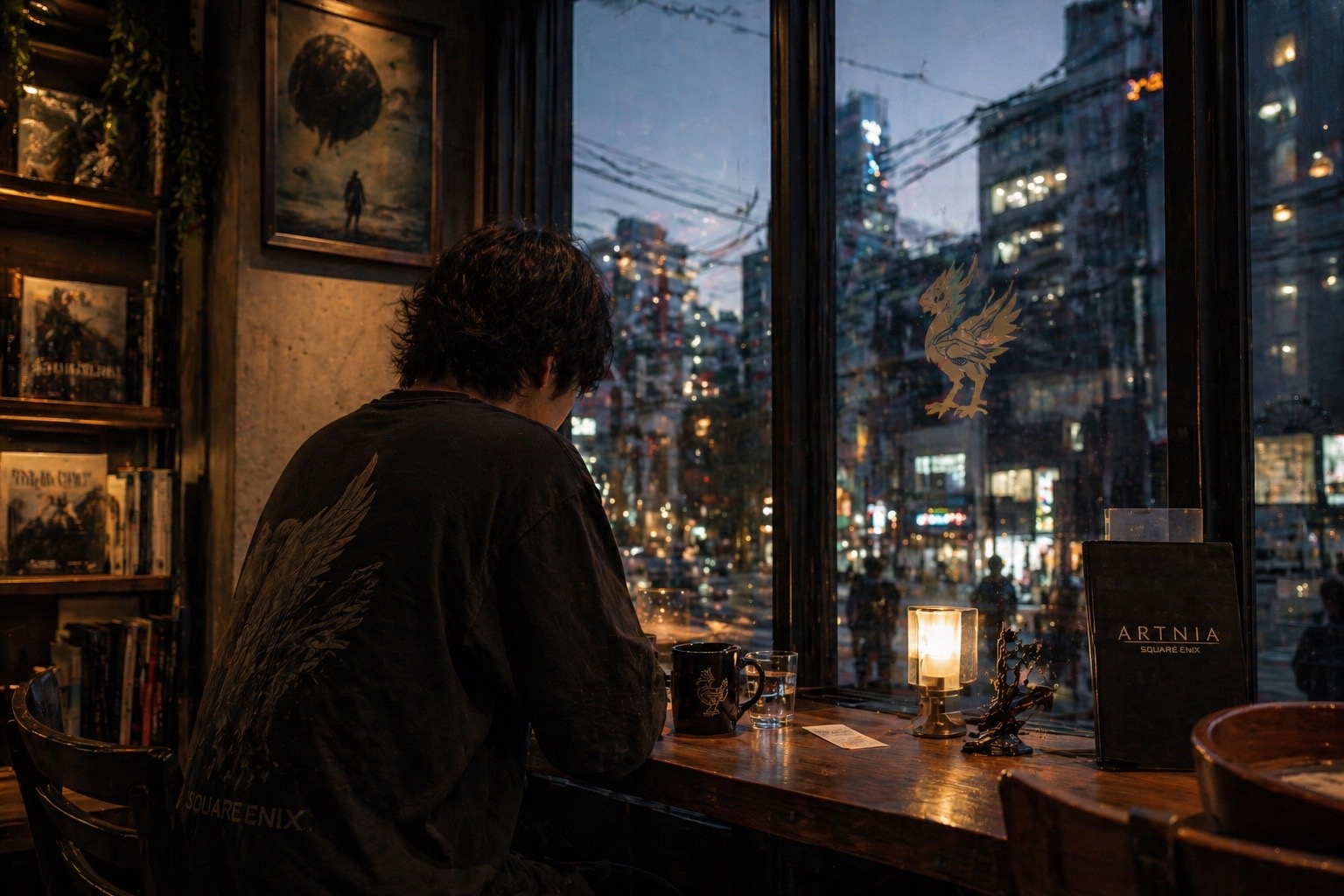
Square Enix is not opening cafés. That’s the surface read. That’s the headline. That’s what gets shared. But underneath, something more structural is being built—something quieter, and far more permanent.
Square Enix is stepping out of the console and into the physical world. Not as a stunt. Not as a limited activation. As infrastructure.
Los Angeles and Tokyo are not random selections. One is where culture is manufactured and exported. The other is where fandom is ritualized and sustained. Together, they form a loop—creation and devotion, output and return. By placing permanent cafés in both, Square Enix isn’t entering two cities. It’s closing a circuit.
For decades, they built worlds you visited temporarily. You entered through a screen. You played. You left. Even at its most emotional, the relationship was contained—bounded by hardware, by time, by the moment you turned the system off.
Now, that boundary is being removed.
Inside a space shaped by Final Fantasy or Kingdom Hearts, the interaction changes. You are no longer controlling a character inside a world. You are physically present inside its logic. The music, the textures, the pacing of the room, the objects placed in your hands—they are no longer representations. They are extensions.
And that distinction is everything.
Because memory does not behave the same way in physical space. You don’t remember a menu screen. You remember a place. You remember where you sat, what was said across from you, the quiet moment between conversations, the feeling you didn’t realize you were holding onto until later. The experience becomes anchored—not in interaction, but in presence.
That is the product.
The café is simply the delivery system.
This also removes the final layer between company and audience. No algorithm decides what you see. No storefront intermediates the experience. Square Enix controls the environment, the tone, the emotional arc from the moment you walk in to the moment you leave. It becomes direct—not to consumer, but to human.
And once a company owns both the intellectual property and the environment in which that property is felt, something shifts. The relationship stabilizes. It deepens. It becomes harder to interrupt, harder to replace, harder to forget.
We’ve seen early versions of this. Disney built it at scale—large, immersive, occasional. Nintendo translated it into retail—controlled, precise, but still transactional.
This move sits somewhere else entirely.
Smaller. Closer. Repeatable.
Not a destination you plan for, but a place you can return to without thinking.
And that frequency changes the nature of the relationship.
Because frequency builds familiarity. Familiarity builds comfort. And comfort, over time, begins to feel like belonging.
That is where the shift becomes personal.
Because once a space becomes part of your routine, it begins to hold moments you didn’t plan to give it. A quick stop that turns into a long conversation. A quiet afternoon that settles into something you carry with you. A version of yourself that only seems to exist there.
And you don’t notice it happening in real time.
You only recognize it later—when the place means something more than it should.
That is the power being constructed.
But it only works if the illusion holds. If the space feels too polished, too engineered, too aware of itself, it collapses into what it actually is—a themed environment designed for consumption. The emotional thread breaks. The experience flattens.
For this to work, it has to feel like it exists beyond you. Slightly imperfect. Unforced. Alive in a way that doesn’t require your attention to justify itself.
Because the goal isn’t to impress the fan.
It’s to let them belong without asking.
And if Square Enix gets that right, the implication is clear.
They are no longer building games.
They are building places.
And once a brand becomes a place, your relationship to it changes in ways that are difficult to measure and even harder to undo.
You don’t just engage with it.
You begin to locate parts of your life inside of it.
The afternoon you stopped by without thinking.
The conversation you didn’t expect to have.
The version of yourself that existed, briefly, in that space.
And once a company begins to hold your memories, it is no longer competing with other products.
It is sitting alongside your life.
At that point, leaving doesn’t feel like switching brands.
It feels like leaving a place you’ve been.
Related Posts

Louis Vuitton Accelerates into Formula 1 with Historic Partnership
Louis Vuitton Becomes Official Partner of Formula 1.

Inside CharlieBird: Samantha Smart Expands the Frame
Building Dimension

Inside the Swell Effect: Why Amanda Golka’s Word Moves a Generation
One creator, countless events

NBA Title Holder Nikola Jokić Shares Insights on Exclusive Partnership with Performance Footwear Brand 361° for Signature Shoe Line
Nikola Jokić has officially inked a signature shoe with 361.

Not Made from paris madame ft mike tyson
Mike Tyson s not made from Paris
The Waldorf Astoria Miami Beach Isn’t Just Replacing the W—It’s Repositioning What Luxury Means
The Business of Luxury