


This Isn’t an adidas Collaboration — It’s an Airline Learning How to Behave Like Culture
By Cody Bryant
There was a time when anniversaries were measured in messaging. A brand would reach a milestone and respond with a film, a commemorative logo, a line about legacy. It would speak outward, hoping the audience would listen long enough to care. Most didn’t. Not because the history lacked weight, but because the format lacked consequence. Celebration became informational—something to acknowledge, not something to carry.
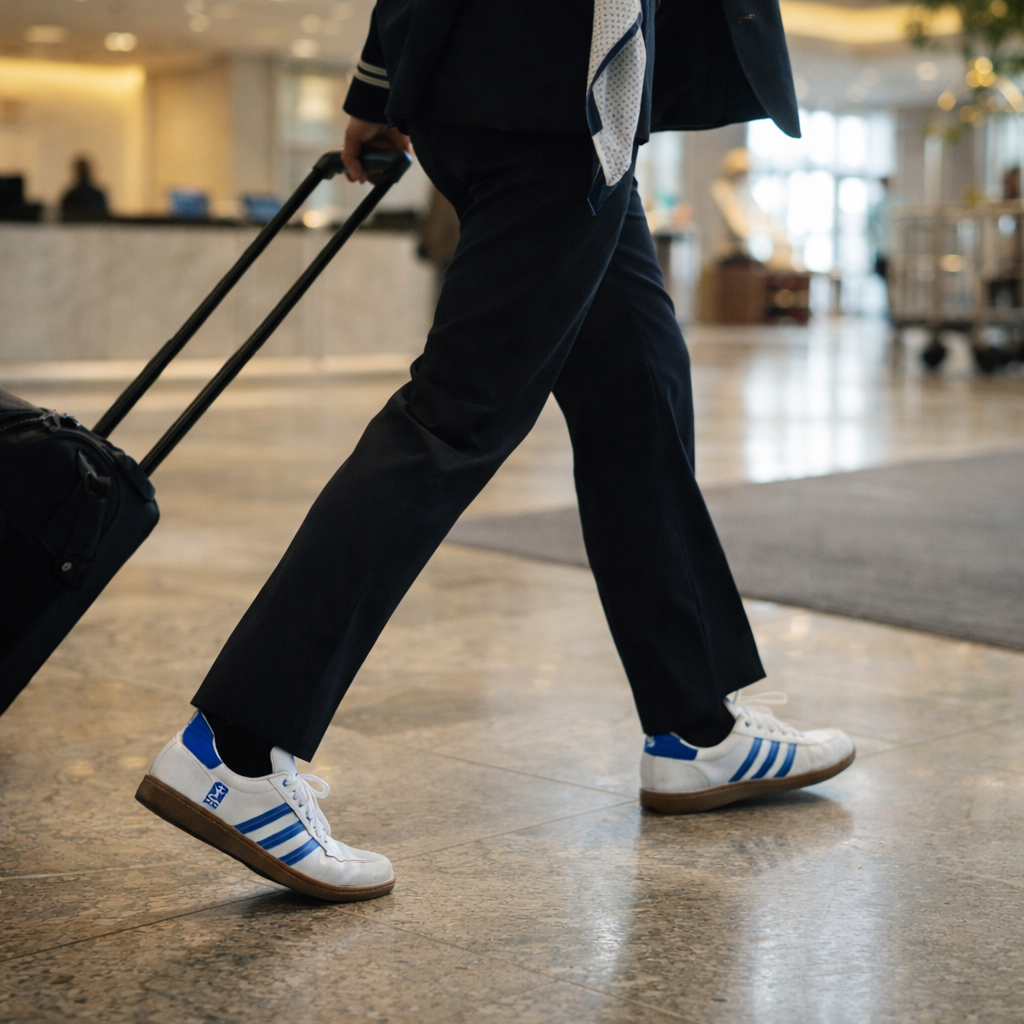
So when United Airlines marks one hundred years with a co-branded Adidas Samba, the instinct is to read it as familiar. adidas collaborates constantly. The silhouette is known. The format is proven. On the surface, this is just another entry in a long line of brand partnerships.
But that reading misses the shift entirely.
Because this isn’t special because adidas collaborated.
It’s special because an airline understood how not to.
Most adidas collaborations operate inside culture—fashion, music, sport, designers. They extend an existing conversation. They borrow energy from places where relevance is already alive. An airline does not live in those spaces. It exists as infrastructure. Utility. Movement. Which means when United Airlines enters a sneaker collaboration, it isn’t extending culture—it’s crossing into it. And that tension is what makes people look.
The choice of the Samba is precise. It doesn’t chase relevance; it maintains it. For decades, it has moved across cities and subcultures without needing reinvention. In that way, it mirrors aviation itself: global, habitual, quietly essential. The product already understands movement before the brand is ever applied. Which means the collaboration doesn’t feel imposed. It feels aligned.
But the real decision—the one that transforms this from product to system—is distribution.
This wasn’t made for the public.
It was made for employees.
That single shift in audience rewires the entire meaning of the object. Instead of asking the public to celebrate the brand, the brand embeds meaning inside the people who represent it. The gesture becomes internal—but the signal becomes external.
What follows is predictable, and that’s the point. A few pairs surface. Worn in transit. Seen in passing. Captured without intention. The object begins to move—not through media spend, but through proximity. It gains value not because it was marketed, but because it wasn’t. Scarcity forms naturally. Narrative follows organically. And something that was never for sale becomes more visible than most things that are.
This is the new architecture of brand expression. Not campaign → audience → impression. But object → environment → circulation.
Because objects behave differently than ads. They move. They age. They accumulate context. They don’t ask for attention—they earn it over time. And when designed correctly, they carry the brand further than any controlled message ever could. The Samba becomes less about footwear and more about proof: proof that the brand understands where culture actually lives now.
There is also a deeper implication—one that extends beyond a single anniversary. When a company begins to create artifacts instead of advertisements, it is quietly building a new layer of infrastructure. A cultural product layer. Something adjacent to the core business, but no less strategic. Airlines once built loyalty programs to retain customers. This is the next evolution: building cultural systems to remain visible without speaking.
And visibility now is no longer about reach.
It’s about presence.
If United Airlines continues in this direction—if this is not a one-off but a signal of intent—then the implication is clear. The brand is no longer content with transporting people. It is beginning to position itself as something that moves through culture itself. Quietly. Indirectly. Systemically.
Because the future of brand communication won’t be announced.
It will move without permission.
Related Posts

Casio Unveils the GBD-300: The Latest Addition to the G-SHOCK G-SQUAD Line
G-SHOCK releases Workout Logs with More Comfortable Fit

Precision in Every Detail: Porsche Design Tower Bangkok Reimagines Ultra-Luxury Living
By LuLu Clemmons Porsche Design Tower Bangkok, Asia’s first ultra-lu

Peloton Unveils Holiday Campaign: Empowering You to “Exercise on Your Terms”
By Grey Jackson Peloton has unveiled its 2023 holiday campaign, titled
What Happens When a Shoe Stops Explaining Itself
The Social Work of a Shoe
Sinners Was Never Just a Movie — It Was a World Waiting to Be Entered
Beyond the Screen

Ja Rule Unveils ‘The Sunrise Tour’: A Spectacular Celebration of 25 Years in Music and Culture, Set to Kick Off in Spring 2024
Renowned rapper, actor, entertainer, and entrepreneur Ja Rule is geari