

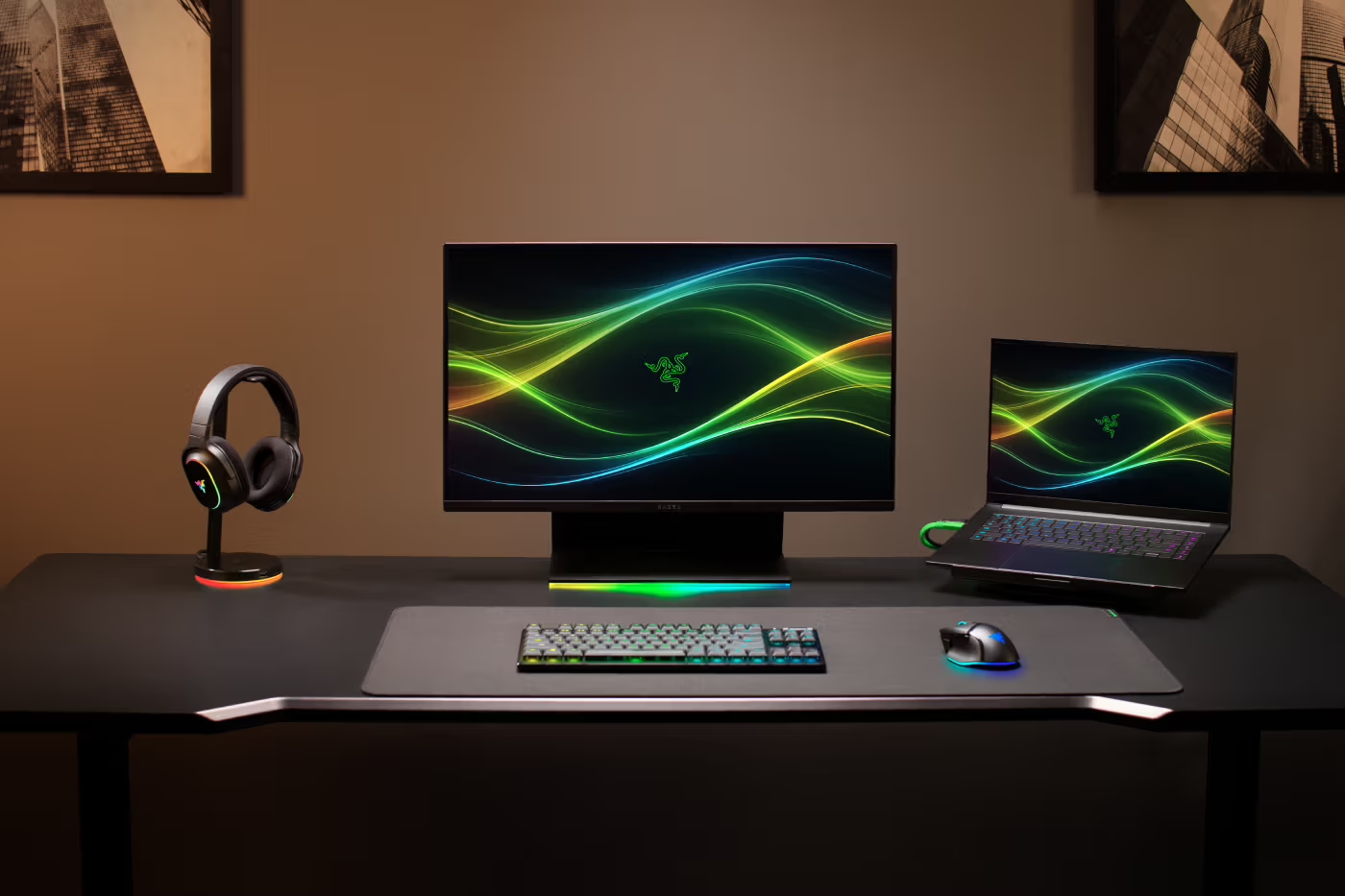
Razer Removes the Desktop’s Advantage
By Brian k. Neal
Razer didn’t just announce a new Blade 16. It quietly redefined what a portable machine is allowed to be.
For years, “gaming laptop” meant compromise—power traded for heat, mobility traded for thickness, performance that arrived with a cost you could feel in your hands and on your lap. That category is over now. Not because of one spec, but because the system has shifted underneath it.
The 2026 Blade 16 doesn’t present itself as a laptop trying to keep up. It presents as a fully realized performance environment that happens to close.
At its core sits the Intel Core Ultra 9 386H, a 16-core processor that moves with a kind of quiet authority—up to 4.9GHz when pushed, but more importantly, built for sustained intelligence, not just spikes. Paired with NVIDIA’s RTX 50 Series GPU, the machine stops thinking in terms of “graphics” and starts operating in terms of capability. Rendering, simulation, AI acceleration—it’s all the same conversation now. The line between gaming, creation, and computation continues to collapse, and this machine doesn’t pick a side. It absorbs all three.
Memory follows that same logic. Up to 64GB of LPDDR5X running at 9600 MHz isn’t about excess—it’s about removing hesitation. The system doesn’t wait for you to decide what kind of workload you’re running. It assumes you’ll do everything.
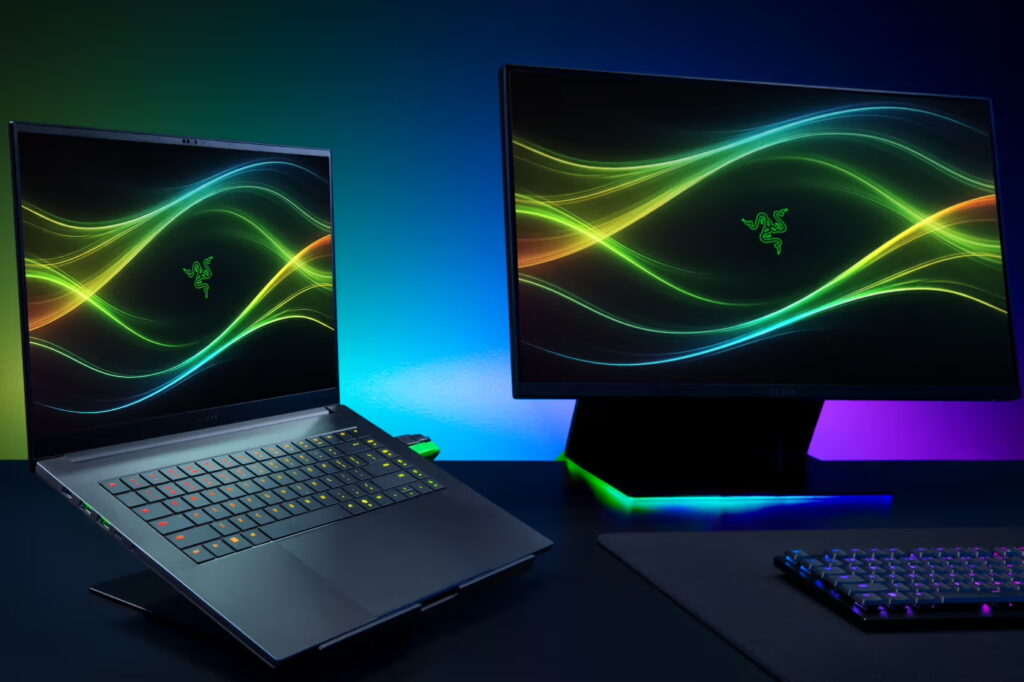
And then there’s the heat—the part that used to expose the illusion. Razer’s refined vapor chamber system, built with ultrathin fins and dual-fan architecture, isn’t marketed as a feature. It’s treated like infrastructure. Invisible, but essential. Because true performance isn’t about how fast a machine can spike—it’s about how long it can hold its position without breaking form.
Visually, the Blade 16 makes its argument without raising its voice. A 16-inch QHD+ OLED panel at 240 Hz doesn’t just look sharp—it feels immediate. True blacks, 1100 nits in HDR, VESA TrueBlack 1000 certification. The kind of display that doesn’t decorate the experience, it defines it. Movement becomes clarity. Color becomes intent.
And yet, the most aggressive part of the entire system might be what it refuses to do.
It doesn’t get bigger. It doesn’t get louder. It doesn’t abandon the idea of elegance.
At 14.9 millimeters thin and just over 2 kilograms, carved from a single block of T6 aluminum, the Blade 16 maintains a form factor that feels almost deceptive. It looks like restraint. It performs like excess. That tension is the point.
Because this is no longer about building the most powerful laptop.
It’s about building a machine that removes the idea of limitation altogether.
The Blade 16 doesn’t ask where you are. It assumes wherever you are is enough.
Related Posts

Lil Yachty Leads AIAIAI and HIDDEN.NY’s Clear-Cased Audio Revival
Translucent Tech, Modern Sound

IN THE BLACK NETWORK Partners with UrbanflixTV to Expand FAST Channel Lineup with Scripted Content
IN THE BLACK NETWORK (ITBN), a prominent streaming service spotlightin

Prime Video by Amazon to Introduce Advertisements for Subscribers
Amazon is introducing a novel approach to generate revenue

The Streaming Wars Are Over:Netflix Picked a Winner
Entertainment Without Borders

Game Time, Prime Time: SGA, Reese & Melo Lead NBA 2K26’s Bold Era
Game Time, Prime Time
Technogym Ecosystem Unveiled: The Singular AI-Powered End-to-End Open Platform at IHRSA Los Angeles
Technogym Ecosystem Unveiled