


Sydney Shea Measures Alignment, Not Attention

Words By Kyra Greene
In independent pop, intimacy has become a visible currency—circulated, measured, and too often mistaken for access. What once lived in private now arrives pre-framed, ready for consumption, collapsing the line between confession and construction. Sydney Shea does not participate in that collapse. Her work is not interested in proximity—it is interested in truth. There is a difference between showing and revealing, between emotion that is lived and emotion that is staged. In a landscape that rewards immediacy, she moves with restraint, letting feeling settle before it speaks.
Nothing is shared until it no longer needs to be. In independent pop, intimacy can become a commodity. How do you prevent vulnerability from turning into performance?
We’re living in a time where audiences want intimacy with an artist’s process. The line between genuine vulnerability and performance can blur quickly. I’ve felt that tension — the desire to create in solitude while also knowing that sharing that solitude can make people feel connected rather than just entertained.
For me, the difference comes down to intention. I don’t share something to heighten it or dramatize it. I share it when it feels settled. Going live has helped with that. There’s less curation, less editing, less opportunity to turn emotion into spectacle. It’s just presence. If I’m still trying to prove something through the moment, I keep it private. If it feels grounded, I let people in.
Vulnerability becomes performance when it’s exaggerated for reaction. I try to stay aware of that line.
When you write on guitar before production enters the room, what truths surface that digital refinement often tries to smooth over?
When it’s just me and my guitar, there’s no judgment — only playing. That’s where the most honest version of a song shows up. There’s no production to hide behind, no texture to lean on. If the melody and the lyric can hold their own in that room, I know the song is real.
Production will always elevate a song. It can expand it, deepen it, make it cinematic. But I know my writing works if it can survive as just voice and guitar. That’s the test. If it moves me without anything added, then it’s strong enough to grow.
The truths that surface in that space are usually the simplest ones — the lines that feel almost too direct. Digital refinement can sometimes polish away the rawness that made the song breathe in the first place. I try to protect that original pulse before anything else touches it.

Speed is rewarded in this era. What has slowness taught you that momentum could not?
Slowness has taught me how to stay present. When things don’t happen overnight, you’re forced to actually live inside the process instead of racing toward the outcome. The struggle stops feeling like an obstacle and starts feeling like training. Pressure, when it’s not fueled by panic, sharpens you.
The slow burn builds longevity. I would rather gain each listener one by one than be exposed to millions before I fully understand myself. Growing gradually has allowed me to keep refining my sound without freezing it too early. There was a time when I felt pressure to define what “Sydney” was — to brand it, to lock it in. Slowness taught me that I don’t have to define it prematurely. Sydney is just who I am right now. And that evolution is the point.
Momentum can create visibility. Slowness builds foundation.
How do you know a song is resolved — not structurally complete, but ethically honest?
Telling the truth is the hardest thing anyone can do — for themselves and for their art. It can’t be surface-level truth. You have to dig for the diamond inside it. The first draft is usually emotional, but the final draft has to be accountable. I know a song is ethically honest when I’ve told the story without protecting myself or distorting anyone else — and when I can explain what it’s truly about in one sentence. When I sing it and something lifts off of me instead of tightening in me, that’s when I know it’s done.
Metrics are immediate; resonance is delayed. Which one governs your decisions, and how do you measure the difference?
There was a time when I needed someone else to approve what I posted before I felt safe sharing it. If something didn’t get the response I expected, I internalized it. I equated engagement with worth. When the numbers were low, I felt small. That was a fragile way to build.
Metrics are immediate, and they can feel definitive. But they measure attention, not alignment. Social media is a résumé — it shows activity. It doesn’t prove depth. Resonance is slower and harder to quantify. It’s the person who stays. The listener who returns. The crowd that knows the words before they’re released.
I’ve learned that if I let numbers govern my decisions, my creativity tightens. When I focus on connection instead of reaction, my work feels grounded. Metrics can inform strategy, but they don’t define my direction.

Independence is often romanticized. What parts of self-governance are rarely discussed — and least glamorous?
Being independent means acting as the label. You’re the writer, the producer, the strategist, the publicist, the creative director. There isn’t a team buffering decisions for you — you absorb the wins and the losses. Learning how to build something without relying on someone else to validate or execute your vision has forced me to develop discernment. Every choice is mine, which means every mistake is mine too.
It’s not easy. It’s often quiet, administrative, and unseen. But there’s a different kind of fulfillment in knowing the master is yours — that what exists in the world exists because you willed it into being.
Where have you been asked — subtly or directly — to become more universal, and what did you risk by resisting that?
The pressure to become more “universal” is often subtle. I have a song that opens with the line, “pissed on the flower I planted for you.” When my mom first heard it, she asked if I could soften it — maybe change it to “stepped on the flower.” I understood the instinct. The original line is blunt. It’s uncomfortable.
But “stepped on” wasn’t what it felt like. It felt brutal. And if I softened it, I would have been rewriting the emotional truth to make it easier to digest.
Later, I sang that song for a songwriter I’ve admired for years. When I reached that line, they stopped me and said, “That right there — you’re a songwriter. Don’t ever hold back.” It wasn’t that I needed permission. It was confirmation that specificity is the work. You risk comfort when you resist dilution, but you protect the integrity of the feeling. And that’s worth more than being universally palatable.
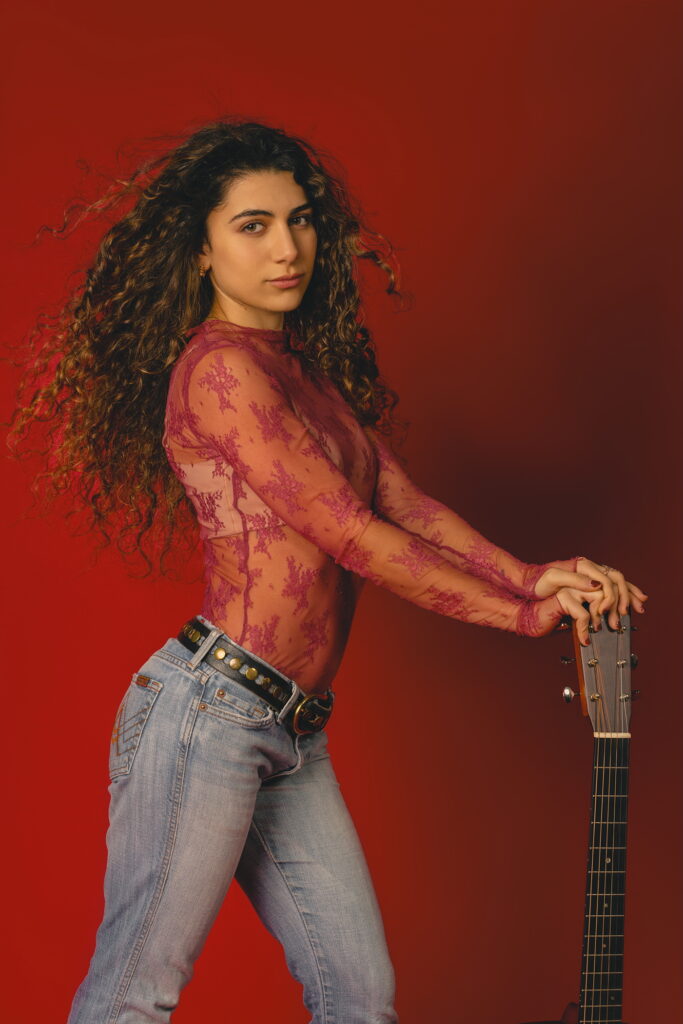
Softness is frequently misread as fragility. In your work, where does strength actually live?
Softness is often mistaken for fragility, but my strength lives in love. Loving fully — without irony, without armor — takes more discipline than detachment ever will. It’s easy to harden. It’s easy to become cynical. Staying open requires endurance.
Love is the standard I hold my work to. If a song doesn’t come from love — even if it’s about pain — it’s not finished. And in my life, love comes before music. Music is how I express it, but love is the reason I create at all.
Years from now, when context is stripped away, what would remain undeniable about this era of your creative life?
Years from now, when context fades, I hope what remains undeniable is that I stayed my own. I didn’t trade authorship for access, and I didn’t let pressure dictate my worth. In an industry that often rewards insecurity — rewards comparison, speed, and self-doubt — I chose alignment instead.
This era of my creative life wasn’t about chasing fame or negotiating my identity. It was about building from love — for the music, for the people listening, and for something deeper than visibility. I stayed open-hearted in a space that can tempt you to harden. If anything endures, I hope it’s the sense that the work was made from devotion, not desperation.
My stepfather was a driving force in my creative life. He passed away when I was five, but his guitar remained in the corner of our house — a quiet presence. Music was always there. It felt chosen for me as much as I chose it. I carry my work forward in his spirit.
What remains after the noise of metrics, visibility, and momentum fades is something far less negotiable: authorship. Sydney Shea is not building toward recognition—she is building from alignment. The songs begin where they always have, in the quiet space between voice and guitar, where nothing can hide and nothing needs to perform. It is there the work proves itself, before anything is added, before anything is seen. Long after context dissolves, what will endure is not the speed of her rise, but the integrity of her staying—open, exacting, and entirely her own. Not louder. Not faster. Just true.
Photography By Danielle Herzog @danielleherzog
Related Posts

Dwayne Johnson Is Taking Project Rock Beyond Under Armour
A celebrity partnership ends. The brand moves forward.

Buildings that once distributed culture are now hosting it
The Lobby Isn’t for Waiting Anymore
Michelle Núñez: Fearless in Film, Music, and Storytelling
Michelle Nunez multi talented.

Dua Lipa Stars in YSL Beauty’s New ‘Libre Flowers & Flames’ Campaign
Introducing YSL Beauty's LIBRE FLOWERS & FLAMES: A Fiery New Fragrance

Usher Joins Forces with Skims Mens for Latest Campaign
Usher teams up with Skims Mens for new campaign.

Fortnite Welcomes Lewis Hamilton and Roscoe, His Canine Companion, to the Icon Series
By DaMarko Webster Fortnite has unveiled its latest addition to the co