

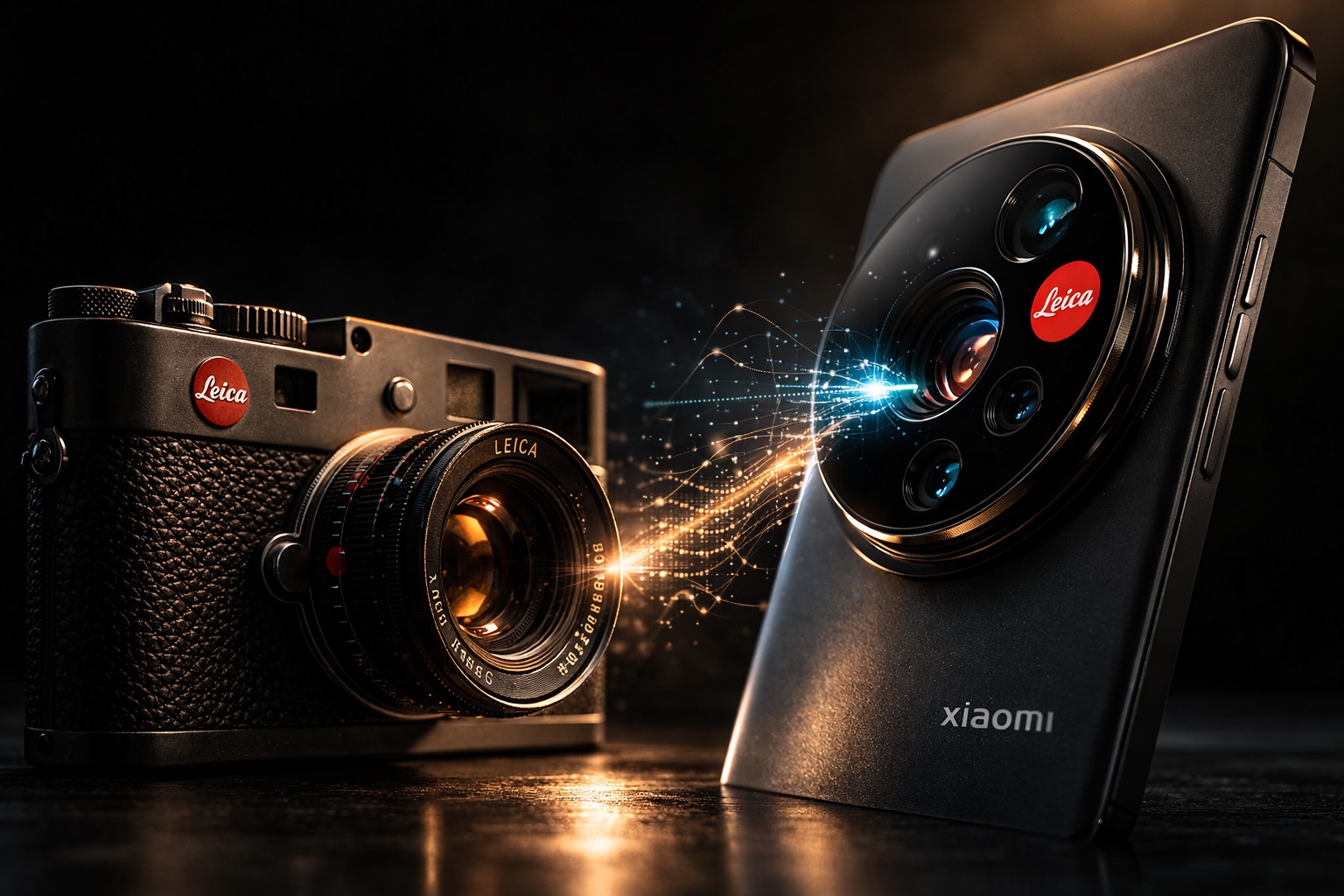
The Smartphone Became the World’s Camera Leica Moved In
By Brian k. Neal
In 1925, a small camera appeared at the Leipzig Spring Fair that quietly changed photography forever. Built by the German optics company Leica, the Leica I replaced the heavy plate cameras of the era with something radical: a compact 35mm camera small enough to carry anywhere.
Before Leica, photography was slow and deliberate. Cameras were large, exposures were long, and images were often staged in studios or carefully constructed environments. The Leica changed that equation overnight. For the first time, photographers could move freely through the world, capturing life as it unfolded rather than arranging it in front of a lens.
Within a generation, the camera helped give rise to modern photojournalism and street photography. Photographers like Henri Cartier-Bresson carried Leica cameras through cities and across continents documenting everyday life with an immediacy that had never existed before. Cartier-Bresson would later call it the decisive moment—the instant when life, composition, and emotion align inside a single frame.
Leica didn’t just build a camera.
It changed the behavior of photography.
Nearly a century later, photography is undergoing another transformation just as profound.
But this time, the camera isn’t shrinking into a handheld rangefinder.
It’s migrating into the smartphone.
Today billions of images are captured every day on devices carried in pockets around the world. The smartphone has quietly become the most widely used camera platform in history. Photography is no longer something people prepare to do—it exists continuously alongside life itself.
Many traditional camera companies resisted this shift. Others ignored it.
Leica made a different decision.
Instead of competing with the smartphone, the company began embedding its photographic philosophy inside it.
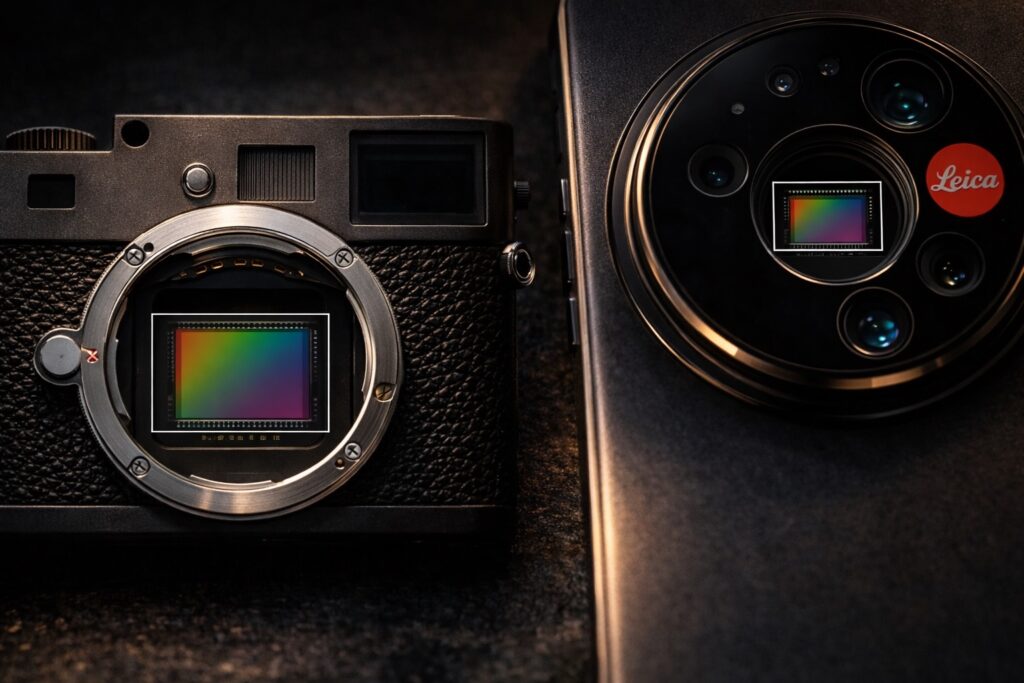
Through partnerships with manufacturers such as Xiaomi, Leica’s optics philosophy, color science, and image rendering are now integrated into a new generation of camera-focused smartphones. Devices like Xiaomi’s flagship Ultra series combine large sensors, multi-lens systems, and computational photography with Leica’s visual signature.
The result is a subtle but important shift.
These are no longer phones that happen to include cameras.
They are cameras that happen to be phones.
This distinction reveals a deeper transformation happening across the imaging industry.
For most of photography’s history, camera companies controlled the entire system: lenses, mechanics, sensors, and the visual language of the image itself. Smartphones disrupted that structure. Technology companies suddenly owned the world’s dominant camera platform.
The question facing legacy imaging brands became existential:
Fight the smartphone—or shape it.
Leica chose to shape it.
Across the industry, similar alliances are beginning to emerge. Optical companies that once defined photography’s visual language are collaborating with smartphone manufacturers to shape the next generation of imaging systems. Hardware companies provide processing power, software ecosystems, and global distribution. Imaging companies contribute something equally valuable: aesthetic authority.
Phones build the device.
Photography companies define the image.
Seen this way, Leica’s strategy is less about entering the smartphone market and more about ensuring its visual philosophy continues to influence how photographs are made in the twenty-first century.
A century ago, Leica helped make photography portable.
Today photography is no longer simply portable.
It is ubiquitous.
And once again, Leica has positioned itself inside the device that defines how the world captures its moments.
The camera didn’t disappear.
It migrated.
And Leica followed it.
Because the next era of photography won’t belong to cameras or phones alone.
It will belong to the companies that understand how images are engineered, interpreted, and shared across billions of devices simultaneously.
In that future, the most important camera companies may not be the ones building cameras.
They may be the ones defining how the world’s cameras see.
Related Posts

Pearl TV: Tucson Television Stations Launch NEXTGEN TV Service
TUCSON TELEVISION STATIONS LAUNCH NEXTGEN TV
LG Display Begins Mass Production of Industry’s First 13-Inch Tandem OLED Panel for Laptops
LG Display is a leader in innovative display technologies

The Most Powerful Media Companies Don’t Call Themselves Media
The Platform Is the Publisher Now

AIAIAI Unveils TMA-2 DJ Wireless Headphones, Claiming the Title of First-Ever Wireless DJ Gear
AIAIAI Announces 'World's First Wireless DJ Headphones', Launching Ear

SYKY Unveils Revolutionary Fashion Experience on Apple Vision Pro
SYKY Launches Pioneering Fashion Experience on Apple Vision Pro
Xencelabs Reveals Revolutionary 16-Inch 4K OLED Pen Display: The Perfect Fusion of Professionalism and Mobility
Xencelabs Reveals Revolutionary 16-Inch 4K OLED Pen Display