
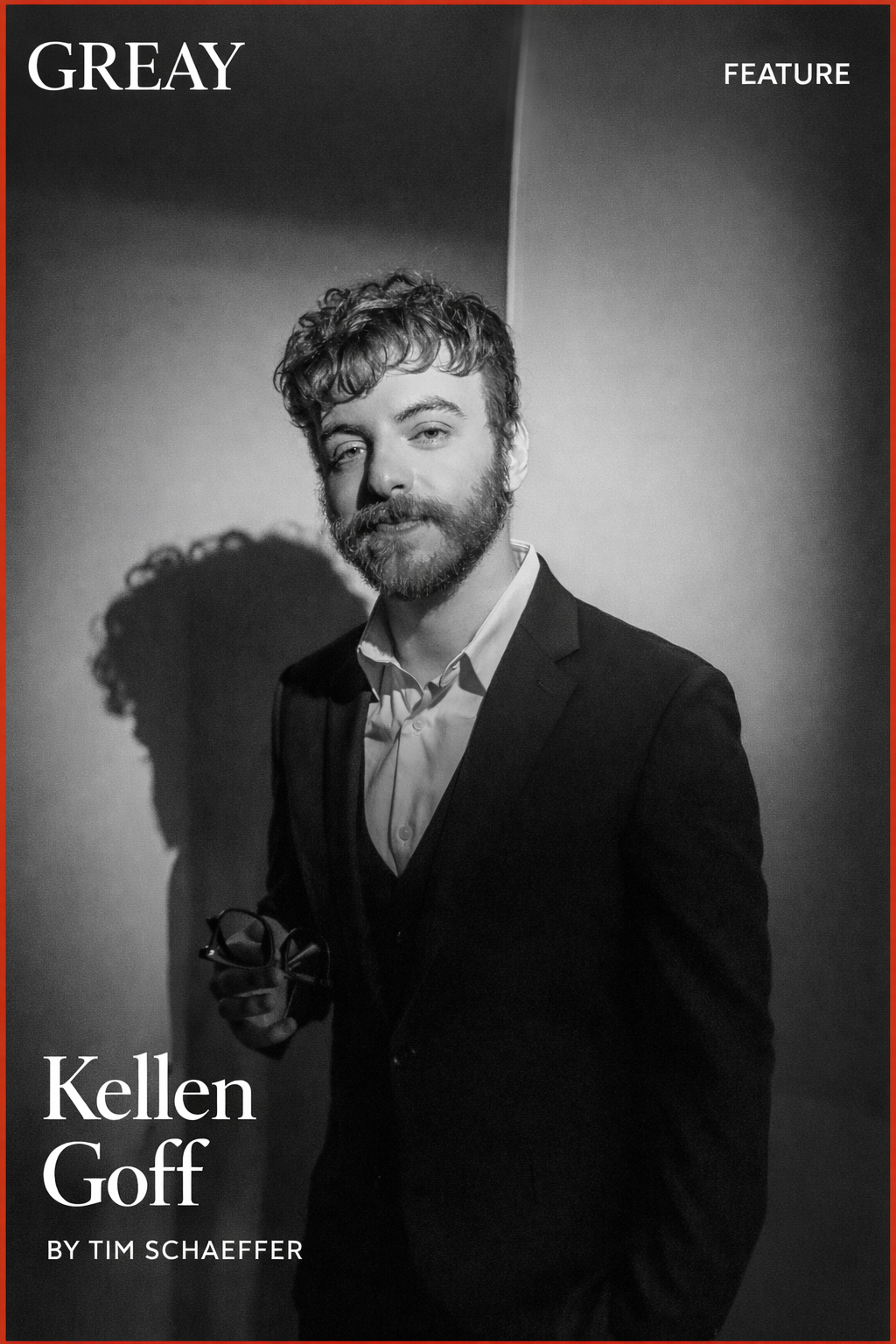
Kellen Goff and the Architecture of Emotion
By Kyra Greene
In most corners of entertainment, performance begins with the body. With Kellen Goff, it begins with something far less visible—and far more precise. Before a single sound is shaped, there is a question of architecture: who this person is, what they carry, and how they move through the world emotionally. The voice is not designed. It is uncovered.
Across horror, anime, and gaming, Goff has built a career not on vocal invention, but on emotional inevitability—where a villain’s restraint or a hero’s fracture is dictated not by tone, but by control. “The mic may not see it, but it hears it,” he says, describing a process that prioritizes internal truth over external effect. It is this inversion—emotion before sound—that allows his characters to feel less like performances and more like lived realities, even in worlds that are anything but human.
You’ve voiced characters across an incredible emotional spectrum—from villains to vulnerable heroes. When you take on a new role, what is your process for finding the emotional “center” of a voice that doesn’t physically exist on screen yet?
Truthfully, I try not to start with the voice as much as I start with the character I’m voicing. I ask: Who are they? What’s their backstory, their goal, their personality? Once I have that clear, the voice tends to emerge on its own, shaped naturally by all of it.
Being in a generated emotional headspace can also influence how I voice a character. A villain being quiet or a hero sounding rough usually comes from how in control, or not, they feel, rather than from a deliberate vocal trick. The mic may not see it, but it hears it, if that makes sense. When the emotional center is clearly conveyed, the voice stops feeling “invented” and starts feeling inevitable. That’s when the character really comes alive, because you’re past doing a voice. You’re fully embodying a different life. Someone once said that acting is just gaslighting yourself into believing you’re a different person, and I’ve found that painfully apt.
Five Nights at Freddy’s has become a cultural touchstone, and your work as Freddy, Funtime Freddy, and other characters helped define the franchise’s sound. Looking back, how has that universe shaped you as an artist—and what does it feel like to carry a fandom that passionate?
Ah yes, the Freddies. The FNAF characters have always lived in that strange middle ground between goofy and scary. Figuring out how best to exist in that space is a lovely challenge. I experimented with expanding how much I could do with tone, timing, and just “letting it cook,” instead of going big all the time. Going big has its place, but it’s far less impactful when you haven’t properly ramped up to it.
The fandom is wild, but in the absolute best way. They are intense, passionate, and incredibly smart. The fans don’t just play the games, beat them, and move on. They go much further. From theories to art to music, their passion for this universe and franchise seems limited only by their creativity, which feels limitless. So many people have confided in me about how they grew up playing the games and how they helped them escape reality, even if only for a little while. Being part of something that means so much to so many people is surreal, and it’s an honor I don’t take lightly.
You’ve talked openly about navigating neurodivergence and identity in your creative career. How has your personal lived experience informed the way you approach performance, connection, and the characters you choose to bring to life?
Having autism and figuring out my identity along the way has made me deeply aware of how differently everyone moves through the world. I wish we could reclaim the term “snowflake” for its original intent, to illustrate the beauty of how no two people are exactly the same. It’s fascinating to understand where someone different from you is coming from, and that perspective can greatly help an actor connect with and appeal to a wider range of lived experiences.
I’ve spent a lot of time feeling slightly out of step with the room. For a good part of my life, I barely stepped outside my room out of fear that I would make people uncomfortable. As I’ve grown, though, I’ve learned that what makes you unique is often what attracts people most, as long as you own it. My autism is a superpower, and I use it to analyze, recreate, and understand humans in a way that only I can. Now, whether in recording booths, at social events, or at conventions, I do my absolute best to create moments that feel real and recognizable, even if only by a little. I prefer my interactions to be genuine, especially as the world feels more and more artificial.I’m also drawn to characters who are a little messy, misunderstood, or living on the edge of what is considered “normal,” because those people and characters feel honest to me. Candor is warmth humans desperately need.
At the end of the day, I just want to tell stories through my characters that feel human and specific, where being different isn’t something to fix, but what makes them their own person. If someone sees themselves in that, then we’ve both won.
Voice actors often have to create texture, fear, humor, and vulnerability with only a microphone in front of them. What’s one moment in your career where you surprised yourself in the booth—where you discovered something new about your craft?
There was a session where I was voicing Sasaki from Sasaki & Miyano. The lines were fairly standard, but I kept overthinking them and trying to “sell” the performance to an audience that wasn’t physically in front of me. Nothing was landing, and I was getting frustrated with myself. Sasaki is a very personable and relatable character for me, and I wanted to do him justice and pass that relatability on to others going through similar emotional hardships, especially since this was my first romantic lead role. At one point, the director, Emily Fajardo, told me to stop acting and just say the lines the way I would to someone in my own life. I took a moment to sit with that and thought about my mom, our goofy little ways of showing each other love, and the way we talked for our pets. Everything suddenly loosened up. I said the lines the way only I could say them, drawing on my childhood. I stopped pushing, let the pauses breathe, and trusted that the mic would pick up the small, human moments. When we listened back, it felt more real than anything I had been forcing. That moment really stuck with me. It taught me that sometimes the strongest choices we can make are the quiet ones. It completely changed how I approach intimate or emotional reads now. Often, the minimum an actor has to do to stand out is draw on their own experiences.
Animation and gaming are undergoing a massive evolution with AI tools, remote recording, and digital production pipelines. What excites you most about the future of voice acting, and what boundaries do you think the industry must protect?
It’s exciting to see how much more accessible voice acting has become for people who want to break in, and even for those of us who have been in the industry for a while. When the pandemic hit, we all had to quickly build home studios so we could continue working. While we’ve largely shifted back to recording in studios more often than not, that period laid important groundwork for remote recording to be taken seriously. I worked on many dubs with casts made up of actors in Los Angeles, Texas, New York, and even out of the country. With new technology constantly being introduced, you don’t necessarily have to be in one specific city anymore. That means more voices, more styles, more talent, and far more interesting stories being told, especially on the indie side. It also makes collaboration easier and faster, particularly in gaming and animation, where large projects are constantly evolving.
At the same time, you’re absolutely right that clear boundaries need to exist around this new technology. Performance is meant to be human. Generative AI is a slippery slope toward the loss of mental and emotional engagement. It encourages writers, performers, directors, editors, and creatives of all kinds to rely less on their craft. I see it as an affront to what makes our work genuine, and an insult to those of us who have worked so hard to get where we are. Many people share this sentiment, yet we find ourselves competing with it more and more. A while ago, there was significant backlash when Amazon re-released anime dubbed with AI voices. The performances were devoid of emotion and character, and the pushback caused Amazon to reverse course, at least temporarily. Now, however, there are rumors of it returning, with job postings related to it beginning to appear.
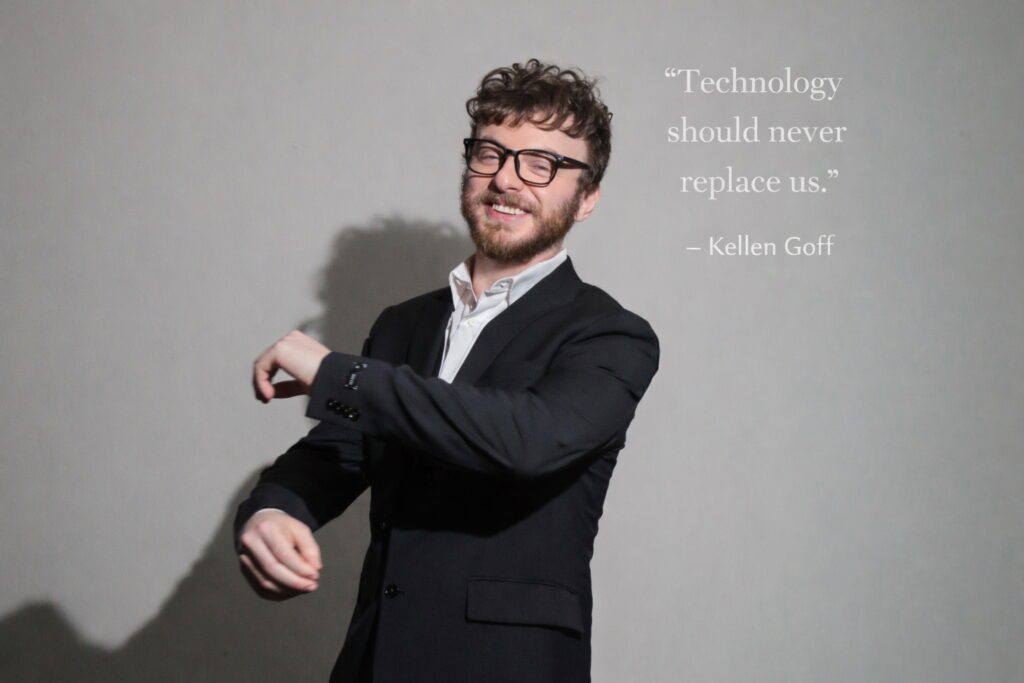
Even so, the resistance is tireless, even in the face of Goliath. A voice is not just a sound. It is our identity and our livelihood. Actors should always have control and consent over how their voices are used. Technology can be an incredible tool when used responsibly, but it should never replace us. When it does, we lose more and more of our human connection with one another.
6. You’ve collaborated with iconic creative teams, from indie developers to major studios. Is there a specific director, writer, or sound engineer who fundamentally changed the way you think about performance?
I’ve worked and continue to work with so many inspiring people. My favorite directors are the ones who trust the actor enough to explore and improvise. I’ve also worked with many who have a clear vision of exactly what they want and will not compromise that for anything, and others who treat me as a true collaborator, letting me contribute as much input as I can. There is validity to both approaches, and they have taught me a lot about being fluid in the process. Coming in with rigid energy makes you more likely to break, but if you go with the flow, the reads feel more fun and natural.
As far as directors go, I have adored working with Brittany Lauda, Jason Topolski, Emily Fajardo, Austin Sisk, Wes Gleason, Sara Sherman, Mike Schneider, and JB Blanc. Some of my favorite writers include Madeleine Morris, Matt Shipman, Aaron Dismuke, Khoi Dao, and Jared Rosen. For sound engineers, Geoff Bisente, Eddie Correa Jr., Keely Pierson, John Shieh, Kevin Falsey, Naji Ali, Joey Little, Rob King, and Noeha Rose are all masters of their craft.
Your characters often live in universes that are visually intense—horror, sci-fi, supernatural worlds. How do you mentally
transition in and out of darker roles without carrying any of that emotional residue home with you?
Yeah, I’ve had to get pretty good at that for the sake of my mental health. I try to be really deliberate about switching gears when the work is, pun intended, said and done. And it has gotten easier with time. When you’ve gone in and out of those heavier worlds and characters enough times, especially repeat roles like one of my Freddy characters or Overhaul, you learn how to leave the weight at work and not drag it all home with you. Building on that, I don’t think of the character’s darkness as something I need to absorb. I kind of “borrow it” for the day. It’s a mindset trick that reminds me I’m not stuck with it forever. It is just temporary. That, and lots of reels of baby animals.
When I come down from the emotional highs, I try to do something that feels overly normal, calm, and very me. Reels of cute animals, spending time with friends, playing with my Transformers. Very positive, smile-inducing things.
Many fans admire your ability to create wildly different vocal personas. What is the most technically challenging voice you’ve ever crafted, and what kind of physical preparation did it require?
The hardest ones are always the screamers or a voice that sits just outside my natural range, especially when I have to hold it up for long sessions. Anyone can do a voice for a few lines, but doing it for hours without blowing out your throat is the real challenge. Fiddlesticks from League of Legends is a low and gritty collection of vocals. Diavolo does nothing but scream. That kind of texture can mess you up fast if you do it the wrong way.
For anyone looking to get into this kind of work, prep is key. Lots of vocal warm-ups, breath support, staying hydrated, throat-coat tea, saltwater gargles, nin jiom, and figuring out where the sound actually lives in you so that it is not all in your throat. Not to mention how much posture and positioning matter. I found that for some of these lower, gritty, loud, and rough voices, once my body was in the right place—usually standing up—the voice kind of clicked. Once that set in, it was less about doing the voice and more about maintaining it safely and consistently without overthinking it. A lot of times, if you find me at a convention and ask me to do the voice of one of my characters, I generally shy away from the aggressive ones so I do not ruin my throat, not only for the rest of the weekend, but also for any upcoming recording work I have.
From conventions to livestreams, you’ve cultivated a strong bond with your community. How do fan interactions influence your sense of responsibility as both a performer and a public figure?
That’s convenient that I just mentioned conventions. Interacting with fans really gives a new perspective on it all, and it truly is one of the greatest perks of this career. Being in and meeting the community, whether in person or on streams, makes everything stop feeling abstract and impersonal. You get to experience first-hand how much the work actually means to some of these people, sometimes in really personal ways. They trust me with their confessions and with the characters that have brought them so much joy, sadness, longing, or a range of emotions.
Any character I have been blessed to voice could mean the world to somebody, and I try so hard to be genuine, respectful, and aware, knowing that every interaction carries an unknown weight. I take notes on what they like about my performances and what they do not like. No opinion goes unheard if I can help it. Their support, enthusiasm, and conversation are all so motivating and grounding. It reminds me why I do this at all and pushes me to grow and keep doing better—for them.
Voice actors rarely get the mainstream spotlight that on-camera actors do, yet the impact is enormous. What would you like the larger entertainment industry to better understand about the artistry of voice acting?
I think the biggest thing I wish were more globally recognized in the mainstream is that voice acting is acting. You do not need someone whose face is well known to make an animated character memorable in this day and age. Not to say that those actors do not do great work, but in instances like this, we have literally honed this specific subsection of the craft as our career. It is very different from on-screen acting. It is similar in that every emotion, shift, and intention has to be clear, or it just does not land. It is different in that you can only use your voice to convey it. When you are used to relying more—or equally—on body movements and facial expressions to convey intentions, it can be difficult to make the switch to relying on vocals alone.
There is a lot of technical skill involved that most people do not realize. It is not just ‘doing a funny voice.’ It is stamina, mic awareness, consistency, breath control, and being able to deliver the same performance over and over while keeping it natural. It is about becoming a character, not just sounding like one. The overall goal is to make the audience forget that it is a performance and instead connect with the character and their story.
If you could design your dream role—no studio restrictions, no genre limits—what kind of character or world would you want to explore next?
I have always, always wanted to be a Shonen protagonist. It feels like the final frontier. I know we cannot get everything we want in life, and it may not happen, but I will not stop hoping.
With such a dynamic and ever-expanding career, what personal or professional milestone are you hoping to hit in the next chapter of your journey?
I would love to be in more cartoons—pre-lay cartoons, the type where you voice first and then they animate to it. I had so much fun being in Your Friendly Neighborhood Spider-Man, and that is the kind of work I would love to do much more often. I would also love to voice in more movies. I would love to be an alien transformation in Ben 10, or a Transformer.
At the end of the day, though, I just want to continue doing what I am doing, and I hope to do so for a long time to come.
In a moment where performance is increasingly treated as something that can be replicated, scaled, or automated, Kellen Goff offers a quiet counterargument. His work suggests that what audiences respond to is not perfection, but presence—the subtle, unrepeatable imprint of a human being navigating emotion in real time.
A voice, in that sense, is not just a sound design element within a larger production. It is the final layer of authorship. The proof that someone was there—feeling, choosing, and believing. And as long as that remains true, no matter how advanced the tools become, there will always be a line technology cannot cross. Because what Goff ultimately builds is not a voice. It is recognition—the moment an audience hears something and understands, without seeing it, that it is alive.
Photography: Tim Schaeffer @timschaefferphoto
Grooming: Dre Ronayne @dreronayne
1 Comment
Comments are closed.
Related Posts
Nintendo and Sony Join Forces for Live-Action Adaptation of Legend of Zelda
Nintendo and Sony Join Forces


Salomon’s Paris Hub Signals a New Era for Performance-Led Lifestyle
From Trail to City

Sprite is reinventing its iconic Obey Your Thirst campaign, featuring contemporary icons Anthony Edwards and Sha’Carri Richardson
Sprite is relaunching its iconic Obey Your Thirst campaign.
The Billionaires Didn’t Disappear. They Just Stopped Branding Themselves
The New Status Symbol Is Subtlety

Globant and Formula 1 have unveiled a multi-year partnership aimed at elevating the digital experiences within the world of Formula 1
Globant and Formula 1 have unveiled a multi-year partnership
Roger Goff
Really nicely done. I enjoyed this take on Kel; it captured him at his very best. There is so much to Kellen as a person and as an artist, so many layers. His passion, dedication to his craft, humor and humanity. He really is a pretty remarkable human (although I might be a little biased). This interview captures a lot of that. Great job.