


The AI Model Must Now Introduce Itself
By Sydney Chambers
For the first time in modern advertising history, a person appearing in an advertisement may legally be required to disclose that they are not a person at all.
With New York mandating disclosure when AI-generated models appear in advertising campaigns, the state has quietly created a new category in media: the synthetic performer. The rule is simple on the surface—if the model in the advertisement is created by artificial intelligence, the audience must be told. But the cultural meaning behind that small disclosure is much larger. It marks the moment when the advertising industry must formally acknowledge that some of the “people” selling products may not exist.
Advertising has always manipulated reality. Skin was airbrushed long before Photoshop. Lighting flattened imperfections. Landscapes were composited together in post-production. For decades the industry improved reality by adjusting what the camera captured.
Artificial intelligence changes the equation entirely. Instead of modifying reality, it replaces it.
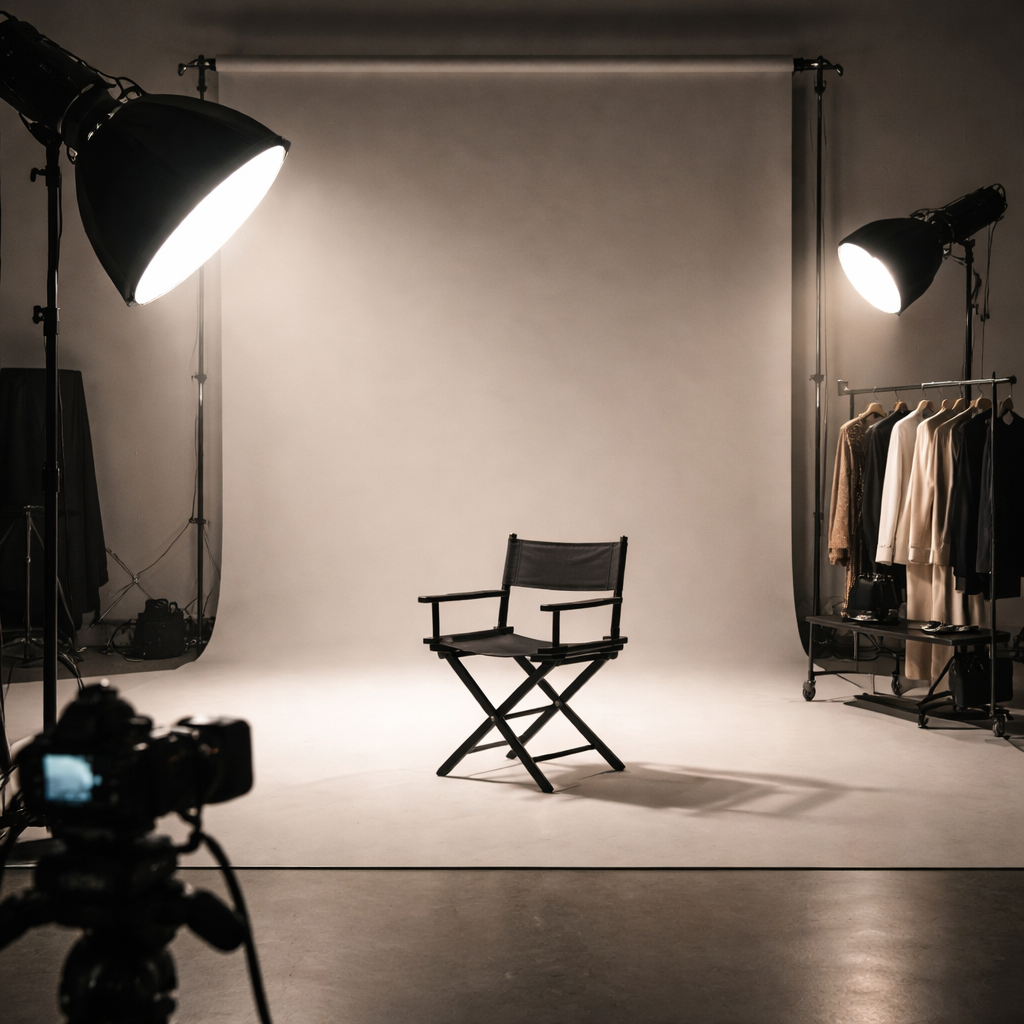
The model in a campaign may now be generated from datasets rather than casting calls. There is no photoshoot. No stylist fitting clothing. No photographer directing the pose. Instead, algorithms trained on millions of human images produce a face that appears convincingly human but has never existed in the physical world. What once required a studio, a crew, and a subject can now be created by software in a matter of minutes.
The economic pressure behind this shift is obvious. A traditional advertising shoot carries significant costs. Models are hired. Photographers are booked. Production teams coordinate locations, travel, lighting equipment, and wardrobe. The entire process is both expensive and time-consuming.
AI advertising collapses that ecosystem into a rendering engine and a prompt. A brand can theoretically generate dozens of campaign variations without booking a single person. For companies operating at massive scale—particularly fast fashion, e-commerce, and algorithmically driven marketing—the efficiency is difficult to ignore.
Which is precisely why regulation has begun to appear. The disclosure requirement is not being introduced because synthetic models are rare. It exists because they are expected to become common.
Yet this technological moment is not entirely without precedent. The current shift echoes a transformation that quietly reshaped advertising in the 1980s: the rise of stock photography.
Before stock photography libraries emerged, most advertising imagery required original production. Companies commissioned photographers, hired models, and built sets specifically for each campaign. The image itself was a bespoke production.
Stock photography changed that system. Vast image libraries allowed advertisers to license pre-existing photographs instead of producing them from scratch. An advertisement that once required a photoshoot could now be assembled from an archive.
The result was a dramatic acceleration in the speed and economics of advertising production. Campaigns became faster to assemble and significantly cheaper to produce.
But stock photography still relied on something fundamental: a real person had once stood in front of the camera. The photograph might be reused across thousands of advertisements, but the human subject existed somewhere in time.
Artificial intelligence removes even that final step. Instead of licensing an image of a person who existed in the past, advertisers can now generate a person who never existed at all.
Seen through that lens, AI models are not an entirely new phenomenon. They are the logical endpoint of the stock photography economy—a system that has been steadily reducing the need for original human production for decades.
What makes the moment culturally significant is that audiences are now being asked to recognize the difference.
By requiring disclosure, New York has created a visible divide between two types of advertising faces: human performers and synthetic performers. That distinction may soon operate in the marketplace the way authenticity markers function in other industries. Labels that identify organic food, handcrafted goods, or Swiss mechanical watches do more than provide information. They create a hierarchy of value.
In luxury fashion and editorial photography, authenticity has always carried symbolic weight. The texture of real skin, the subtle imperfections of natural light, and the presence of a human subject contribute to the emotional credibility of an image. In that environment, knowing that a person actually existed during the making of a photograph becomes part of the product’s cultural value.
Ironically, the spread of synthetic imagery may strengthen that perception. As AI-generated campaigns proliferate across high-volume advertising channels, real human presence may become a form of prestige.
The advertising industry could gradually split into two parallel systems. AI-generated performers dominate scale-driven environments such as e-commerce catalogs, automated marketing campaigns, and rapid-turn digital advertising. Human performers remain essential for luxury campaigns, celebrity partnerships, and editorial storytelling where authenticity itself is part of the brand message.
This shift also signals something deeper about labor in the creative industries. For more than a century, advertising production relied on an entire ecosystem of human talent—models, photographers, stylists, makeup artists, lighting crews, and production teams. Synthetic performers introduce the possibility that some of that labor may no longer be necessary for certain types of campaigns.
The debate surrounding AI models resembles earlier moments in economic history when automation transformed industries by replacing repetitive human work with machines. The difference now is that automation is not occurring on factory floors. It is occurring in the cultural industries, where faces, identity, and human presence are central to the product itself.
The most fascinating element of the new disclosure rule may ultimately be psychological. Imagine two advertisements appearing side by side. One contains a small note indicating that the model was generated by artificial intelligence. The other contains no such disclosure.
For the first time in the history of advertising, audiences may begin asking a question that was previously irrelevant.
Was this person ever real?
That question may become one of the defining tensions of the next era of visual culture. Artificial intelligence can produce faces that are technically flawless and infinitely scalable. But advertising has always depended on more than perfection. It depends on the subtle credibility that comes from human presence.
AI may dramatically expand the scale at which advertising can be produced. But the meaning of an image—the sense that a moment actually happened, that a person stood in front of a camera, that a human interaction occurred—still belongs to the physical world.
In the end, the disclosure requirement does more than regulate technology. It acknowledges a new reality.
The advertising industry has invented a new kind of performer.
And for the first time, that performer may have to introduce itself as artificial.
Related Posts

Commodore Is Betting That Less Technology Has Become a Premium Product
The phone isn't rejecting technology—it's redefining its role

Disney and TikTok Are Building a New Content Pipeline Into Disney+
By DaMarko GianCarlo For most of Hollywood’s relationship with socia

Graymatics Unveils Partnership Program for Smart Cities in Brazil
Graymatics, a globally recognized multimedia cognitive processing firm

Global Streaming Infrastructure Is Being Rewritten in Africa—And Showmax Is the Test Case
Streaming Isn’t Collapsing—It’s Rebuilding

The Estate Is Becoming the Final Studio
Death No Longer Ends Production

INTRODUCING “HYPNOVELS,” A REVOLUTIONARY USE OF GENERATIVE AI TO TRANSFORM BOOKS INTO MESMERIZING ANIMATIONS
Silverside AI has introduced Hypnovels, a groundbreaking Generative AI