


The Billionaires Didn’t Disappear. They Just Stopped Branding Themselves
By Chad Coleman
For most of the 2000s, wealth was loud.
Luxury houses printed their names across belts, handbags, and sneakers. Logos became shorthand for arrival. Visibility was the currency of status, and the fashion system happily supplied the tools: monograms, hardware, recognizable silhouettes. If people could see the brand from across the street, the signal worked.
Then something changed.
The internet flattened visibility. Social media democratized the performance of wealth. Anyone could rent the aesthetic of luxury for a weekend, photograph it correctly, and broadcast it to thousands. The logo — once a marker of elite access — became widely reproducible.
And when a signal becomes easy to replicate, the people who rely on signals move on.
Quietly.
Today the most powerful wealth signals are often the least visible. Fabrics instead of logos. Construction instead of branding. A sweater whose softness communicates more to the initiated than any printed monogram could.
This is where Brunello Cucinelli enters the conversation — not as the story itself, but as one of the clearest examples of the shift.
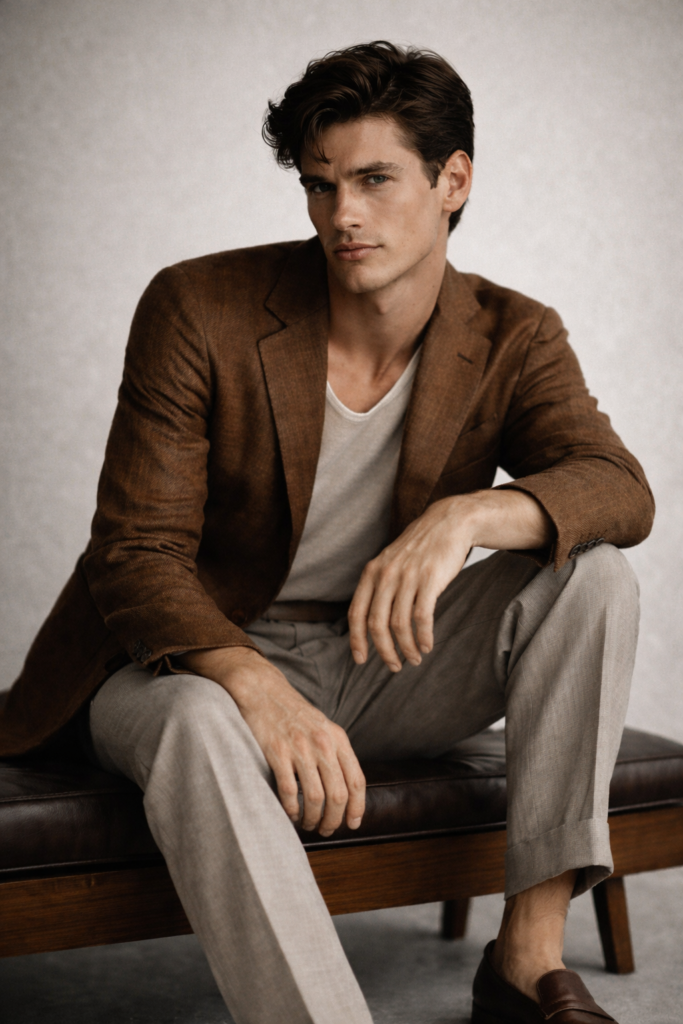
The Italian house built its reputation on understatement. Cashmere knits that carry no visible logo. Suits that rely on cut and drape rather than decoration. Color palettes that hover around sand, stone, smoke, and winter sunlight. To an untrained eye, the clothes appear simply “nice.” To someone who understands fabric and tailoring, they reveal something else entirely.
They reveal literacy.
The difference between logo luxury and fabric luxury is the difference between public recognition and private recognition. Logo luxury is meant to be seen by everyone. Fabric luxury is meant to be recognized by a much smaller audience — the people who know what they’re looking at.
In that sense, quiet luxury is not about modesty. It’s about control.
The moment wealth becomes easy to imitate publicly, the real signal moves into territories that require knowledge: fiber quality, garment construction, proportion, finish. Signals migrate from the visible to the legible.
This migration is happening far beyond clothing.
Architecture has moved from marble spectacle to restrained minimalism. Hospitality favors quiet material richness over theatrical décor. Even technology executives — once comfortable in branded hoodies — increasingly adopt a restrained aesthetic that communicates stability rather than disruption.
In every case, the same pattern appears.
When attention becomes cheap, discretion becomes expensive.
The broader culture often calls this “quiet luxury,” but that phrase understates what is really happening. This is not a stylistic trend; it is a recalibration of status communication in a hyper-visible economy.
If everyone can perform wealth online, the ruling class must communicate wealth differently. The signal becomes harder to read, not easier.
That is why brands like Brunello Cucinelli resonate so strongly with certain circles of wealth. Not because the garments shout status, but because they whisper it in a language most people do not yet speak.
And whispers travel differently than logos.
Logos announce themselves to the crowd.
Whispers move through rooms where recognition is already assumed.
Which may explain why the uniform of power today often looks surprisingly simple: a soft cashmere sweater, an unstructured jacket, neutral tones that dissolve rather than dominate.
To the public eye, it can appear almost ordinary.
But that is the point.
The billionaires did not disappear.
They simply stopped branding themselves.
Related Posts
LAY’S NAMED OFFICIAL SPONSOR OF FIFA WORLD CUP 26™ & FIFA WOMEN’S WORLD CUP 2027™
Lay’s Teams Up with FIFA for World Cup Sponsorship
Drake’s OVO Hits the Fairway: Streetwear Swagger Meets Callaway Precision
By Jayson Echo Drake’s OVO has officially taken its talents to the f

Reimagining Travel: How CASETiFY Is Shaking Up the Luggage Scene
CASETiFY Expands Into Travel.

Nintendo and Sony Join Forces for Live-Action Adaptation of Legend of Zelda
Nintendo and Sony Join Forces

Louis Vuitton Forges Alliance with Fencing Champion Enzo Lefort in LVMH Collaboration
By Dean Woods The world of high fashion and the precision of elite fen

Spotify Doesn’t Need to Take Music Videos From YouTube—It Only Needs the Premiere
The first 48 hours are the new battleground