

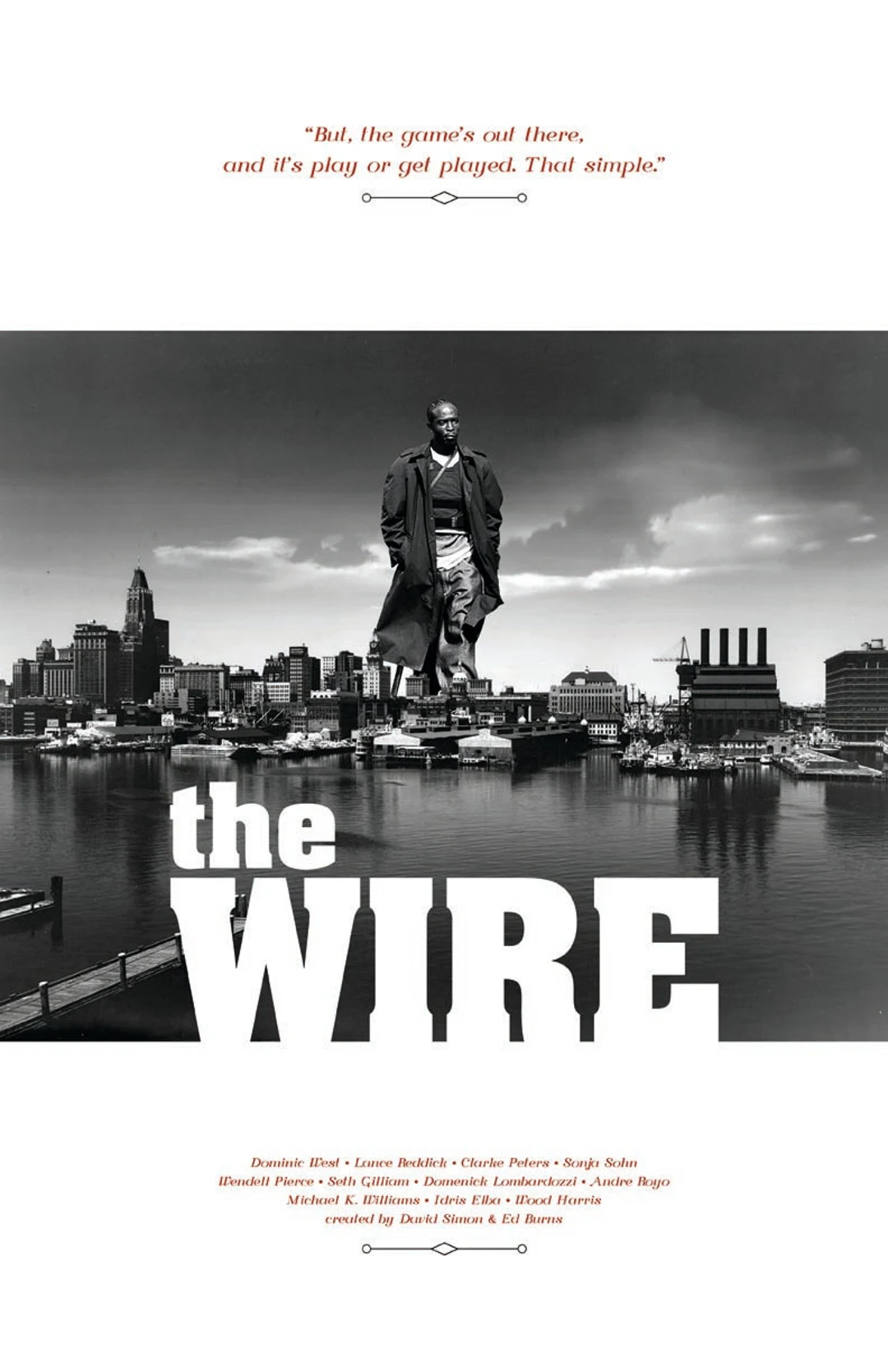
How The Wire Trusted Viewers With Complexity—Before Culture Learned to Ask for It
By Kyra Greene
When The Wire first aired, it arrived quietly, almost defensively, as if unsure whether television—or its audience—was ready to meet it on its own terms. It offered no grand entrance. No sweeping hero’s journey. No singular figure to anchor identification or allegiance. Instead, it presented Baltimore as a living system, porous and indifferent, and asked viewers to sit inside that system without the comfort of moral punctuation.
At the time, the reaction was predictably reductive. The show was labeled “anti-police” or “anti-city,” depending on who felt most exposed. It was accused of cynicism, of bleakness, of withholding emotional release. Viewers accustomed to television that resolved conflict through character arcs struggled with a series that insisted conflict was structural, not personal. The Wire wasn’t interested in who you wanted to root for. It was interested in what kept happening regardless of who tried to intervene.
That dissonance—between expectation and intention—was the point.
In the early 2000s, American television was still largely oriented around the individual as the site of meaning. Even its prestige turns were character-driven morality plays, where institutions served as backdrop rather than subject. The Wire inverted that relationship entirely. People mattered, deeply, but they were downstream of forces far larger than themselves: bureaucracies, incentives, budgets, politics, history. Everyone was trapped. No one was innocent. Very few were malicious. Most were simply constrained.
This refusal to moralize made the show difficult to digest in real time. Viewers wanted villains. The Wire gave them departments. They wanted corruption. The show gave them incentives. They wanted redemption. It offered trade-offs.
What The Wire understood—before this kind of thinking became fashionable—was that institutions do not fail because of bad actors; they fail because they are often functioning exactly as designed. Police departments chasing clearance rates. Schools prioritizing test scores over children. Newsrooms valuing spectacle over depth. City halls responding to electoral cycles rather than civic consequence. These were not indictments delivered with outrage. They were observations delivered with patience.
And patience was the show’s greatest gamble.
The Wire trusted that viewers could hold complexity without needing it simplified into opposing sides. It trusted that discomfort could be more honest than catharsis. It trusted that meaning could emerge cumulatively, across seasons, across perspectives, across time. This was a radical assumption in a medium built around immediacy.
In retrospect, it is no accident that the show’s stature has only grown as discourse culture has accelerated. In an age defined by hot takes and binary alignment, The Wire feels almost subversively calm. It does not tell you what to think. It shows you how things work. It does not reward reaction. It demands attention.
Crucially, the series never confuses visibility with power. Characters rise to prominence only to discover how little leverage they possess. Ambition is routinely thwarted by inertia. Reform arrives, briefly, only to be absorbed or neutralized by the very systems it hoped to change. This was not nihilism; it was realism. And realism, when stripped of sentimentality, can feel threatening.
The original political misunderstandings of The Wire say less about the show than about the moment it entered. American culture, then as now, was uncomfortable with narratives that refused absolution. We prefer stories that reassure us someone is in control—someone good or someone bad. The Wire offered something more unsettling: a world where outcomes are shaped by incentives rather than intention.
That idea has aged better than the arguments around it.
Today, the show is often praised as prophetic, but prophecy implies inevitability. The Wire was not predicting the future; it was documenting the present with unusual rigor. What changed was not the system, but the audience. Over time, viewers grew more fluent in the language of institutions. Conversations about mass incarceration, media ethics, urban policy, and educational inequality became mainstream. Complexity, once resisted, became a requirement.
Seen through that lens, The Wire didn’t catch up to culture. Culture caught up to The Wire.
This is why the series endures—not as nostalgia, not as prestige canon, but as a reference point for how storytelling can engage power without theatricalizing it. It remains one of the few works of popular television that resists being turned into an argument. It cannot be easily quoted into submission or clipped into ideology. Its authority comes from accumulation, not assertion.
In an era when so much television is designed to provoke reaction, The Wire stands as a reminder of a rarer ambition: to observe, to connect, and to trust the viewer enough to let meaning unfold without instruction.
That trust is its quiet legacy.
Not that systems are cruel—though they often are.
But that understanding them requires patience, humility, and a willingness to sit with unresolved truths.
Long after the arguments faded, The Wire remained.
Not because it was right, but because it was rigorous.
Not because it chose a side, but because it refused to pretend sides were sufficient.
That is not just good television.
It is cultural intelligence—played in the long game.
Related Posts

Canada Goose Unveils Exclusive Collaboration with KidSuper and NBA All-Star Shai Gilgeous-Alexander
Canada Goose Unveils Exclusive Collaboration with NBA.

BOSE INTRODUCES THE SOUNDLINK MAX
Introducing the SoundLink Max by Bose

The Critically Acclaimed Action RPG Horizon Zero Dawn is Heading to the Big Screen
‘Horizon Zero Dawn’ Film Adaptation Officially Confirmed

Alexie Olivo Is Learning That Success Means Choosing Her Own Direction
Choosing purpose over expectation

Audi and Inter Miami CF Announce Multi-Year Premium Partnership
Audi is the Premium Automotive Partner of Inter Miami CF

Charlize Theron Is Hunted in Netflix’s Relentless Survival Thriller Apex
No Escape. No Mercy.